ECONOMICS COMMENTARY — 21 Aug, 2026
US flash PMI signals welcome mix of hotter output growth, cooler inflation

Flash PMI data from S&P Global showed US business activity growth accelerating sharply for a second successive month in August to reach the fastest since April 2022. Supply times lengthened sharply again, however, and to one of the greatest extents seen over the past four years, contributing to a further build-up of uncompleted orders across both manufacturing and services.
Jobs were added at the fastest rate since the start of last year as increasingly confident companies took on more staff to meet higher demand. Business growth expectations struck a nine-month high. Price pressures meanwhile moderated, especially in terms of selling price inflation, though input cost inflation remained elevated thanks principally to high energy prices. As such the data hint at a hawkish bias among policymakers.
Strong third quarter GDP signaled as growth surges in August
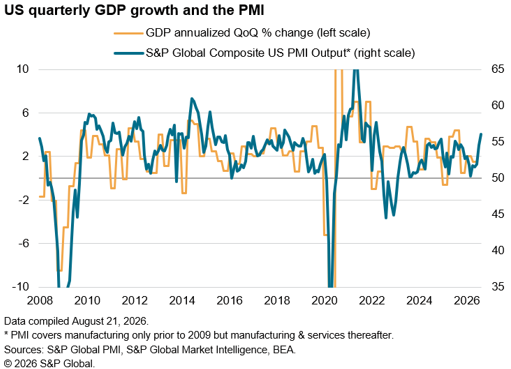
The headline flash S&P Global US PMI Composite Output Index rose from 54.5 in July to 56.0 in August, registering the fastest growth since April 2022.
The survey data for the third quarter is currently pointing to annualized growth approaching 3.0%, up solidly from the 1.5% pace seen in the second quarter.
Sector divergence
While the survey signals a marked acceleration of business growth so far in the third quarter, the drivers of growth have diverged. While strong manufacturing growth throughout the second quarter has faded over the summer, such that goods production showed the smallest monthly rise for 13 months in August, service sector activity has revived from the sluggish pace reported in the second quarter to reach the fastest since December 2024 in August.
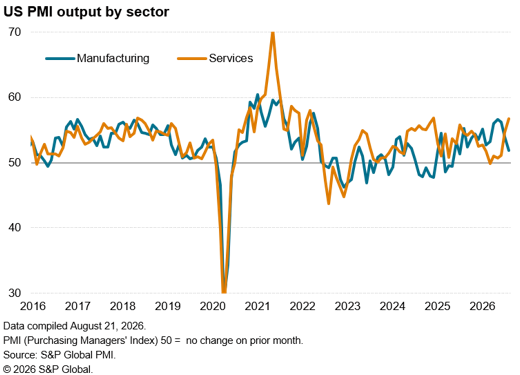
This changing sector pattern of growth is less evident for order books, with both manufacturing and services again registering robust increases in demand in August. Nonetheless, while the growth trend for orders has slowed in manufacturing, it has improved in services.
Supply delays lead to higher order backlogs
This divergence reflects some cases of manufacturing production being constrained by raw material shortages, linked to supply chain delays, as well as reports of less precautionary inventory accumulation. Safety stock build-ing due to concerns over price rises and supply shortages due to the war in the Middle East had been a key driver of factory growth in the early months of the conflict, but now appears to be fading. Input buying by manufacturers also rose only slightly in August, registering the smallest increase so far this year.
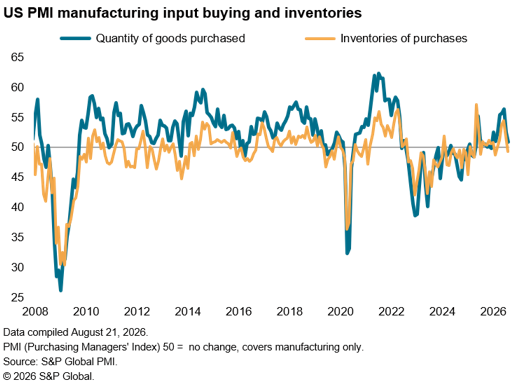
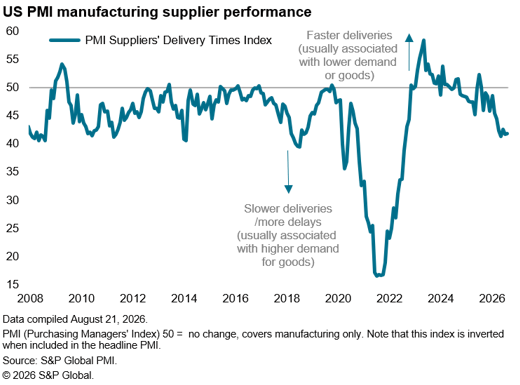
However, supply chain delays remain widespread, with supplier delivery times lengthening in August to one of the greatest extents seen over the past four years, blamed on shipping delays, tariffs, and diminished stock availability at suppliers.
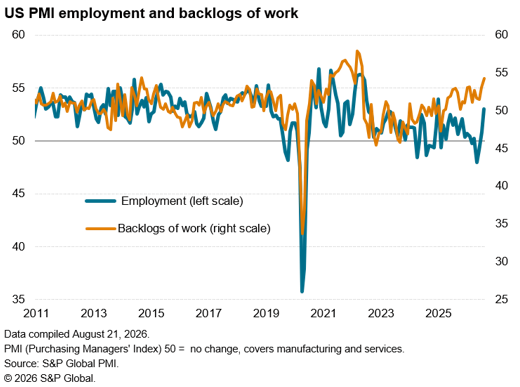
Supply delays caused backlogs of work to accumulate again in manufacturing, with outstanding orders having risen since the start of the war to a degree not seen since 2022. However, strong demand combined with supply constraints has also led to rising backlogs in the service sector, where outstanding orders rose in August at the sharpest rate since May 2022.
Hiring perks up
Having shown little net change over the prior eight months, employment rose sharply in August. The increase in payrolls signaled was the largest since January 2025 and second largest recorded over the past four years. An especially marked rise in staffing was reported in the service sector, the largest rise since the start of last year, but factory job growth also picked up to the highest since January of this year. Job gains reflected improved business confidence about the near-term outlook and fuller order books.
Optimism rises
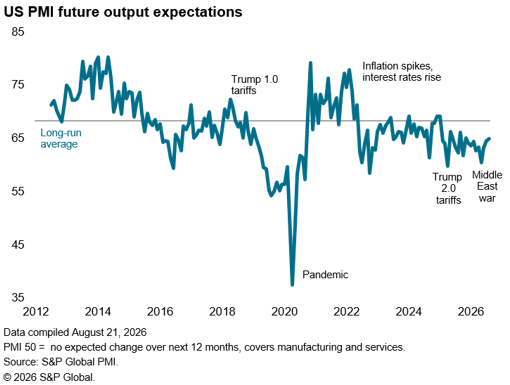
Business output expectations also improved in August, recovering to their highest since November of last year, reflecting a combination of order book backlogs, rising customer enquiries, expansion plans, and an easing of concerns over the economic impacts of tariffs and the war in the Middle East. Confidence improved in both manufacturing and services during the month.
Prices pressures cool
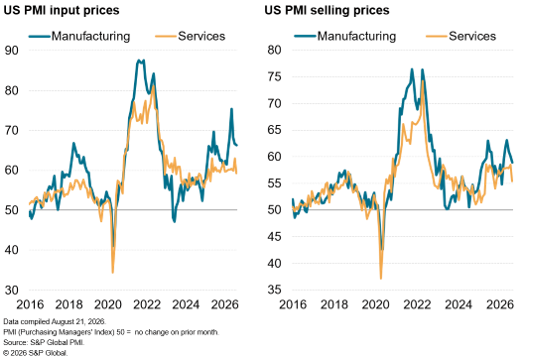
Confidence was also buoyed by price pressures having moderated in August. Average input costs measured across both goods and services rose at the slowest pace since February. However, rates of increase remained elevated by historical standards, blamed by survey contributors on high energy prices, squeezed supply lines, and tariffs. The average cost increase so far in the third quarter consequently slightly exceeds that seen in the second quarter despite August’s easing.
As input cost inflation dropped to the lowest since the start of the war in the Middle East, selling price inflation also moderated. Average prices charged for goods and services rose in August at the slowest rate since last November, softening to a ten-month low in services and a six-month low in manufacturing. Fewer reports of the need to pass through higher fuel and energy prices were a key driver of the reduced rates of increase.
Hawkish bias
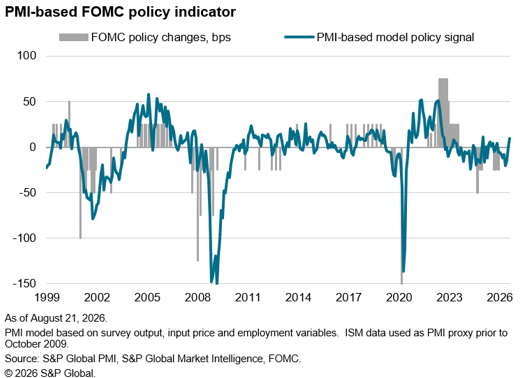
The improvement in the employment index from the flash PMI, combined with the acceleration of output and elevated price gauges, pushes the survey data back into rate hike territory, according to historical comparisons of the survey against FOMC policy decisions in prior years. However, the signals have been volatile so far this year, reflecting the rapidly changing geopolitical environment in particular, and notably the volatility of energy prices. It is therefore likely that the FOMC will retain a hawkish bias but leave rates on hold pending further clarity on the eco-nomic situation.
Access the latest PMI press release here.
© 2026, S&P Global. All rights reserved. Reproduction in whole or in part without permission is prohibited.
Purchasing Managers' Index™ (PMI®) data are compiled by S&P Global for more than 40 economies worldwide. The monthly data are derived from surveys of senior executives at private sector companies, and are available only via subscription. The PMI dataset features a headline number, which indicates the overall health of an economy, and sub-indices, which provide insights into other key economic drivers such as GDP, inflation, exports, capacity utilization, employment and inventories. The PMI data are used by financial and corporate professionals to better understand where economies and markets are headed, and to uncover opportunities.
Read our latest PMI commentary here.
This article was published by S&P Global Market Intelligence and not by S&P Global Ratings, which is a separately managed division of S&P Global.
Theme
Location
Products & Offerings