Research — Aug 12, 2026
Dominion's storage mandate highlights value of long-duration capacity

Virginia is accelerating its transition to a cleaner, more resilient grid even as electricity demand surges, particularly from data centers. In April 2026, Virginia passed landmark legislation that significantly expands energy storage targets for Dominion Energy Inc. subsidiary Virginia Electric and Power Co. and American Electric Power Co. Inc. subsidiary Appalachian Power Co. The new mandates give Virginia one of the largest state-level storage requirements in the US and will require substantial deployment of both short- and long-duration battery energy storage system (BESS) technologies, reshaping grid planning and project development. Long duration is here taken to mean 10 hours or more. If shorter-duration BESS are used to meet these mandates of installed capacity, the ability of each additional megawatt of capacity to reduce peak demand will diminish over time. They become less cost-effective as a result, reinforcing the strategic importance of developing long-duration solutions.

➤ Virginia's landmark energy storage legislation, signed in April 2026, mandates Dominion Energy Inc.'s Virginia subsidiary to procure 16 gigawatts of short-duration and 4 GW of long-duration battery storage by 2045, and for Appalachian Power Co. to procure 780 megawatts of short-duration by 2040 and 520 MW of long-duration by 2045, creating one of the largest state-level storage targets in the US.
➤ The pace and scale of battery build-out will reduce the effective load-carrying capability of four-hour storage over time, making a mix of durations critical to sustaining accredited capacity, i.e. capacity that can be dedicated to reliability.
➤ Meeting the short-duration mandate with a portfolio of batteries that last four, six or eight hours is more effective for optimizing accredited capacity and the capital cost per kilowatt of reliable storage than relying solely on four-hour resources.

Dominion Energy's recent actions reflect its commitment to a cleaner, more resilient energy portfolio and compliance with the Virginia Clean Economy Act of 2020. Dominion's 2024 Integrated Resource Plan (IRP) outlines a comprehensive strategy to add 21.1 gigawatts of new clean energy capacity by 2039/2040, including 12 GW of solar, 3.5 GW of wind and 4.5 GW of battery storage. Just a year later, however, Dominion updated the IRP in response to significant increases in demand projections for the territory and extended the IRP targets to 20 GW of solar, 3.5 GW of wind and 9 GW of BESS by 2045. Most recently, in April 2026, Democratic Governor Abigail Spanberger, signed House Bill 895 and Senate Bill 448, significantly expanding Virginia's energy storage requirements to address rising electricity demand, grid reliability and renewable energy integration. Specifically, Dominion Energy is mandated to obtain (by building, purchasing or procuring) 16 GW of short-duration BESS by 2045, with an interim target of 4 GW by the end of 2030, and 3.48 GW of long-duration BESS by 2045, with an interim target of 2 GW by the end of 2035. Appalachian Power, which is responsible for less than 10% of the state's electricity, is also mandated to procure a less impactful 780 megawatts of short-duration BESS by 2040 and 520 MW of long-duration BESS by 2045.
ELCC highlights limits of 4-hour storage
S&P Global analysis of the Dominion Energy short-duration portion of the storage mandate highlights how performance and cost trends vary across storage durations, particularly regarding effective load-carrying capability (ELCC) and capital costs. The marginal ELCC is a crucial metric for evaluating the ability of new capacity added to a portfolio to contribute to reserves at hours of peak demand. Grid operators rely on this or similar metrics — particularly for intermittent resources, but increasingly for thermal resources, too — to plan for reliability.
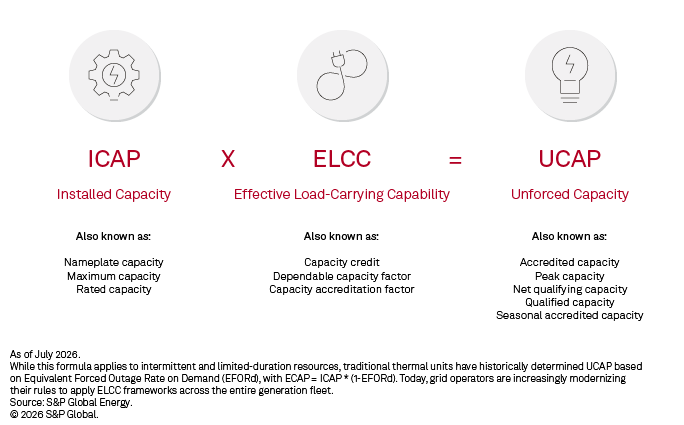
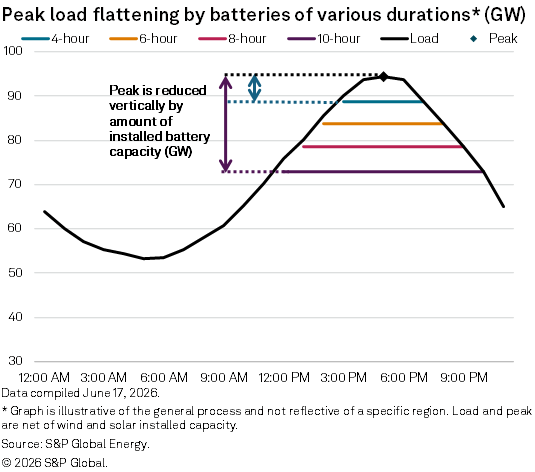
For storage, ELCC reflects a unit's ability to flatten the peak demand, net of any installed wind and solar capacity. As depicted in the graphic below, peak demand is reduced by the installed capacity of a battery for a window the width of its duration. Once the flattened demand curve is wider than an individual battery's duration, then the ability of any additional capacity to meet that demand, as measured by marginal ELCC, begins to decline. Multiplying installed capacity (ICAP) by the ELCC value produces the accredited, unforced capacity (UCAP), representing the available capacity for reliability at peak demand hours.
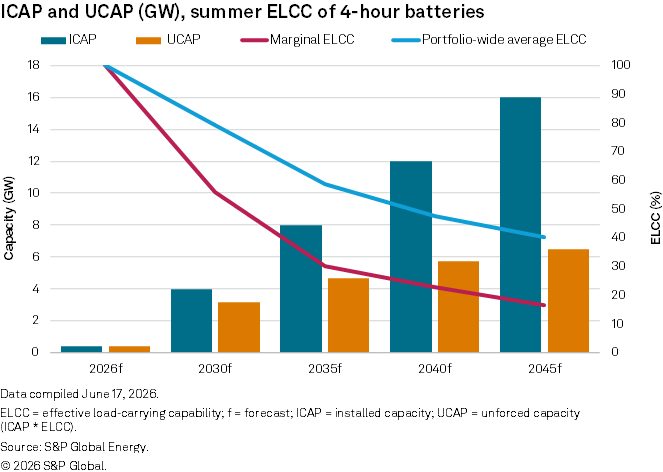
Current battery storage technology is predominantly lithium-ion based, and allows for durations of four hours or less. Dominion's most recent request for proposals (RFP) has specified that it requires BESS to be minimum four-hour energy duration using Li-ion technology or alternative compatible technologies. We estimate that 2030 is a reasonable time period for batteries of six hours and above to come online. While initial deployment of four-hour BESS offers high reliability contributions, continued reliance on short-duration storage will yield diminishing returns in terms of UCAP, peak-reducing capacity. If Dominion met the short-duration mandate of 16 GW ICAP by 2045 — including 4 GW by 2030 — entirely with four-hour BESS, both the marginal and portfolio ELCC would decline rapidly as deployment scales. By 2030, marginal ELCC falls to 56%, so the 4 GW ICAP contributes less than 3.2 GW UCAP toward summer peak demand. By 2045, marginal ELCC drops to 16%, and 16 GW ICAP provides only about 6.5 GW UCAP for a portfolio-wide average ELCC of 40%.
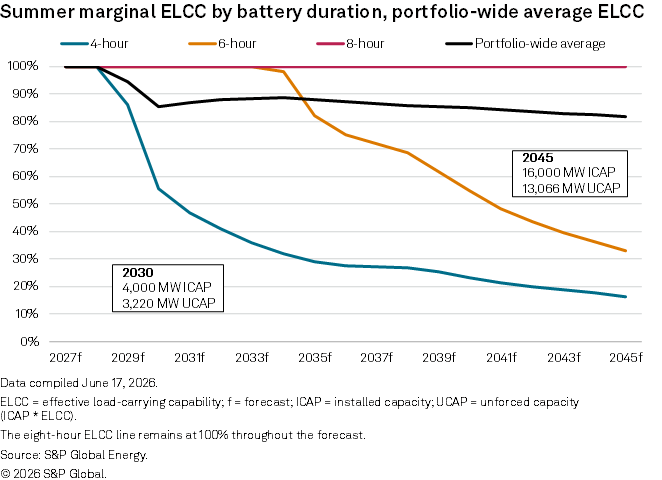
While immediate development of long-duration storage would provide the most reliability, the current pace of technological growth suggests that the transition to longer durations is more likely to be gradual. Medium-duration batteries (e.g., of six or eight hours) maintain higher ELCC percentages than four-hour BESS, so shifting to medium-duration BESS as technologies become available will be a better solution toward keeping capacity accreditations high. Six-hour BESS will keep full capacity accreditation (100% ELCC) until its installed capacity reaches 18% of net peak demand; for eight-hour BESS, it is 22%.
With a portfolio of four-, six- and eight-hour BESS used to meet the 16 GW target, the total peak-contributing capacity will remain closer to the installed capacity. Beginning the slow build-out of six- and eight-hour duration BESS at 1 GW ICAP of the 4 GW ICAP total in 2030, this already boosts the portfolio UCAP to 3,220 MW UCAP, from 3,172 MW. The difference widens notably over the forecast period. By 2045, the 16 GW ICAP target — comprising 4.5 GW ICAP of four-hour, 5.5 GW ICAP of six-hour, and 6 GW ICAP of eight-hour BESS — contributes 13 GW UCAP, double the four-hour-only figure, for a portfolio-average ELCC of 82%.
Loss of ELCC increases cost of accredited capacity
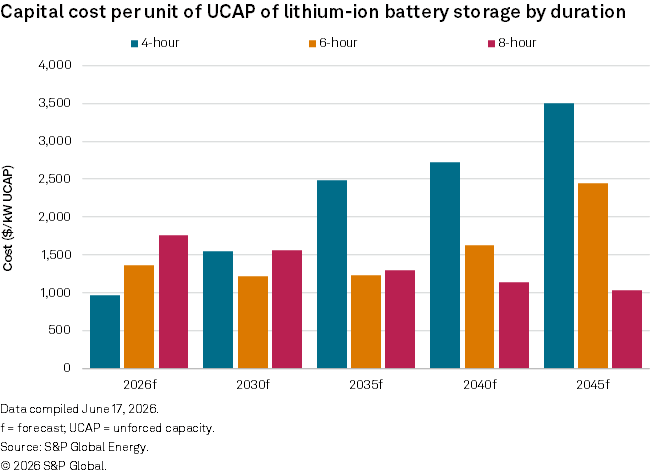
To compare the cost of reliability value of different durations of Li-ion BESS as ELCC declines, we analyze the capital cost of the various-duration batteries per each kilowatt of accredited capacity. This reveals that the cost-effectiveness of four-hour batteries decreases substantially over time, as costs rise to $3,500/kW UCAP in 2045.
As technology improves and costs per kW ICAP fall, the cost per kW UCAP of six-hour BESS will also decrease, for as long as the ELCC value remains at 100%. Once the ELCC value begins to fall, costs per kW UCAP will increase. For durations of eight hours (and more), the ELCC value remains at 100%, so the cost per kW UCAP decreases over time, given the expected decrease in capital costs. By the 2040s, when the Dominion storage target is above 10 GW, it is significantly more cost-effective to build an eight-hour battery with full ELCC value than a four-hour battery with minimal reliability value. Furthermore, the expected capacity revenue of the eight-hour battery would provide stronger returns than the four-hour battery with small accreditation in the capacity market. This strongly underscores the importance of medium- and long-duration storage for maintaining grid reliability at an economic cost as total storage capacity grows.
Virginia has positioned itself at the forefront of energy storage deployment, with Dominion Energy leading significant procurement efforts. The recent legislative mandates have transformed previous plans, creating an ambitious road map for both short- and long-duration storage through 2045. The rapid increase in mandated capacity, particularly the introduction of long-duration storage targets, reflects a strategic response to growing demand, grid reliability challenges and the diminishing returns of exclusively short-duration solutions.
This aggressive approach will necessitate substantial investment, technological innovation (especially in long-duration energy storage) and careful regulatory oversight. Developers, utilities and other stakeholders must closely monitor these evolving requirements and market signals to capitalize on the significant opportunities presented by Virginia's energy transition.
S&P Global Energy provides content for distribution on Capital IQ Pro.
For wholesale prices and supply and demand projections, see the S&P Global Market Indicative Power Forecast.
This article was published by S&P Global Market Intelligence and not by S&P Global Ratings, which is a separately managed division of S&P Global.