Blog — August 28, 2026
AMLR 2027: Why Readiness Must Start Now
Executive Summary: The EU’s landmark Anti-Money Laundering Regulation (AMLR) 2024/1624 is no longer a distant policy development. Enforced from July 10, 2027, AMLR replaces a fragmented landscape of national directives with a single, harmonized rulebook across all EU Member States. AMLR fundamentally elevates compliance, operational, and data expectations for financial institutions and obliged entities, including a stricter supervisory environment, stringent beneficial ownership rules, and severe financial penalties for non-compliance.
Waiting for final technical standards is a critical operational vulnerability; institutions must immediately audit client data, re-engineer workflows, and build scalable operating capacity to ensure readiness across customer due diligence, ongoing monitoring, business-wide risk assessment, reporting obligations, and governance frameworks. The direction of travel is clear: organizations will need stronger evidence, structured processes, tougher controls, and better traceability across the customer lifecycle.
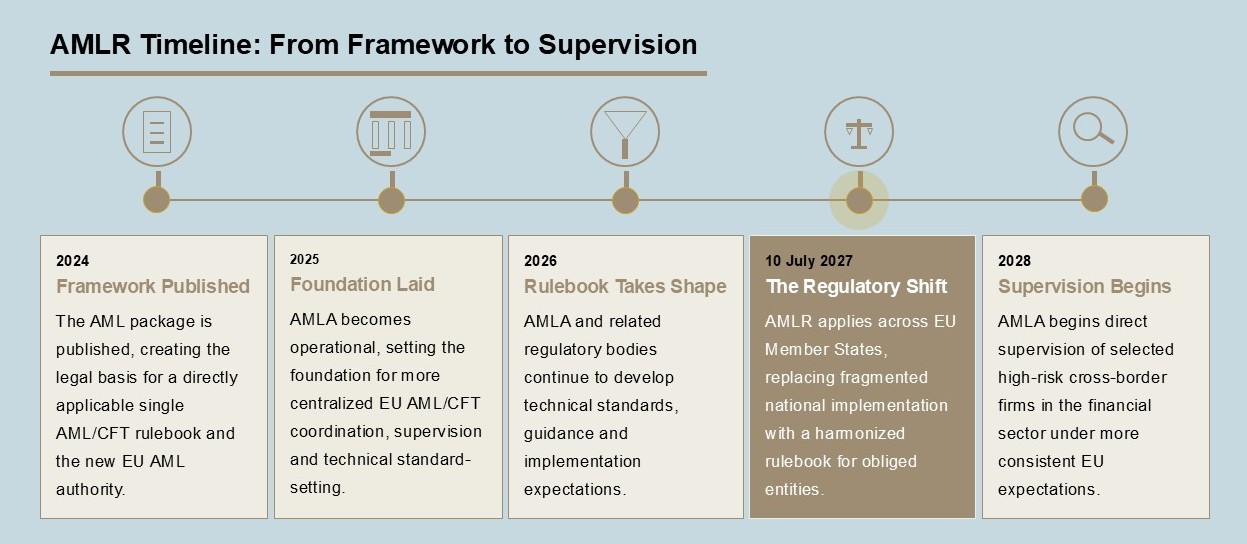
AMLR Timeline: From Framework to Supervision - click to see infographic.
From Awareness to Readiness
AMLR will fundamentally change the operating baseline. A framework that has historically been shaped through national implementation will be replaced by a harmonized EU rulebook for obliged entities. This shift eliminates regulatory arbitrage and creates uniform operational expectations across all EU member states. While creating greater consistency, it also exposes uneven legacy processes. Many organizations still adhere to fragmented KYC standards, siloed customer records, variable documentation quality and remediation activity that is episodic rather than sustainable.
Beyond harmonizing rules, AMLR significantly broadens the regulatory perimeter and introduces stricter operational thresholds:
- Expanded Obliged Entities: The regulation extends compliance requirements across new sectors.
- EU-Wide Cash Cap: Introduces a uniform, EU-wide maximum limit of €10,000 for cash payments, establishing a strict compliance boundary across commercial transactions.
- Interconnected Beneficial Ownership Registers: Mandates standardized, interconnected, and accessible central beneficial ownership registers across all Member States to expose complex, multi-layered corporate structures.
Critical Operational and Technical Challenges
Translating policy into daily operations presents significant structural hurdles for risk, compliance, and technology leaders. The most difficult work is likely to sit below the policy layer. Institutions will need to assess whether they can identify customers consistently, verify ownership and control structures, evidence with documentation, maintain records, and demonstrate that screening, monitoring and maintenance controls are working as designed. Organizations must establish audit-ready, evidence-backed identification and verification for Ultimate Beneficial Owners (UBOs). Siloed customer records, legacy KYC files, and incomplete documentation quality must be systematically remediated.
The Risk of Delay: Why Waiting Is a Strategic Vulnerability
Some institutions may be tempted to defer operational investments until The Anti-Money Laundering Authority (AMLA) finalizes all Regulatory Technical Standards (RTS) and Implementing Technical Standards (ITS). This strategy carries extreme operational risk. The enforcement date is fixed, and fast approaching. While the work required to prepare data, controls, ownership evidence, governance and operating capacity is substantial, gap assessments, data-quality reviews, file remediation planning and operating-model design can begin now. Capacity should be retained to incorporate final AMLA instruments as they are adopted.
AMLR readiness also requires improved coordination between compliance, operations, technology, data, legal, and front office teams. Organizations must be able to show how requirements are embedded into workflows, how exceptions are escalated, how evidence is retained and how accountability is maintained.
Building a Durable Readiness Programme
A practical AMLR readiness programme should start with four priorities. First, assess current KYC, CDD, beneficial ownership and monitoring processes against the emerging EU baseline. Second, identify gaps in customer data, supporting documentation, ownership evidence, screening controls and audit trails. Third, prioritize remediation of high-risk customer populations and legacy files that are unlikely to meet future evidencing expectations. Fourth, move from one-off remediation to ongoing monitoring, maintenance and periodic refresh that can support business-as-usual compliance after 2027.
For cross-border groups, the benefits of acting early extend beyond regulatory compliance. A consistent customer data foundation can reduce duplication, improve onboarding efficiency, strengthen risk decisioning and create a clearer audit trail across jurisdictions. In a supervisory environment that is expected to become more evidence-led, operational discipline can become a competitive advantage.
Strategic Execution with S&P Global Managed Services
Achieving AMLR compliance while managing operational overhead requires scalable capacity, specialized domain expertise, and advanced data architecture. Outsourcing portions of a compliance framework does not remove accountability, but it can help organizations execute at the pace and scale required by the AMLR timetable.
AMLR should therefore be viewed less as a single compliance deadline and more as a catalyst for modernizing operations. Organizations that start now will be better placed to absorb final technical standards, evidence readiness to supervisors and build repeatable processes that remain effective beyond the initial implementation sprint.
The countdown has started. S&P Global’s differentiated data, audit-ready traceability, technology architecture, and expert managed services personnel help impacted organizations gain a stronger, more resilient financial-crime control environment.
Turn AMLR readiness into a competitive advantage.
Discover how S&P Global's KYC Technology and Services can help you streamline customer due diligence, accelerate remediation, strengthen audit readiness, and build a sustainable compliance framework for 2027 and beyond.
Content Type
Segment
Language