Research — July 14, 2026
uniQure's Huntington's prospects brighten after FDA shift

By Jueeli Kadam
Shares in Dutch gene therapy developer uniQure NV (NASDAQ: QURE) have surged more than 190% year-to-date after the U.S. Food and Drug Administration reversed its earlier stance and agreed that existing Phase I/II data could support an accelerated approval filing for AMT-130, the company's experimental treatment for Huntington's disease. The company now plans to submit its biologics license application in the third quarter of 2026. Huntington's disease is a rare neurodegenerative disorder with no approved therapies that have been shown to slow disease progression.
The decision marks a turnaround after the FDA concluded earlier this year that the available evidence was insufficient to support a filing and recommended an additional sham-controlled trial.
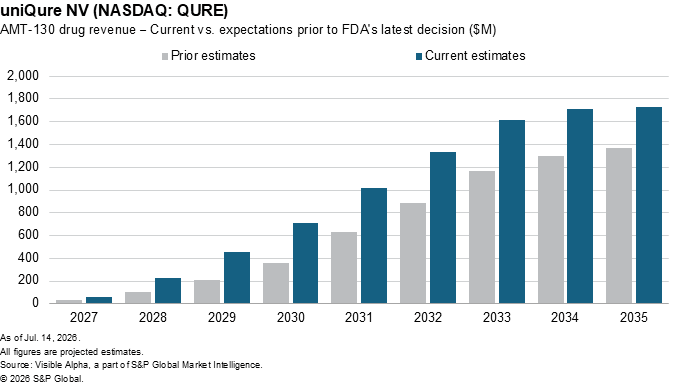
Visible Alpha consensus reflects the sharp shift in sentiment. Analysts have raised the estimated probability of success for AMT-130 to 73%, from 35% before the FDA's decision. Revenue expectations have also been revised higher, with risk-adjusted sales now forecast at $65 million in 2027, the therapy's potential launch year, rising to $231 million in 2028, 118% above previous estimates of $106 million.
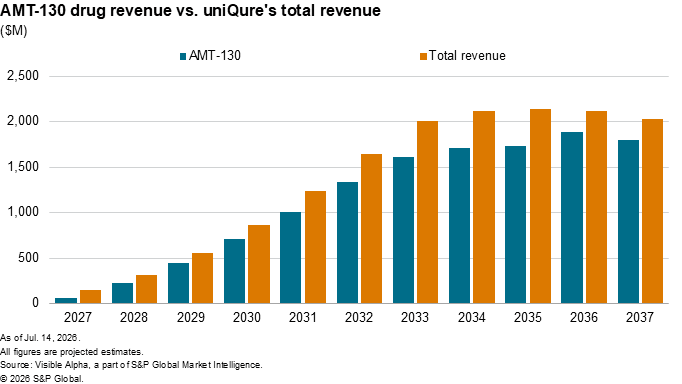
Peak sales are now projected to reach $1.9 billion by 2036, with AMT-130 expected to account for as much as 89% of uniQure's total revenue. If approved, the therapy would not only become the first disease-modifying treatment for Huntington's disease but would also transform uniQure from a development-stage biotechnology company into one driven by a single blockbuster commercial asset.
This article was published by Visible Alpha, part of S&P Global Market Intelligence and not by S&P Global Ratings, which is a separately managed division of S&P Global.
Content Type
Products & Offerings
Segment
