ECONOMICS COMMENTARY — 24 Jul, 2026
UK flash PMI signals faster growth and lower inflation in July

UK businesses reported stronger activity in July, pointing to a faster pace of economic growth at the start of the third quarter. However, overall services growth remained lackluster amid cost-of-living pressures, and manufacturers and their customers continued to build precautionary stocks, meaning part of the recent factory upturn could prove short-lived.
Price pressures cooled thanks to the lower oil prices seen during the first half of the month, which could strengthen speculation that the Bank of England will hold off raising interest rates. However, cost pressures clearly remain elevated, leading to a further fall in employment, which has declined continuously since the Autumn 2024 Budget.
With Middle East worries flaring up again in recent days, a sustained cooling in the price data and upturn in business growth is by no means assured.
UK output rebounds at start of third quarter
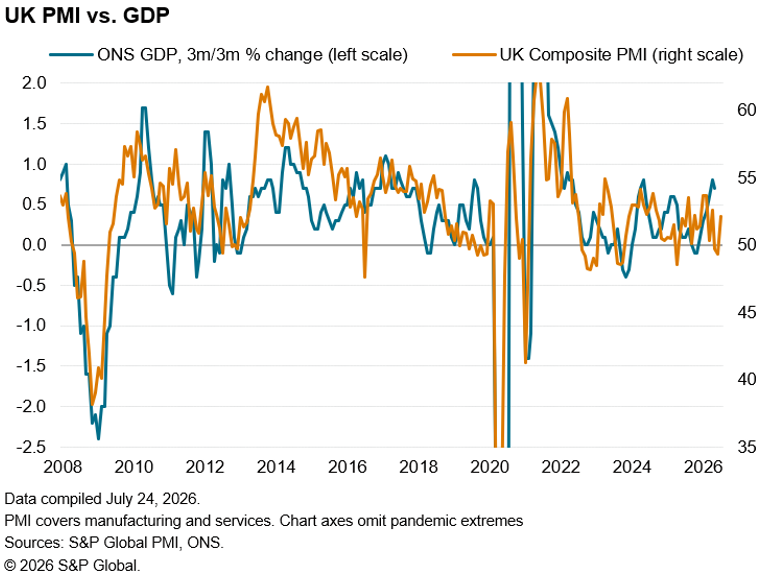
UK businesses reported higher output in July for the first time in three months, according to provisional survey data. The headline ‘flash’ S&P Global Composite PMI Output Index rose from 49.3 in June to 52.1, its highest since April. The July reading is consistent with modest quarterly GDP growth of around 0.2%, an improvement on the flat picture seen in the second quarter.
The PMI data have signalled a volatile path for business growth so far in 2026. A strong expansion earlier in the year faded as rising energy prices and uncertainty linked to the war in the Middle East intensified existing headwinds. The latest July reading adds to evidence that the UK can avoid a downturn, although the outlook remains uncertain because some of the month’s growth drivers appear temporary.
UK services rebound on weather, World Cup and tech spending
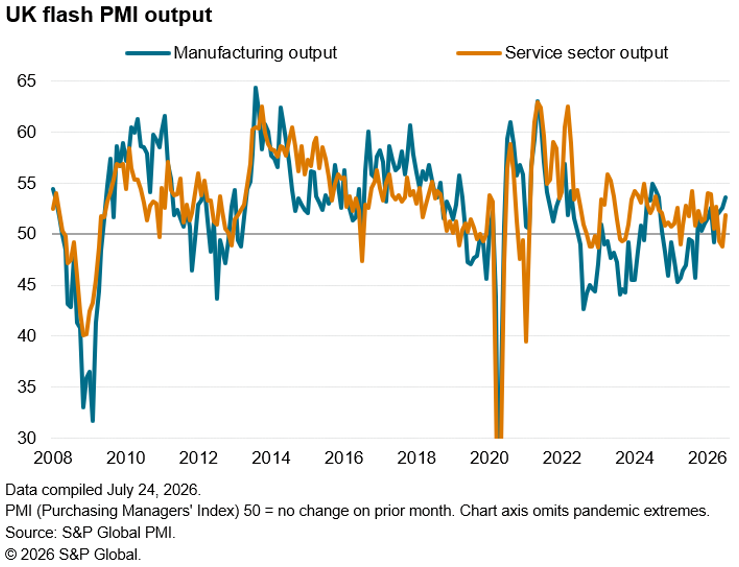
Service sector activity rose for the first time in three months, helped by good weather that supported otherwise subdued spending on hospitality activities such as leisure and recreation. The sector was also lifted by more ‘staycation’ tourism as higher costs and geopolitical uncertainty continued to curb overseas travel. Additional consumer spending linked to the FIFA World Cup provided a further boost. Financial services and IT activity also increased, with IT recording an especially sharp expansion.
UK manufacturing output growth hits strongest since late 2024
Manufacturing output growth meanwhile continued to gain momentum after the brief dip reported in March. July saw the largest monthly rise in production for almost two years as new orders increased at the sharpest rate since February 2022. Companies cited AI-related spending and stronger export orders as key drivers of higher production. Exports showed one of the largest gains recorded this side of the pandemic. However, as in recent months, some of the improvement also again reflected precautionary stock building amid concerns over supply availability and further price rises, widely linked to the war in the Middle East.
UK inflation pressures cool as supply shock eases
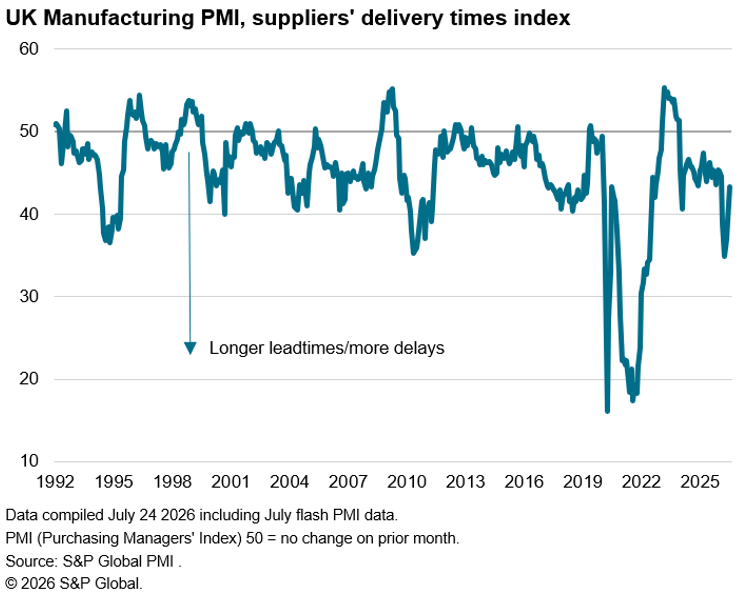
There was some encouragement on the supply side as supplier delivery delays eased. However, overall lead times continued to lengthen, mainly because shipping disruptions linked to lower traffic through the Strait of Hormuz and widespread safety-stock building kept pressure on supply chains.
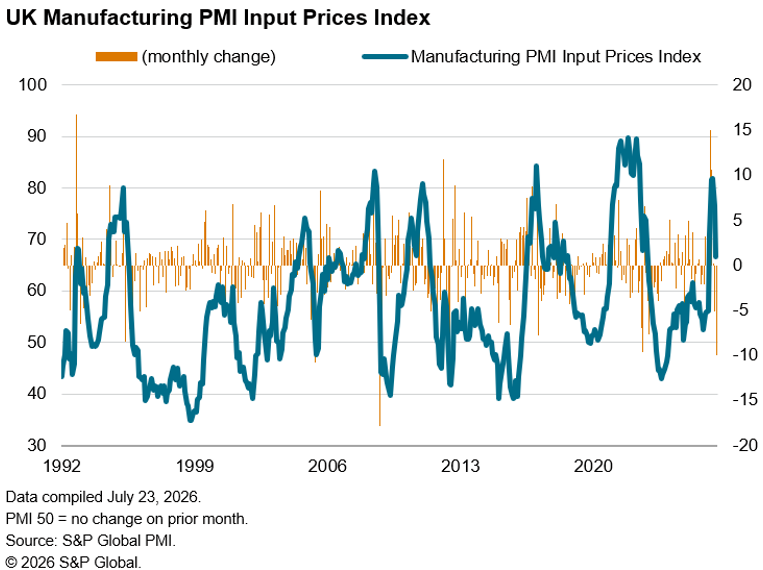
Input cost inflation fell sharply, mainly because of lower energy prices. The rate of cost increase dropped by one of the largest margins in the survey’s history. Notably, the manufacturing Input Cost Index recorded a double-digit decline despite higher steel tariffs in July.
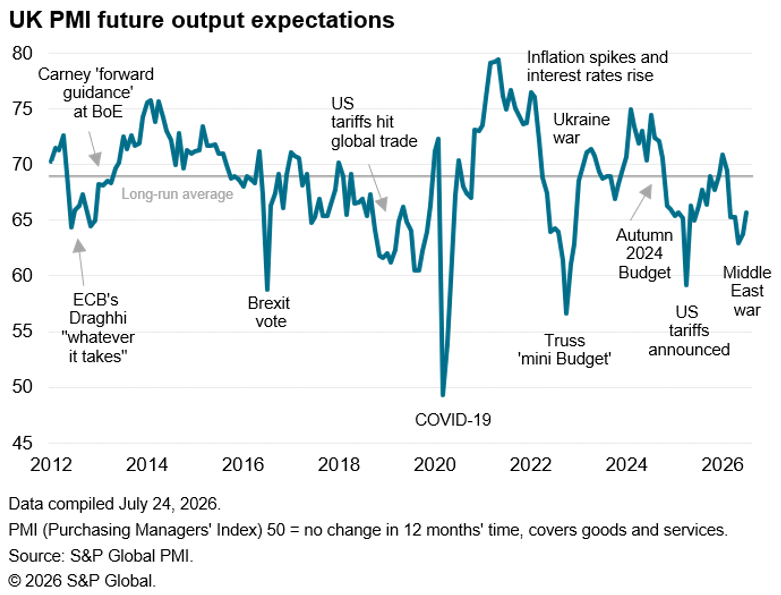
Selling price inflation across manufacturing and services also cooled further in July, falling to its lowest since the outbreak of the war in February. Even so, it remained elevated by historical standards, suggesting scope for higher consumer price inflation in the coming months.
UK employment falls again but job losses ease
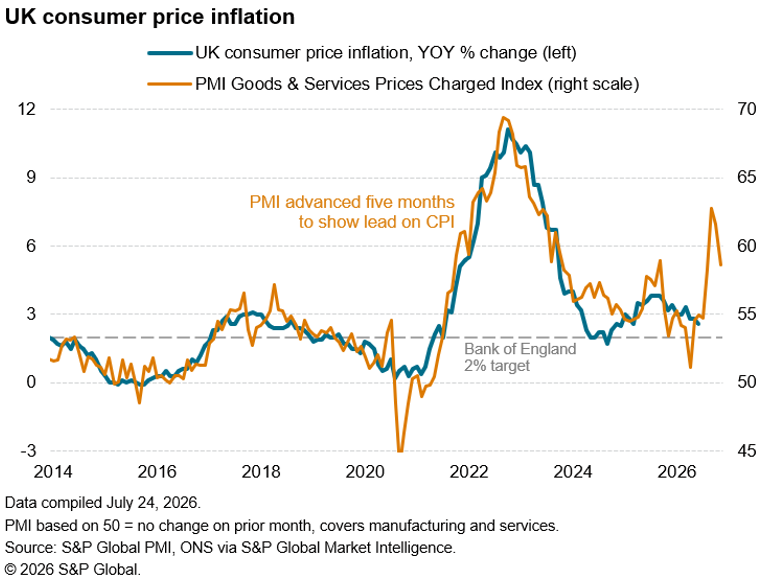
Reduced cost pressures and rising demand encouraged hiring at some companies, offsetting some of the pressure to cut workforce numbers elsewhere. Employment nevertheless continued to fall in July, extending the net decline reported by PMI respondents since the Autumn 2024 Budget. The latest reduction was the smallest since last October.
UK business optimism improves but remains subdued
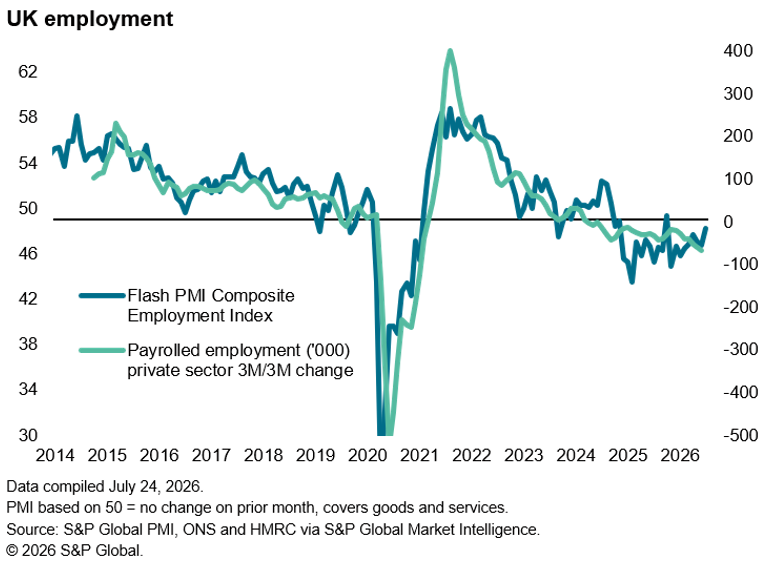
Business optimism for the year ahead strengthened in July, rising further from May’s recent low to a five-month high. However, confidence remained subdued by historical standards. Sentiment was often supported by investment in new products and marketing, while lower energy prices, and in some cases hopes for lower interest rates, added to a brighter outlook. Political uncertainty at home nevertheless weighed on many companies, especially concerns over fiscal policy changes under the new Prime Minister.
Bank of England rate outlook: PMI price gauges ease
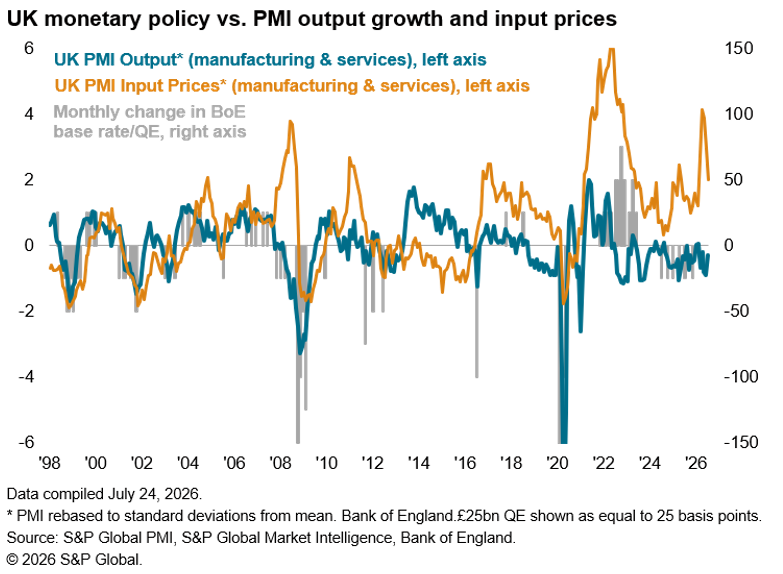
The fall in the PMI price gauges will add to speculation that the Bank of England could avoid raising interest rates for now, focusing instead on accommodative monetary policy to support a faltering and uncertain growth outlook.
Read the press release here.
© 2026, S&P Global. All rights reserved. Reproduction in whole or in part without permission is prohibited.
Purchasing Managers' Index™ (PMI®) data are compiled by S&P Global for more than 40 economies worldwide. The monthly data are derived from surveys of senior executives at private sector companies, and are available only via subscription. The PMI dataset features a headline number, which indicates the overall health of an economy, and sub-indices, which provide insights into other key economic drivers such as GDP, inflation, exports, capacity utilization, employment and inventories. The PMI data are used by financial and corporate professionals to better understand where economies and markets are headed, and to uncover opportunities.
Read our latest PMI commentary here.
This article was published by S&P Global Market Intelligence and not by S&P Global Ratings, which is a separately managed division of S&P Global.
Theme
Location
Products & Offerings