Research — July 23, 2026
Record Seahawks sale highlights surge in sports team valuations

By Iuri Struta
The newly announced $9.6 billion sale of the National Football League Inc.'s Seattle Seahawks team is set to break records amid growing investor interest in sports franchises.
The family of Khosla Ventures LLC founder Vinod Khosla on July 11 agreed to acquire the team from the estate of the late Microsoft Corp. co-founder Paul Allen. When completed, the Seahawks deal would surpass the previous NFL record set in 2023 when the Washington Commanders were bought by a consortium led by Josh Harris and Michael Li for $6.05 billion.
The Seahawks deal also would set a new benchmark for the highest-ever team revenue multiple at 15x. The transaction announcement follows Arctos Partners LP's May investment in the Cleveland Browns, which valued the Browns franchise at $9 billion, or a 13.4x revenue multiple.
"The demand is very strong for sports assets," said Salvatore Galatioto, president of sports advisory firm GSP Partners, in an interview. "I think that trend is going to continue."
Galatioto, a top adviser to team buyers, represented a client who submitted a bid for the Seahawks that fell below the winning bid.
Factors driving valuations higher
NFL valuations have risen rapidly since 2019, driven by factors including expanding TV rights values and a growing pool of interested investors. In 2024, the league changed its ownership rules to allow 10% of an NFL team to be held by institutional investors.
As a result, valuation multiples for NFL teams have increased from mid-to-high single digits in the three years leading up to 2022 to low-to-mid double digits by 2025, and the latest two deals indicate that this expansion is continuing.
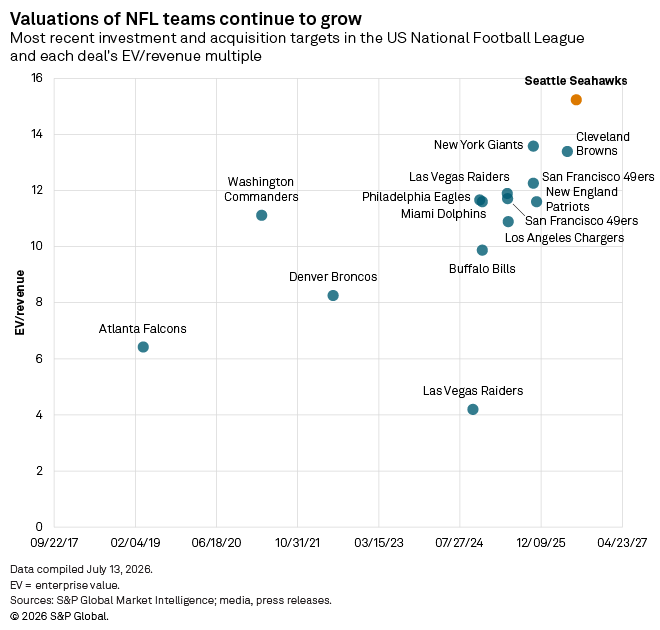
"We are still new in the game of private equity taking stakes in these US sports teams, and so we are still in price discovery phase, for sure," said Greg Bedrosian, CEO of TMT-focused investment bank Drake Star Partners Ltd., in an interview.
"The upswing in valuations will eventually slow down, but we are not there yet," Galatioto said.
Investment return
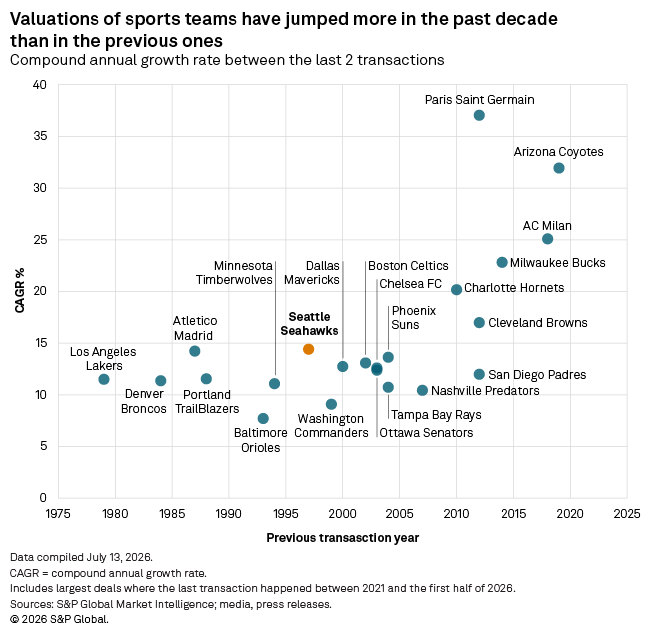
The rapid multiple expansion in the NFL and in sports franchises overall has significantly impacted the return on investment for many previous owners. The Washington Commanders and Seattle Seahawks were acquired around the same time, in 1999 and 1997, respectively. The Seahawks' owners, however, saw their investment value increase at a 14% compound annual growth rate (CAGR), versus 9% for the Commanders' owners. Since 1997, the S&P 500 Index has returned 10% per year.
Applying the Seahawks' new 15x multiple to the Commanders' revenue would imply a valuation of about $10 billion, boosting its historical CAGR to 10%. A key factor in the differing returns was the initial purchase price. Dan Snyder, the previous owner of the Commanders, acquired the team for an enterprise value of $750 million, four times what Allen paid for the Seahawks. The higher initial price for the Commanders was largely due to a rapid appreciation in NFL team values during the late 1990s, spurred by the league's renegotiated media rights deal in 1998, which doubled in value.
The Seahawks are also fresh off a Super Bowl win, having defeated the New England Patriots 29-13 in Super Bowl 60. The game drew an average audience of about 125 million viewers, ranking as the second-largest audience in NFL history.
The Seahawks' record deal remains subject to NFL approval.
This article was published by S&P Global Market Intelligence and not by S&P Global Ratings, which is a separately managed division of S&P Global.
Content Type
Theme
Segment
Language