ECONOMICS COMMENTARY — 24 Jul, 2026
Japan flash PMI signals strongest manufacturing output growth since 2014 as inflation risks persist

The S&P Global Flash PMI® data showed manufacturing output growth in Japan accelerating in July to its strongest since early 2014. However, the rise partly reflected short-term precautionary stock building, notably of oil-based products, while growth across the broader services economy remained lacklustre amid high prices. Average selling prices rose at a rate just below May’s all-time survey high, underscoring Japan’s continued shift into an inflationary environment and reinforcing expectations of further interest rate increases.
Manufacturing surge points to faster third-quarter GDP growth
Business activity growth accelerated for a second consecutive month in July, signalling firmer GDP growth at the start of the third quarter. After falling to a five-month low of 51.1 in May, the headline S&P Global Flash Japan PMI Composite Output Index rose to 53.1 in July. This marked the fastest expansion since the outbreak of the war in the Middle East at the end of February.
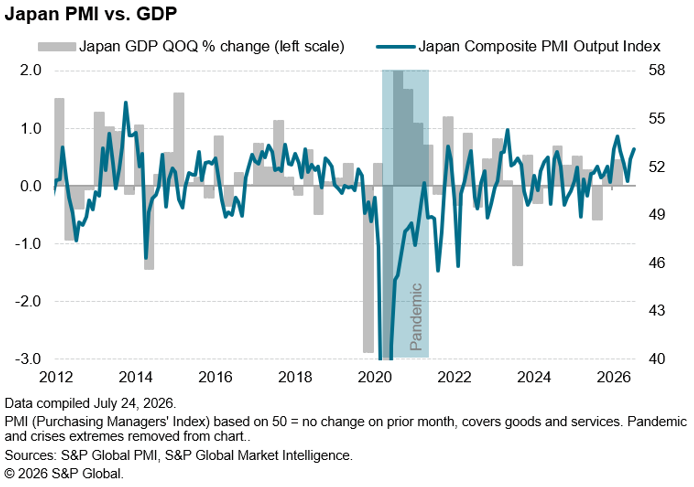
Historical comparisons suggest that the PMI is broadly consistent with GDP growth of around 0.75% on a quarterly basis.
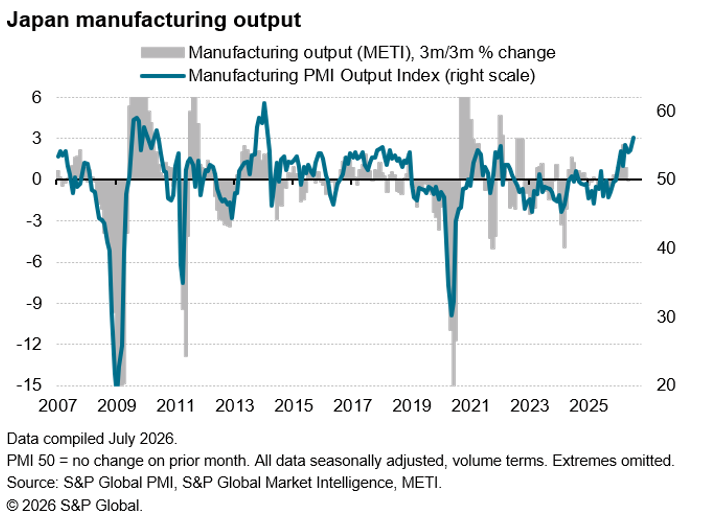
The July improvement was driven by the goods-producing sector, where manufacturing output rose at the fastest rate since February 2014.
Demand momentum cools as business confidence weakens
However, the survey’s sub-indices suggest that the pace of expansion could weaken again in August.
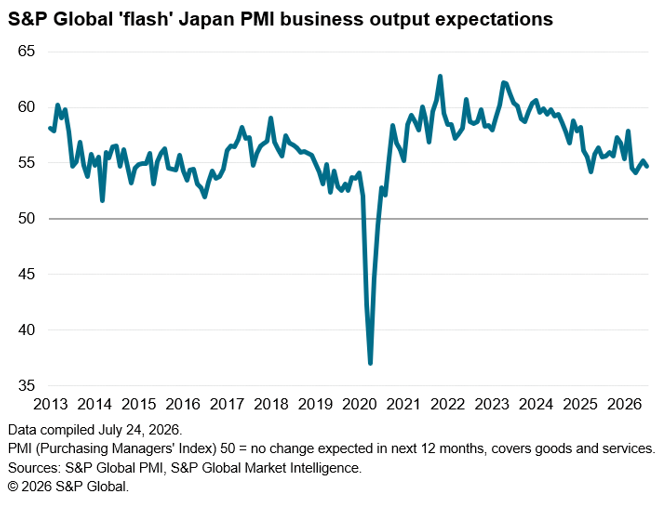
New order growth slowed from June’s four-month high, though it remained the second-strongest since February and contributed to a further build-up of backlogs of work. Even so, the softer rise in demand fed through to weaker business optimism about the year ahead, leaving confidence close to one of its lowest levels since the pandemic.
Precautionary stock building boosts factory output
Furthermore, while part of the manufacturing upswing was linked to AI-related investment spending, notably in semiconductors, and the weaker yen also helped improve export competitiveness, July again brought reports of precautionary stock building in response to the ongoing conflict in the Middle East.
Manufacturers purchased input inventories rose in July at the steepest rate for just over three years. More than half of the companies reporting higher inventories cited the need to secure stocks ahead of potential supply shortages or price increases, especially for oil-based inputs. Such stock building is therefore likely to provide only a temporary boost to manufacturing.
Services lag behind manufacturing rebound
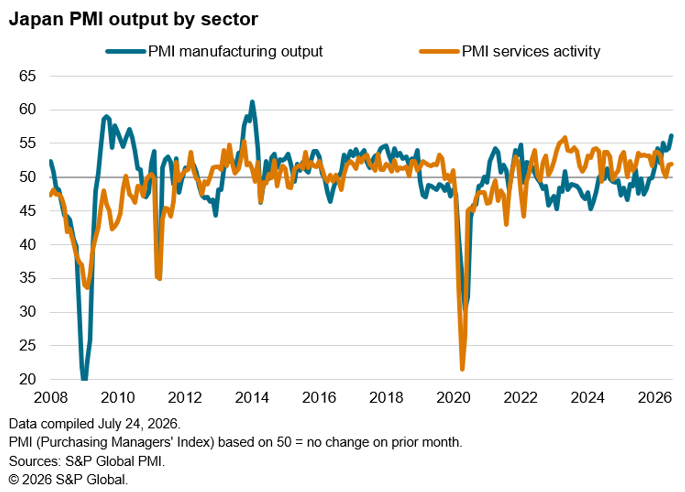
The surge in manufacturing growth was not matched by the service sector. Services activity rose only modestly in July, with the rate of expansion remaining well below the pace seen in the first quarter, before the war.
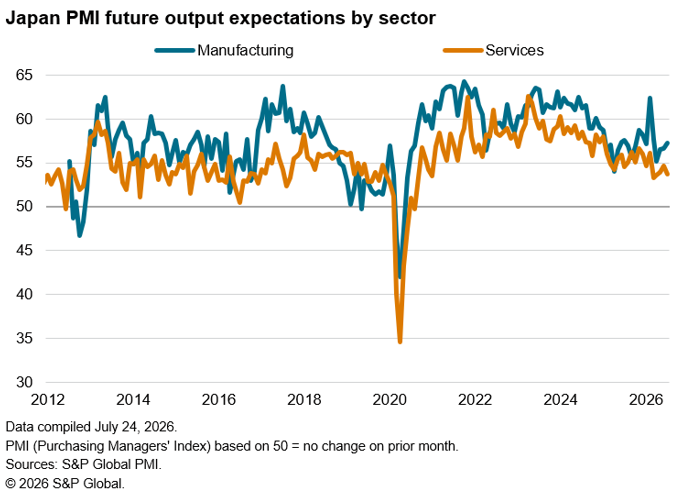
Growth expectations are especially subdued in the services economy, where optimism is close to post-pandemic lows. Sentiment is more upbeat in manufacturing, but even here confidence about future production remained weak by post-pandemic standards.
Supply strains keep price pressures elevated
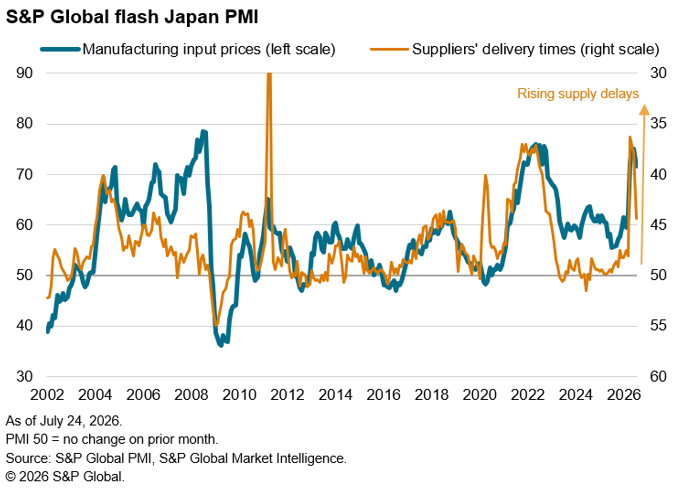
Low confidence partly reflected concerns about supply availability and associated inflationary pressures, most commonly linked to constrained supplies of oil and related products from the Middle East. Although reports of supplier delivery delays eased notably in July, supplier lead times continued to lengthen and manufacturing input prices rose sharply again, albeit at a slower rate.
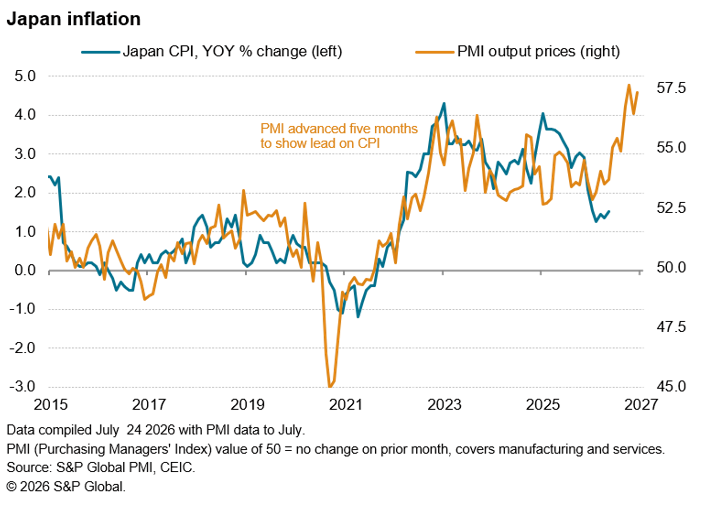
Average prices charged for both goods and services rose at a faster rate in July, with inflation falling only just short of May’s all-time survey high. Alongside supply-related input cost pressures, the weaker yen was reported to have lifted import costs, while labour costs were also widely cited as an additional driver of higher prices.
Inflation backdrop keeps rate-hike expectations alive
Ongoing supply chain disruptions emanating from the Strait of Hormuz are continuing to affect businesses in Japan, with concerns over future energy supply encouraging firms to stockpile related inputs and raising worries about potential constraints on future production. In services, high costs are likewise pushing prices higher and dampening demand.
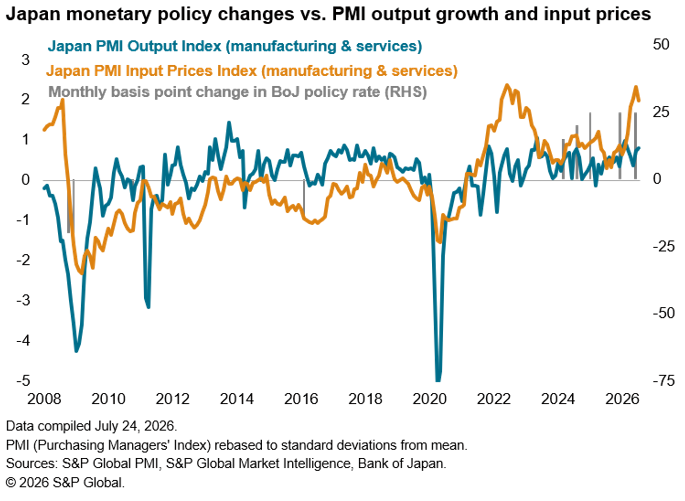
Companies also see the potential for higher interest rates to further subdue demand. The Bank of Japan’s policy rate now stands at 1.0%, its highest since 1995, continuing a tightening cycle that began in early-2024. Rates had previously not been raised for 17 years amid a deflationary environment. The latest PMI data therefore underscore Japan’s continued shift into a more inflationary environment. With the PMI data pointing to inflation rising further from the 1.5% rate indicated by the official data for May, further rate hikes may be on the cards in the coming months.
Access the press release here.
© 2026, S&P Global. All rights reserved. Reproduction in whole or in part without permission is prohibited.
Purchasing Managers' Index™ (PMI®) data are compiled by S&P Global for more than 40 economies worldwide. The monthly data are derived from surveys of senior executives at private sector companies, and are available only via subscription. The PMI dataset features a headline number, which indicates the overall health of an economy, and sub-indices, which provide insights into other key economic drivers such as GDP, inflation, exports, capacity utilization, employment and inventories. The PMI data are used by financial and corporate professionals to better understand where economies and markets are headed, and to uncover opportunities.
Read our latest PMI commentary here.
This article was published by S&P Global Market Intelligence and not by S&P Global Ratings, which is a separately managed division of S&P Global.
Theme
Location
Products & Offerings