ECONOMICS COMMENTARY — 24 Jul, 2026
Flash PMIs signal faster growth across major developed economies, but supply chain and price concerns cloud outlook

S&P Global’s flash PMI surveys showed economic growth across the major developed economies strengthening in July to signal encouraging resilience in the face of the ongoing conflict in the Middle East. However, price pressures stayed elevated, and the renewed escalation of the conflict threatens to reverse some of the improvement.
Major developed market growth hits eight-month high in flash PMI data
Business activity across the four largest advanced economies – the US, eurozone, Japan and the UK (the ‘G4’) – gained momentum for a second successive month in July, according to flash PMI data. Growth accelerated to its fastest since last November, moving above the average seen over the past three years, to mark a clear recovery from the lows caused by the war in the Middle East between March and June.
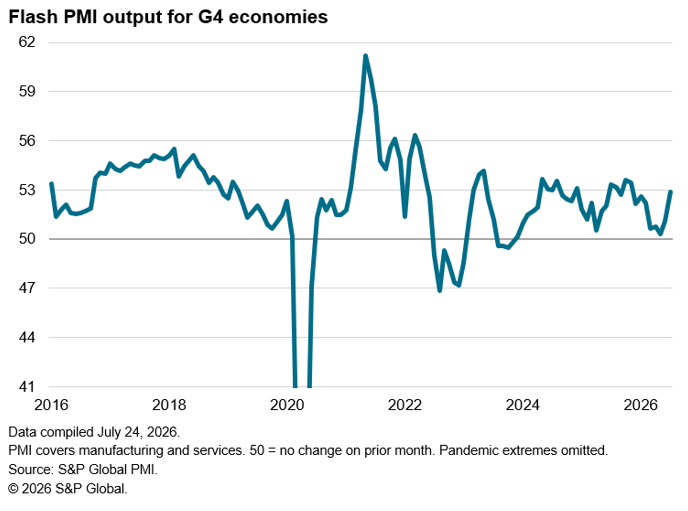
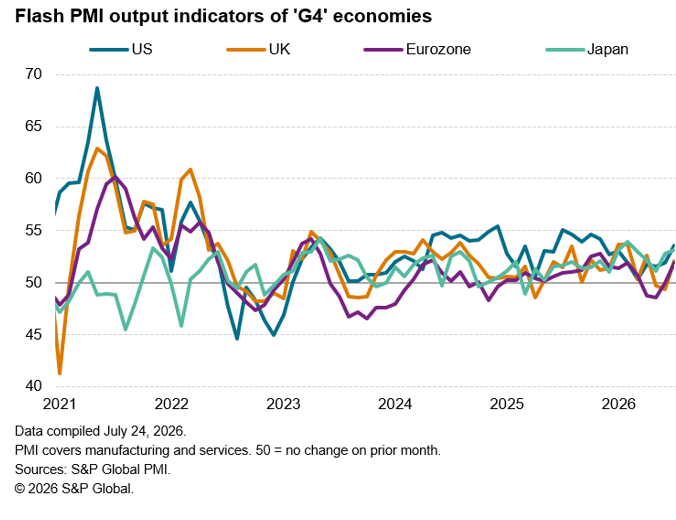
Growth accelerated in all four major developed markets. The US recorded the strongest rise, with growth at its fastest since last November. Japan followed, posting its largest increase since February. The eurozone and UK also returned to growth, after activity had stagnated in the eurozone and fallen in the UK in June.
Service sector growth surge offsets slower manufacturing expansion
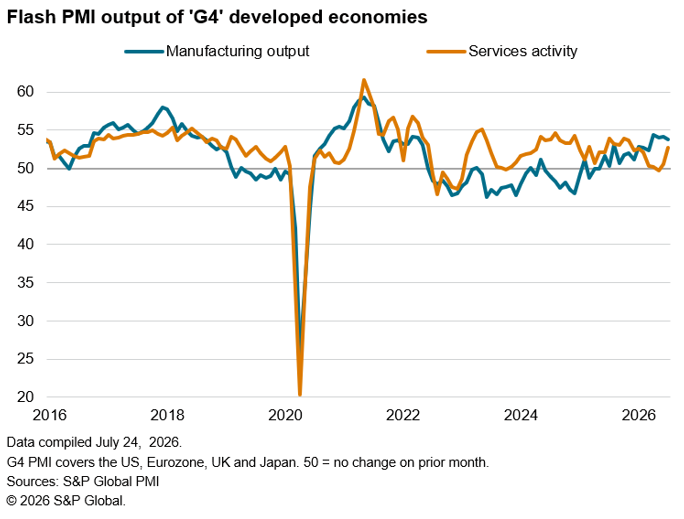
By sector, G4 manufacturing outperformed services for a seventh successive month, an unusually long spell by recent standards. However, the gap narrowed in July as manufacturing growth eased slightly while services activity rose at its fastest rate since last November.
In manufacturing, Japan led the G4, reporting the strongest production growth since 2014. Growth also improved in the eurozone and UK, reaching the highest levels since February 2022 and September 2024 respectively. By contrast, US factory output growth slowed to a four-month low, though it remained robust.
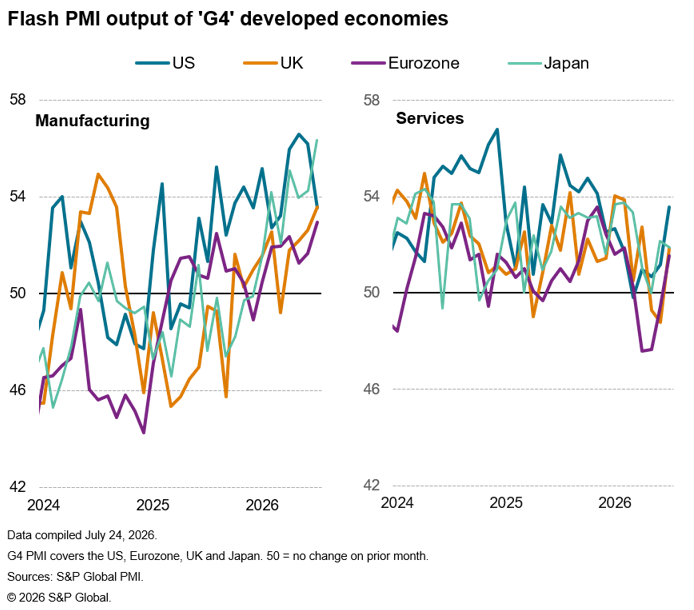
The US led the G4 services expansion, with growth at an eight-month high. The UK and eurozone both returned to modest growth after two and three months of respective declines. Japan’s services economy continued to expand, but at a slightly slower pace.
World Cup, hot weather and inventory building provide temporary PMI boost
Two factors are important when assessing whether July’s improvement can last.
First, service-sector growth – especially in the US and Europe – was temporarily lifted by hospitality and leisure activity around the FIFA World Cup. Hotter-than-usual weather also boosted demand for some recreational services.
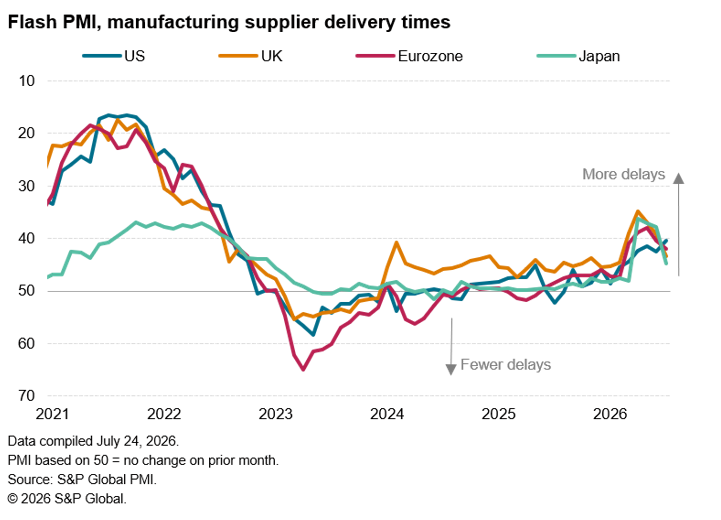
Second, manufacturers again reported widespread precautionary stock building as a short-term driver of higher production. However, anecdotal evidence suggests that this stock-building has begun to fade, notably in the US. In some cases, supply shortages limited purchasing. Supplier delivery times notably lengthened more sharply in the US than in Europe and Japan.
Inflation and price pressures hold the key to the G4 economic outlook
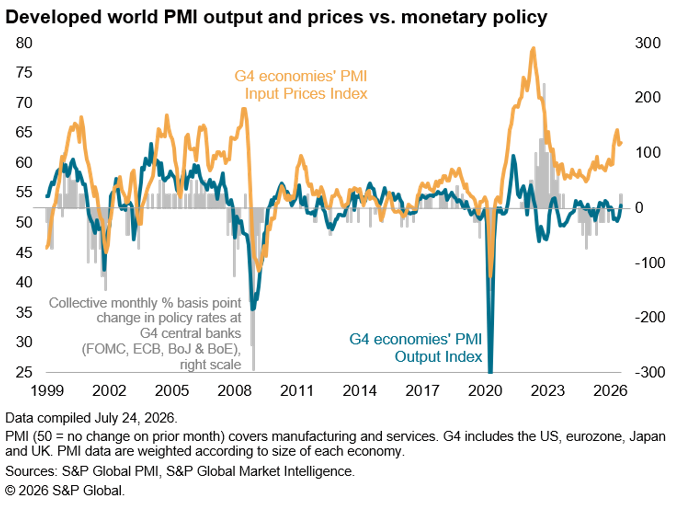
Part of the July improvement in demand and activity reflected weaker price pressures compared with earlier peaks. Oil prices fell sharply in June before rising again in mid-July, helping to ease demand-dampening price rises in services such as travel and transport.
However, the flash PMI data were collected from 9-22 July, so many responses reflected conditions before oil prices rose again. The recent increase in energy prices in the second half of the month nevertheless added upward pressure to both costs and selling prices across the G4, while steel tariffs introduced on 1 July added further to the inflation picture.
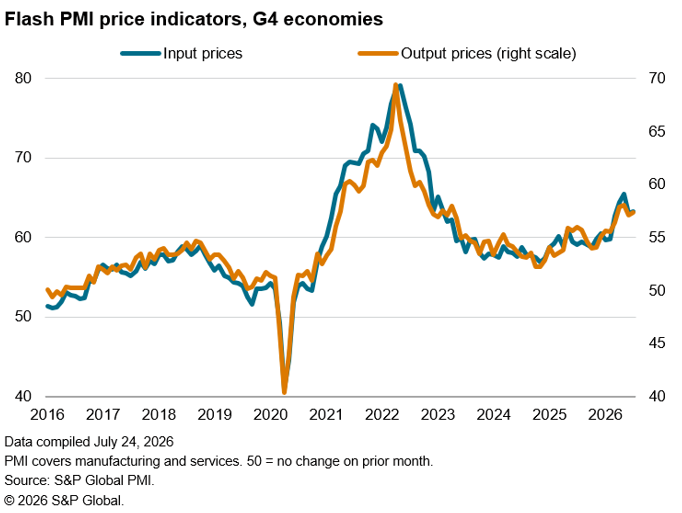
That said, price trends varied among the G4.
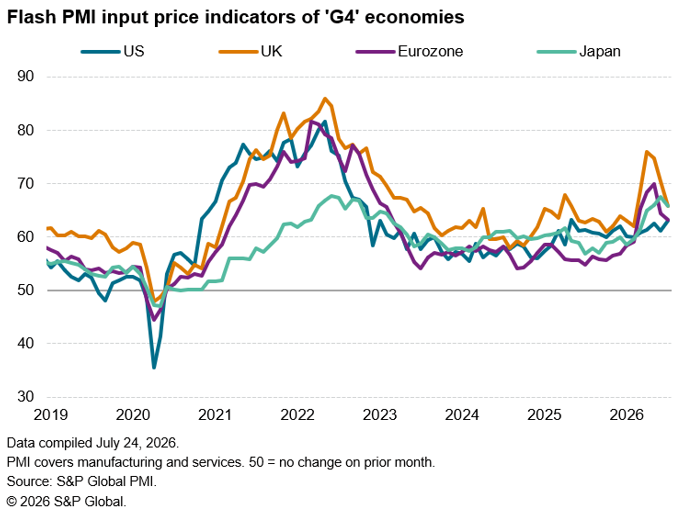
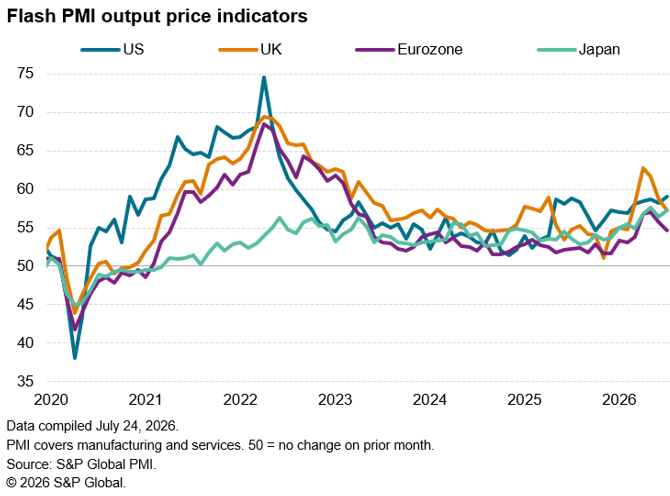
Both input cost and selling price inflation rates accelerated in the US, the latter now at its highest since August 2022 and leading the G4.
Input cost inflation rates meanwhile moderated elsewhere, though only in the eurozone and the UK did this feed through to lower selling price inflation. Japan’s selling price inflation rate rose to a level just shy of May’s all-time survey high.
Policy divergence: central banks face renewed inflation risks
The survey data point to supply issues pushing inflation pressures higher in the US and Japan. In the US, tariffs have reportedly amplified supply chain stresses caused by the war in the Middle East. In Japan, concerns over energy shortages are especially acute. In Europe, improved supply chains and cooler price pressures have helped support demand.
Across the G4, however, the renewed escalation of hostilities in the Middle East threatens to reverse July’s improvements in demand, supply chains and inflation pressures.
Policymakers will therefore welcome the PMI signals of resilient growth, but will want more data on how inflation is evolving amid recent geopolitical developments, including the conflict in the Middle East and further US tariff announcements. With price gauges still running well above levels consistent with central bank targets, recent events have likely shifted the bias towards tighter policy.
© 2026, S&P Global. All rights reserved. Reproduction in whole or in part without permission is prohibited.
Purchasing Managers' Index™ (PMI®) data are compiled by S&P Global for more than 40 economies worldwide. The monthly data are derived from surveys of senior executives at private sector companies, and are available only via subscription. The PMI dataset features a headline number, which indicates the overall health of an economy, and sub-indices, which provide insights into other key economic drivers such as GDP, inflation, exports, capacity utilization, employment and inventories. The PMI data are used by financial and corporate professionals to better understand where economies and markets are headed, and to uncover opportunities.
Read our latest PMI commentary here.
This article was published by S&P Global Market Intelligence and not by S&P Global Ratings, which is a separately managed division of S&P Global.
Theme
Location
Products & Offerings