ECONOMICS COMMENTARY — 21 Jul, 2026
Demand for consumer services has been volatile so far in 2026 due to the Middle East war, and the sector’s health will play a key role in the outlook for global economy

Spending on consumer services, ranging from arts, sporting activities and health and beauty through to restaurants, travel and tourism, has been especially hard hit by the outbreak of war in the Middle East, according to PMI survey data, and a nascent revival in June is under threat from a renewed spike in energy prices.
Tracking this sector is especially interesting as it provides a guide to appetite for discretionary spending by consumers.
Here we look at which countries have seen their consumer service sectors impacted to the greatest extent by the war, and which have so far shown resilience.
About the data
The worldwide Purchasing Managers’ Index™ (PMI®) surveys not only provide headline data for global and national economic trends, but can be analysed at a sector level – both globally and for the individual major economies of the world. These more detailed data help businesses, investors and economists better understand industry contributions to economic performance and dependencies, as well as allowing the assessment of corporate earnings and to benchmark business performance. Download the full report to review the appendix to learn more.
Demand revives for consumer services after war-related downturn
Following the outbreak of war in the Middle East on 28 February, oil prices rose sharply and travel was disrupted due to safety concerns. Worries over fuel availability also led to especially large hikes in prices for air travel booking for the coming months. This energy price shock followed further cost of living pressures in many economies, notably via tariffs in the US and prior energy prices rises in Europe associated with the war in Ukraine.
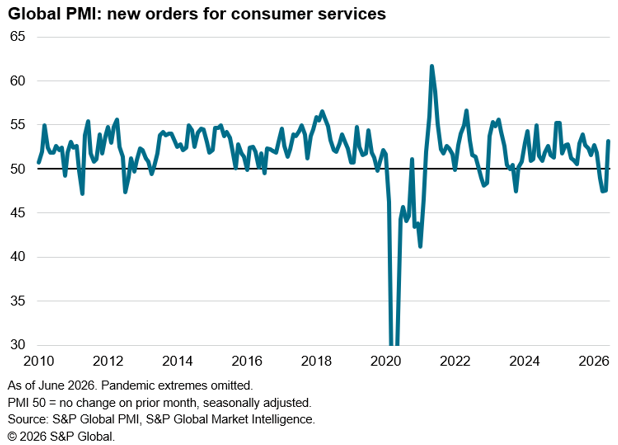
The PMI data show that this living cost squeeze and rise in prices led to a continuous fall in demand for consumer services globally between March and May 2026. The global PMI Consumer Services New Orders Index averaged 48.0 over this three-month period, running below the 50.0 no-change level. The three-month decline was in fact the largest since the COVID-19 pandemic disruptions to services in 2020-2021. Excluding the pandemic, the drop in demand was the largest recorded since global data were available in late-2009.
This downturn ended in June as a ceasefire in the Middle East drove energy prices sharply lower, reducing inflation expectations and steadying both business and consumer confidence. The global rebound in new orders for consumer services seen in June represented the largest monthly increase in demand since last September.
Consumer services hardest hit sector
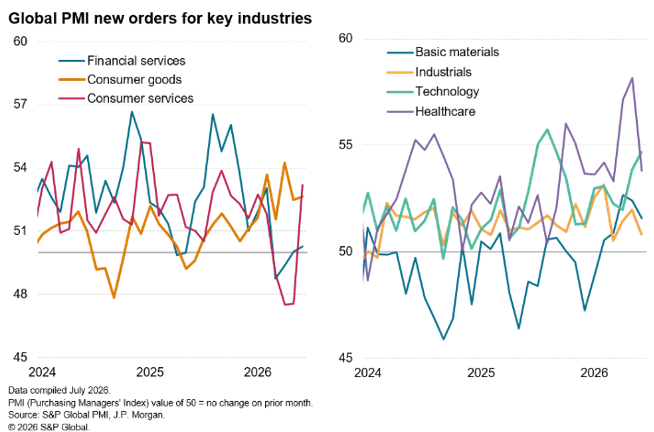
The drop in demand for consumer services between March and May exceeded any other deterioration recorded among the various broad sectors tracked by the S&P Global PMI surveys. In fact, the only other decline in demand during this period was reported for financial services, which saw falling orders during March and April, often linked to the prospect of higher central bank policy rates. All other broad sectors managed to sustain growth in the face of the conflict, albeit generally losing momentum in the initial stages of the war.
Mainland China bucks downturn
Analyzing the consumer services PMI new orders data for nine of the world’s largest economies, we can infer the following:
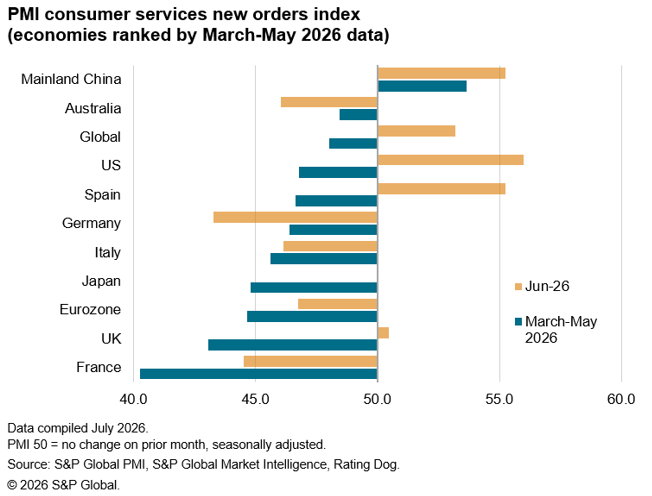
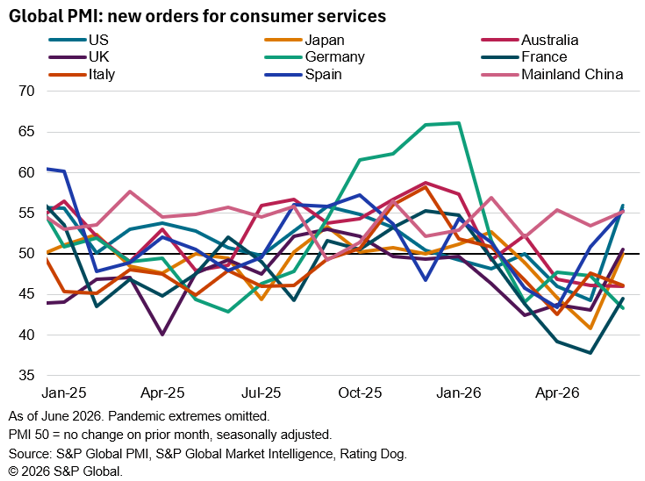
• Mainland China saw the greatest resilience in demand for consumer services between March and May, the PMI New Orders Index averaging 53.7 against the global 48.0 average to also stand out as the only one of the nine economies to report higher demand over this period.
• Mainland China’s outperformance over the past four months can be part attributed to relatively low inflation. Mainland China’s PMI data showed selling prices for consumer services falling over the March-May period and only a slight rise in June.
• The steepest drop in orders for consumer services over the March-May period was reported in France, followed by the UK. Large falls were also seen in Japan and Italy.
• A relatively small drop in demand was evident in Australia, with the US also registering a smaller decline than evident in Japan and throughout Europe.
• While an ongoing expansion of demand was reported in mainland China during June, the month only saw consumer services demand revive to any significant degrees in the US and Spain (the latter helping edge the eurozone back into growth territory).
• A more modest improvement was seen in the UK while no change in demand was reported in Japan.
• Demand for consumer services continued to fall during June in Germany, Italy, and France.
• Germany and Australia meanwhile stood apart by seeing demand fall at a faster rate in June compared to the March-May period.
Outlook
How consumer services demand varies in the coming months amid changing developments in the Middle East and energy markets will provide important insights into broader spending and economic growth trends, signaling how discretionary spending is being affected and revealing cyclical growth differentials between economies.
Combining PMI data to reflect price changes as well as demand can also generate valuable signals for corporate earnings, both at a global level as well as for national equity markets.
© 2026, S&P Global. All rights reserved. Reproduction in whole or in part without permission is prohibited.
Purchasing Managers' Index™ (PMI®) data are compiled by S&P Global for more than 40 economies worldwide. The monthly data are derived from surveys of senior executives at private sector companies, and are available only via subscription. The PMI dataset features a headline number, which indicates the overall health of an economy, and sub-indices, which provide insights into other key economic drivers such as GDP, inflation, exports, capacity utilization, employment and inventories. The PMI data are used by financial and corporate professionals to better understand where economies and markets are headed, and to uncover opportunities.
Read our latest PMI commentary here.
This article was published by S&P Global Market Intelligence and not by S&P Global Ratings, which is a separately managed division of S&P Global.
Theme
Location
Products & Offerings