Research — June 23, 2026
Positive trial data lifts forecasts for Tango Therapeutics’ oncology program
By Shlok Jain
Shares in Tango Therapeutics Inc. (NASDAQ: TNGX) surged to a record high earlier this month after early-stage clinical data suggested a potentially powerful combination in one of oncology’s most difficult-to-treat cancers.
In a Phase 1/2 study, Tango’s PRMT5 inhibitor vopimetostat (TNG462) used alongside Revolution Medicines Inc. (NASDAQ: RVMD) RAS(ON) inhibitor daraxonrasib (RMC6236) produced a 92% objective response rate in patients with advanced pancreatic cancer. The readout sent Tango’s stock up 53% to an all-time closing high, driven by enthusiasm for combination approaches targeting RAS-driven tumors, which account for the vast majority of pancreatic cancers and have historically been resistant to therapy.
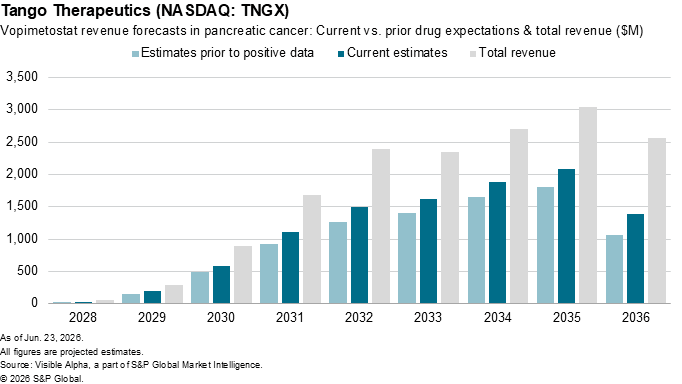
The data has materially lifted expectations for Tango’s precision oncology platform. Visible Alpha consensus estimates imply projected risk-adjusted revenue of about $33 million assuming first commercial launch in 2028 for vopimetostat in pancreatic cancer. The drug is expected to account for roughly 60% of Tango’s total revenue base in its launch year. Analysts expect a rapid ramp thereafter, with sales reaching approximately $1.1 billion by 2031, implying blockbuster status within three years of launch.
The read-across has also sharpened attention on Revolution Medicines’ daraxonrasib, which is being positioned as a potential backbone therapy for RAS-driven tumors. The drug is not yet approved, but is advancing through late-stage development in metastatic pancreatic cancer, a setting with limited effective treatment options and high unmet need.
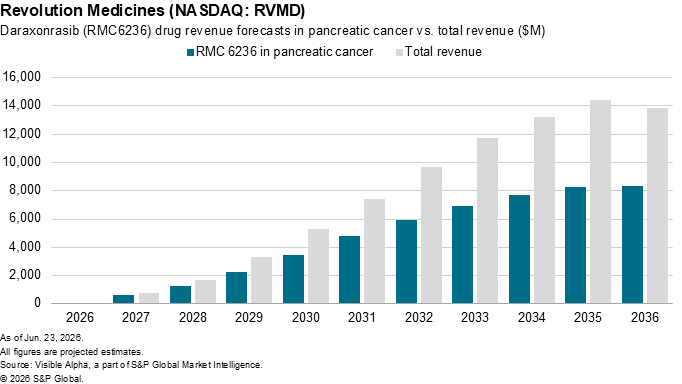
Analysts assign a probability of success of about 81.7% to daraxonrasib in pancreatic cancer, reflecting growing confidence following positive Phase 3 data. Current projections suggest daraxonrasib could generate around $75 million in risk-adjusted sales this year, subject to regulatory approval, rising to roughly $656 million in 2027, its first full year of expected commercial availability, and about $1.3 billion by 2028, implying blockbuster scale.
This article was published by Visible Alpha, part of S&P Global Market Intelligence and not by S&P Global Ratings, which is a separately managed division of S&P Global.
Content Type
Products & Offerings
Segment
