Research — June 25, 2026
Multiyear rate plans filed by San Diego Gas & Electric, Southern California Gas

By Dan Lowrey
Sempra utilities San Diego Gas & Electric Co. and Southern California Gas Co. filed test year 2028 general rate cases with the California Public Utilities Commission on June 15, seeking a combined $2.50 billion in rate relief over four years to fund investments in safety and reliability, wildfire mitigation and the clean energy transition.

➤ Sempra Energy subsidiaries San Diego Gas & Electric Co. (SDG&E) and Southern California Gas Co. (SCG) have filed test year 2028 general rate cases (GRCs) with the California Public Utilities Commission (PUC). SDG&E is seeking $1.07 billion between its electric and gas divisions, while SCG is seeking $1.43 billion in rate increases over a four-year period (2028–2031) to fund safety, reliability, wildfire mitigation, information technology and clean energy transition initiatives.
➤ The requested rate increases are primarily driven by escalating non-discretionary expenses. Key pressures include rising cybersecurity threat mitigation costs, substantial increases in insurance premiums due to wildfire exposure, and upward pressure on employee healthcare and medical benefits.
➤ California's recent wildfire-liability reforms, such as Senate Bill 254, which injected $18 billion into the state's wildfire fund and clarified cost‑sharing between shareholders and ratepayers, have restored some investor confidence. Regulatory Research Associates has therefore lifted the state's utility‑investor rating back to Average/1 as of Nov. 30, 2025, even though the underlying inverse‑condemnation liability risk remains.

SDG&E requested an increase of $72 million in electric base rates (Application 26-06-015 (Elec)) and $208 million in gas base rates (Application 26-06-015 (Gas)) for the 2028 test year. The utility is also seeking combined electric and gas post-test year rate increases of $327.1 million in 2029, $225.8 million in 2030 and $240.4 million in 2031. The company did not provide an estimated electric or gas rate base in the general rate case application.
The rate increase request is primarily driven by the need to maintain safe and reliable service, manage costs and make investments that provide value to customers, addressing challenges such as wildfire risk, extreme weather and cybersecurity threats.
Specifically, SDG&E's request focuses on work such as reducing wildfire and outage risk, protecting the public, employees and contractors, and maintaining and enhancing system reliability and performance through ongoing maintenance and modernization. The utility also aims to strengthen information technology and cybersecurity capabilities supporting system operations, maintain natural gas system safety and integrity, and support customer growth, system utilization and electrification.
With respect to wildfire risk, SDG&E proposes to harden approximately 600 miles of distribution infrastructure over the course of the GRC cycle, including 400 miles of strategic undergrounding and 200 miles of covered conductor. These investments focus on high-risk circuits and are expected to substantially reduce ignition probability.
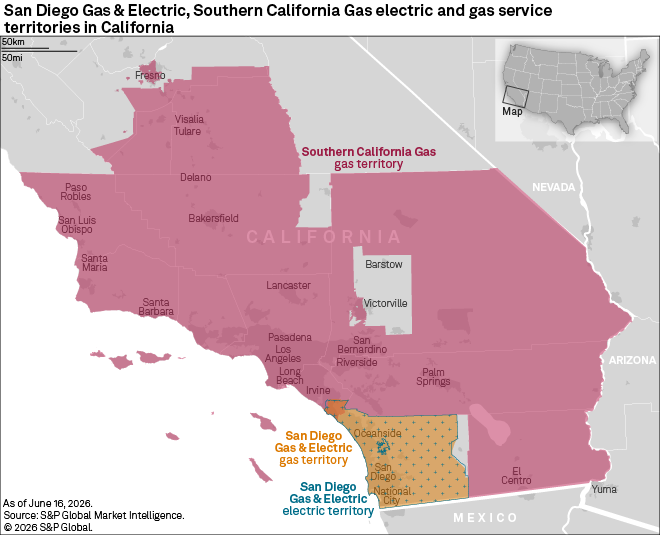
SCG requested a $485 million increase in gas rates for the 2028 test year (Application 26-06-014), with post-test-year increases of $315 million in 2029, $312 million in 2030 and $314 million in 2031. The company did not provide an estimated rate base for SCG in the general rate case application.
The rate increase request is primarily driven by the need to recover reasonable costs for gas operations, facilities and infrastructure, influenced by escalating cybersecurity threats, rising insurance rates, increased medical costs and ongoing investments in operational improvements and technology. Key factors contributing to increased operating expenses include escalating cybersecurity threats requiring enhanced defenses, a significant rise in insurance rates due to a complex litigation environment and the need for wildfire coverage, and substantial upward pressure on employee medical costs.
The general rate request process is scheduled to take between 18 months and two years and is expected to conclude in late 2027.
Every four years, regulated utilities in California are required to file a general rate case (GRC) outlining their capital investments and forecast costs for operations and maintenance. The PUC voted in January 2020 to change the previous three-year rate case cycle for energy utilities to a four-year cycle. A longer cycle allows utilities more time to implement risk-mitigation and accountability structures and less time to litigate issues with stakeholders to make rate cases more efficient and predictable. Investor-owned utilities in California pushed for the change, describing challenges that have impeded the commission from resolving GRC proceedings according to the standard rate case plan schedule and possible ways to help the PUC process GRC proceedings more efficiently.
Cost of capital
Cost of capital is not an issue in the proceedings, as it is determined in a separate automatic adjustment mechanism. SDG&E is authorized a 9.93% return on equity, and SCG is authorized a 9.78% ROE. The commission voted 4 to 1 on Dec. 18, 2025, to adopt new and lower authorized returns on equity for the state's largest investor-owned energy utilities, including Sempra's. The final decision reduced authorized equity returns by 30 basis points across the board, beginning in 2026.
The ROEs remain above recent national averages tracked by RRA.
Previous rate case
The PUC voted on Dec. 19, 2024, to authorize multiyear gas and electric rate increases for SDG&E and SCG, setting rates for 2024–2027.
SDG&E electric rates rose $177.5 million, SDG&E gas rates rose $11.1 million and SCG rates rose $323.6 million retroactively to Jan. 1, 2024. Additionally, the commission approved post-test-year increases for the utilities beginning in 2025 through 2027.
The decision authorized post-test-year increases of $190.2 million (2025), $116.4 million (2026) and $119.9 million (2027) for SCG. For SDG&E, the commission decision did not break out the authorized post-test year increases by operating division (i.e., electric or gas) but did provide a consolidated total. The commission authorized a combined $147.0 million increase in 2025, a $118.6 million increase in 2026 and a $121.7 million increase in 2027.
The authorized rate bases for the 2024 test year were $12.34 billion for SCG, $6.32 billion for SDG&E's electric division and $1.79 billion for SDG&E's gas division.
The commission highlighted rate affordability in a press release following the decision. "While Sempra did not receive the full revenue requirement they requested, the decision balances between maintaining safety, reliability, and investments in clean energy infrastructure and ensuring rates remain affordable for customers," the commission said. The commission also noted that though the rates would be effective retroactively to Jan. 1, 2024, they would not appear on customer bills until Feb. 1, 2025.
Calif. regulatory environment for energy utilities
Supportive wildfire liability protection measures recently passed by the California State Legislature and potential new ones prompted RRA to raise California's ranking back to Average/1 from Average/2 as of Nov. 30, 2025, indicating that the state remains somewhat constructive from a utility investor perspective.
In June 2025, RRA reduced California's ranking from Average/1 to Average/2 due to uncertainty regarding utilities' future wildfire liabilities. RRA continues to wait on cause determination of the destructive Los Angeles wildfires that began in January 2025. While no official root cause report by CalFire has been issued, media reports and lawsuits allege one of the fires — the Eaton fire — was ignited by electric equipment of Southern California Edison Co. Senate Bill 254 removes some uncertainty with respect to liabilities faced by utilities. The legislation added up to $18 billion to California's approximately $21 billion wildfire fund, which protects the state's largest investor-owned utilities from wildfire liabilities. Investor-owned utility shareholders and ratepayers are to split the cost.
For now, the state's inverse condemnation legal standard for wildfire events involving utility equipment remains in place. Under this principle, if a utility's equipment is found to have been a substantial cause of the damage in an event such as a wildfire, the utility, even if it has followed established inspection and safety rules, may still be liable for damage. A report released by the fund administrator on April 7 recommends three pathways for the governor and legislature to consider for improving catastrophe resiliency, particularly wildfires, in the state. Recommendations included community wildfire risk reduction, increasing the size of the Wildfire Fund, creating a state-administered insurance program and eliminating the insurance subrogation system, which could lower wildfire settlement costs for utilities. One pathway recommended in the report is eliminating the "inverse condemnation" standard for utility-caused wildfire damages, proposing a transition to a negligence-based liability framework. However, RRA considers that option unlikely, given that it would require a constitutional amendment approved by the voters, who are largely at odds with utilities over high energy bills.
The more traditional aspects of the California regulatory paradigm are relatively constructive for investors. The state operates under a largely traditional, vertically integrated electric regulatory framework, with direct access available for customers of the large electric utilities, subject to certain load caps. Equity return authorizations for major energy utilities are set using cost-of-capital mechanisms, and recent ROE authorizations have been above industry averages when established.
For more, visit the California commission profile page.
Regulatory Research Associates is a group within S&P Global Energy.
S&P Global Energy produces content for distribution on S&P Capital IQ Pro.
For a full listing of past and pending rate cases, rate case statistics and upcoming events, visit the S&P Capital IQ Pro Energy Research Home Page.
For a complete, searchable listing of RRA's in-depth research and analysis, please go to the S&P Capital IQ Pro Energy Research Library.
This article was published by S&P Global Market Intelligence and not by S&P Global Ratings, which is a separately managed division of S&P Global.