Research — June 12, 2026
FIFA World Cup 2026: Who’s watching around the world?

By Seth Shafer
While World Cup viewership in the US will likely surge in 2026 due to its host country status, Americans typically tend to be far less enthusiastic than viewers outside the US when it comes to soccer. S&P Global Market Intelligence Kagan’s recent consumer surveys in the US, United Kingdom, France, Germany, China, India and South Korea show the US lagging well behind other markets for both soccer and World Cup viewership.

➤ Nearly half of online adults in the UK said they typically watch men’s World Cup games, compared to just 13% in the US. World Cup viewership in other markets ranged from 28% to 43% of total respondents.
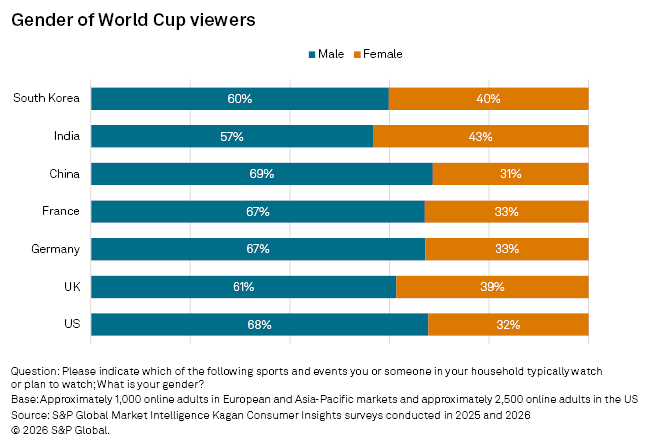
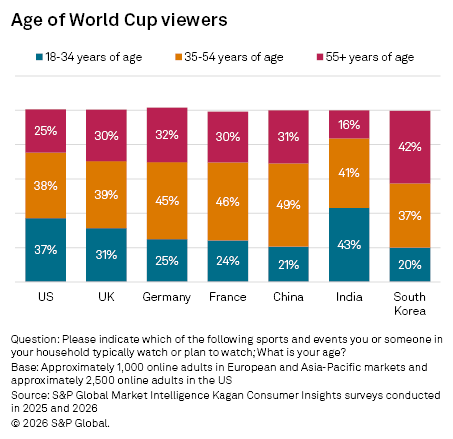
➤ Generally, respondents who watched the World Cup tended to be men ranging from 35 to 54 years of age, although the US, UK and India also saw a significant percentage of viewers among 18- to 34-year-olds.
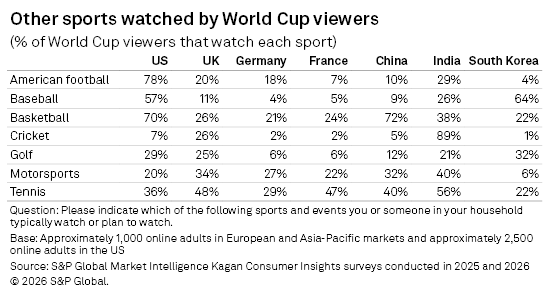
➤ World Cup fans tend to watch other sports as well, especially in the US, where soccer trails football, baseball and basketball by a wide margin. Large numbers of US World Cup viewers indicated also watching football (78%) and basketball (70%), with baseball, tennis and golf also popular options.
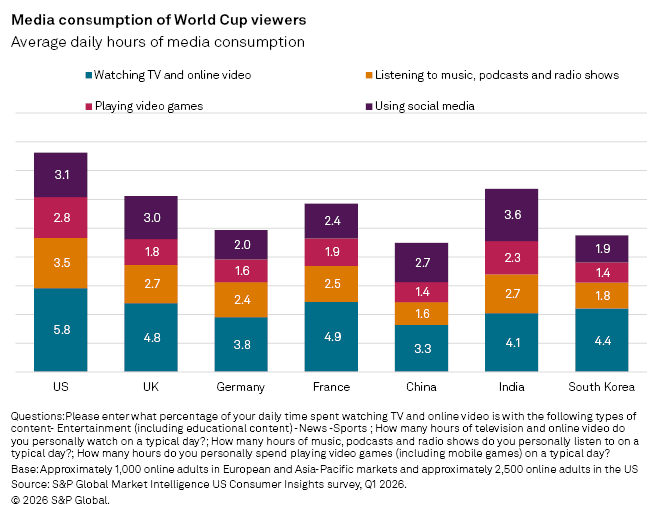
➤ US World Cup viewers led across the geographies surveyed in media consumption, averaging 5.8 hours of TV or online video per day. On average, World Cup viewers devoted about 20% to 30% of their daily hours watching TV and online video content to sports programming.

Viewing of soccer and the men’s World Cup were closely correlated across markets, with a solid majority of soccer viewers also typically tuning in to World Cup coverage. The UK topped the field, with 62% of total survey respondents watching soccer and 48% viewing the World Cup, while the US trailed other markets by a significant margin. Soccer’s popularity continues to boom in the US on the youth level but interest in watching pro soccer and World Cup still lags the big three US sports of football, basketball and baseball.
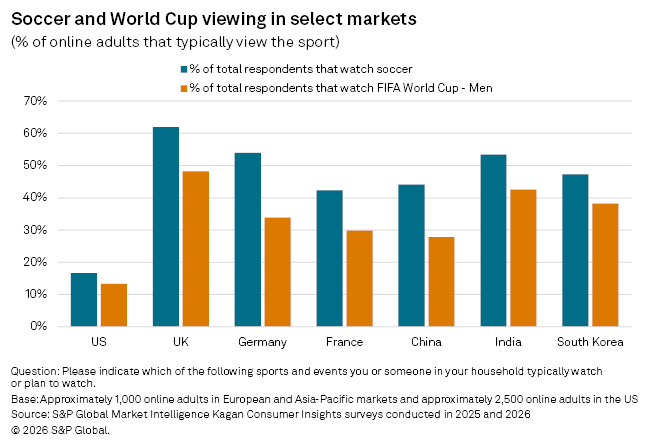
Access data discussed here in Excel.
Similar to many sports, World Cup viewer demographics skewed solidly toward men across all markets, ranging from a nearly 70%/30% men to women split in the US and China to a 57%/43% split in India. Younger viewers in most markets tend to show a more even split across male/female viewers, with the gender gap widening among older viewers.
Viewers were generally well distributed across age brackets, with World Cup viewers in India the youngest (with an average age of 39.0 years), followed by the US (42.5 years of age) and the UK (44.1 years of age); South Korea viewers were the oldest at an average of 48.6 years of age. Younger viewing audiences also unsurprisingly correlated to the likelihood of children in the house, with 61% of World Cup viewers in India reporting that that they lived in a home with kids and 50% of American World Cup viewers living in households with children.
World Cup audiences tend to tune in to a wide range of sports, with very few watching only soccer. The US, UK, and India stand out for their broader cross-sport engagement, with a significant share of World Cup viewers in these markets also consuming other major sports.
Cricket is overwhelmingly popular in India, where 89% of World Cup audiences also follow the sport. Basketball is very popular among World Cup viewers in both China and the US (watched by about 70% in each), while interest in watching baseball is most heavily concentrated in South Korea, where 64% of World Cup viewers also watch the sport. European markets have the highest percentage of overlap between World Cup viewers and tennis watchers.
For additional survey data on sports viewing, please see the following articles: Sports Report, 2026; Sports viewing in the UK; Sports viewing in Germany; Sports viewing in France; Sports viewing in China; Sports viewing in India; Sports viewing in South Korea.
World Cup viewers in the US spend the highest number of average hours per day consuming media than viewers in the other countries surveyed. US respondents reported an average of 5.8 hours per day watching TV or online video, 3.5 hours listening to music, radio, or podcasts and 2.8 hours playing video games. Social media use was the only category in which India surpassed the US, averaging 3.6 hours per day compared to 3.1 in the US. China and South Korea had the lowest total average hours of media consumption. China averaged 3.3 hours on entertainment and 1.6 for music, radio, and podcasts. Both countries averaged 1.4 hours playing video games and South Korea averaged 1.9 hours using social media.
While the average hours spent watching TV and online video varied from region to region, the overall breakout by genre (entertainment, news and sports) remained consistent, with sports viewing typically claiming roughly 20% to 30% of watch time. World Cup audiences’ TV and online viewing by genre showed minor variation between geographies with 12 percentage points separating the highest and lowest in entertainment, 11 percentage points in news and 8 percentage points between the highest and lowest in sports.
The Kagan first-quarter 2026 US Consumer Insights survey was conducted during the first quarter and included 2,517 internet adults. The margin of error is +/-1.9 ppts at the 95% confidence level. The Kagan 2025 Asia-Pacific and European Consumer Insights surveys included about 1,000 internet adults each in China, South Korea, India, the UK, France, and Germany. The margin of error is +/-3 ppts at the 95% confidence level. Survey data should only be used to identify general market characteristics and directional trends.
Consumer Insights is a regular feature from S&P Global Market Intelligence Kagan.
This article was published by S&P Global Market Intelligence and not by S&P Global Ratings, which is a separately managed division of S&P Global.
Content Type
Theme
Segment
Language