Research — June 06, 2026
Consumers in Asia-Pacific and the US fear AI-related job losses

By Keith Nissen
As the use of generative AI tools grows rapidly, the fear of AI-driven job replacement is substantial.

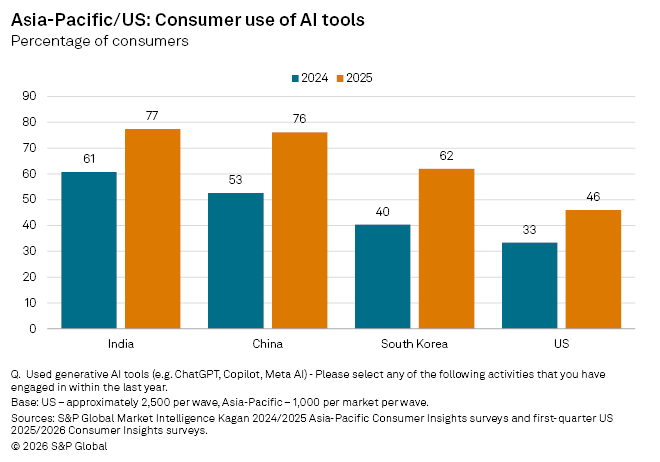
➤ Survey data shows that the majority of consumers in the Asia-Pacific use generative AI tools, like ChatGPT. The US lags behind with just under half of internet adults using AI tools.
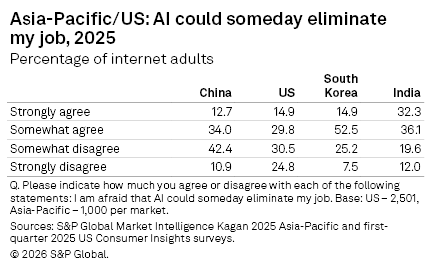
➤ Approximately half of surveyed internet adults in China and the US agree that AI might replace their jobs. In South Korea and India, two-thirds feel susceptible.
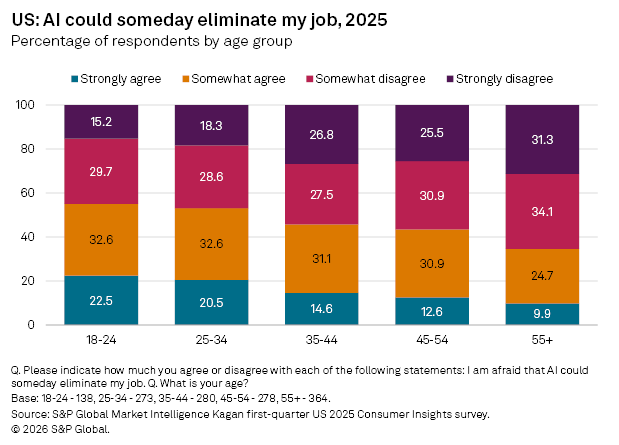
➤ In the US, young Americans under 35 years of age are the most likely to feel that AI-driven job loss is possible.
➤ Young adults in India strongly agree that AI will replace jobs. In China and South Korea, the fear of job loss due to AI is present but less intense.

Consumer adoption of AI tools continues to grow in the US and in the Asia-Pacific. Historical results from S&P Global Market Intelligence Kagan Consumer Insights surveys conducted over the past two years show that use of generative AI tools in India grew 16 percentage points year over year to 77%. The most popular generative AI applications include ChatGPT, Gemini and Meta AI. The survey data also shows that the use of generative AI tools in China and South Korea grew by 23 and 22 percentage points year over year, respectively. In South Korea, ChatGPT, Gemini and CoPilot have the most users. DeepSeek and Doubao dominate the Chinese AI market.
Consumer adoption of AI in the US lags Asia-Pacific substantially, with less than half (46%) of survey respondents reporting the use of generative AI tools. ChatGPT is the US market leader, followed by Gemini and Copilot.
The survey data suggests that consumers are developing a complicated relationship with AI technology. On one side, generative AI tools are being used to aid in everyday activities ranging from helping students with homework, making web searches more efficient and facilitating online shopping to coding software and even providing personalized advice.
On the other hand, many companies are turning to AI to replace functions that today are performed by employees. This is especially true for entry-level jobs that do not require extensive industry experience. While the extent of eventual job losses due to AI remains unclear, AI will reshape job markets, including eliminating some jobs, creating new jobs and changing workflows for others.
To assess consumer attitudes regarding the changes posed by AI in the job market, survey respondents were asked to what extent they agreed or disagreed with the statement “I am afraid that Artificial Intelligence (AI) could someday eliminate my job.” Consumer sentiment in China and the US was largely aligned, with 47% of Chinese internet adults and 45% in the US either strongly or somewhat agreeing with the statement. Over two-thirds of internet adults in South Korea (67%) and India (68%) also strongly or somewhat agreed that AI could replace their jobs. What stands out is that one-third of internet adults (32%) in India strongly agreed that their job might be in jeopardy due to AI, more than double that of South Korea, China or the US.
Even though experts predict that AI will impact white-collar jobs more than blue-collar jobs, the survey data shows that education level is not a major factor in how concerned consumers are. There is also no evidence that household income correlates with how strongly adults feel threatened by AI. Age appears to be the primary factor impacting how consumers feel about AI. For instance, 22% of Americans, ages 18–24 and 21% of those in the 25–34-year-old age group strongly agreed that AI could someday eliminate their jobs. Overall, the majority (55%) of 18–24-year-olds and 54% of 25–34-year-olds strongly or somewhat agreed that AI might someday eliminate their jobs.
While the US survey data reveals that adults under 55 are less concerned about AI job replacement than younger adults, 46% of 35–44-year-olds and 44% of 45–54-year-olds either strongly or somewhat agreed that AI might eliminate their jobs.
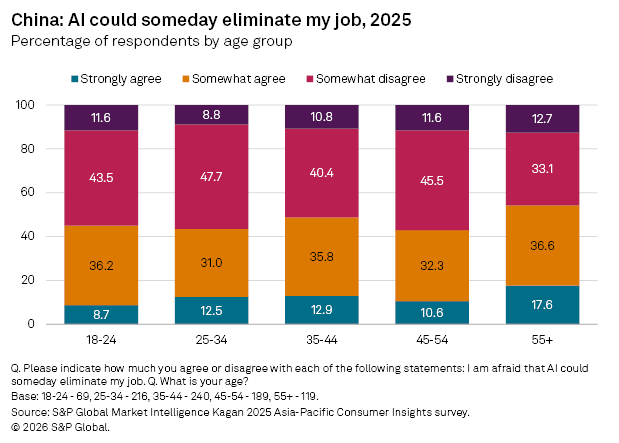
Examining the perceived possibility of AI-driven job loss in China across age groups shows that young adults under 35 feel less threatened than their American counterparts. For example, only 9% of 18–24-year-old adults and 13% of those in the 25–34 age group strongly agreed at AI might threaten their jobs. However, over one-third of respondents in all age categories said they somewhat agreed that AI could eliminate their jobs. What stands out in the data is that 55% of adults 55 years of age and older either strongly or somewhat agreed that AI might cause job losses, substantially higher than the 35% of older Americans who feel that way.
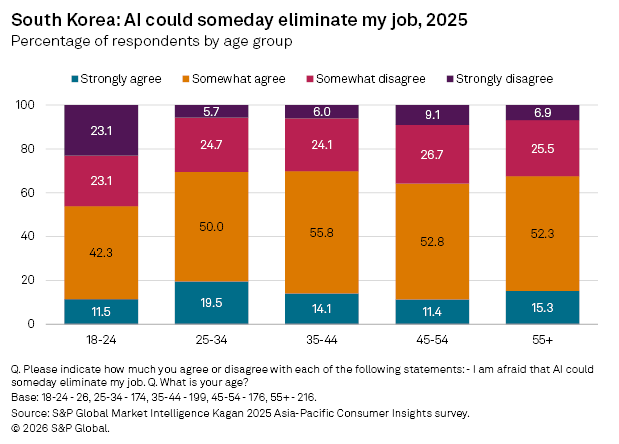
Similar to China, in South Korea a modest percentage of adults across all age groups said they strongly agreed that AI might threaten their jobs. Yet, overall, the majority of South Koreans view AI as a possible replacement to jobs. Seven out of 10 adults between the ages of 25 and 44 either strongly or somewhat agreed that AI might eliminate their jobs. Even among adults 55 and older, 67% view AI as a concern.
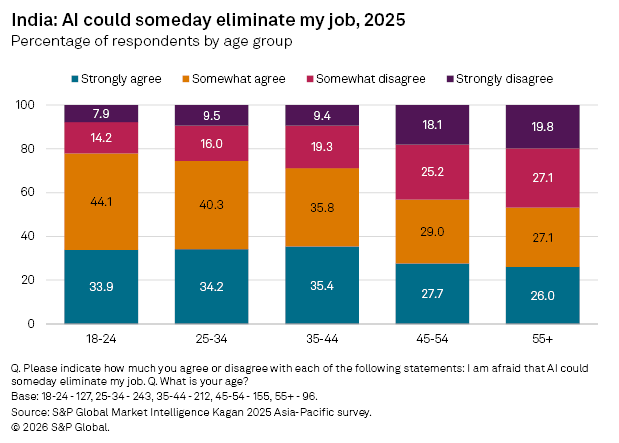
Survey data from India shows that the fear of AI job replacement is also very prevalent. Over one-third of adults between the ages of 18 and 44 strongly agreed that AI might replace their jobs, and over 70% in this age category either strongly or somewhat agreed that AI could someday displace them. Even among those aged 45 and older, over half agreed that AI could replace their jobs, with over one-quarter strongly agreeing. The concern of AI-driven job losses in India may be due to many jobs involving software coding and contact centers that have the potential to be automated using AI technology.
The Kagan first-quarter 2025 US Consumer Insights survey was conducted in March 2025, consisting of 2,500 internet adults. The margin of error is +/-1.9 ppts at the 95% confidence level. The Kagan 2025 Asia-Pacific Consumer Insights survey was conducted in June 2025, consisting of 1,000 internet adults each in China, South Kore and India. The margin of error is +/- 3 ppts at the 95% confidence level. Survey data should only be used to identify general market characteristics and directional trends.
Consumer Insights is a regular feature from S&P Global Market Intelligence Kagan.
This article was published by S&P Global Market Intelligence and not by S&P Global Ratings, which is a separately managed division of S&P Global.
Content Type
Theme
Segment
Language