Research — June 12, 2026
Consumers brings another electric rate case in Mich. of same magnitude as last

By Dan Lowrey
Consumers Energy Co. has returned to the Michigan Public Service Commission with an application to increase electric rates by $480.8 million, a little over two months after its last rate case was decided. In that case, the company sought a comparable increase, but the commission authorized an increase that was 47% of its initial request.
A prehearing is scheduled for June 30. The commission is statutorily required to act by April 2027.

➤ Consumers Energy (CE) returns with another large electric rate filing, seeking a $481 million rate increase just months after the PSC approved a $276.7 million hike focused on reliability investments. The new request includes a $455.8 million base rate increase plus a separate $25 million surcharge to recover a distribution deferral through a rider.
➤ CE requests a 10.25% return on equity, above the 9.84% average ROE authorized nationally for electric utilities in 2025, and a 6.59% overall return on a $17.02 billion rate base for a test year ending April 30, 2028. The company is currently authorized a 9.90% ROE — a level the commission has authorized for CE through several past cases dating back to 2020 — so the filing tests how far the commission is willing to move beyond past precedent.
➤ The Michigan regulatory climate is viewed as somewhat constructive but was downgraded in 2024 to average due to tighter outcomes in rate proceedings.

The company's request in Case U-22070 is premised on a 10.25% return on equity (44.62% of regulatory capital structure) and a 6.59% return on an average rate base valued at $17.02 billion for a test year ending April 30, 2028.
The requested 10.25% ROE exceeds national averages tracked by Regulatory Research Associates. An analysis conducted by RRA indicates that the average ROE authorized for all electric utilities in rate cases decided in 2025 was 9.84%, up from the 9.79% average in 2024. Of the total electric rate case decisions, 86 electric ROE authorizations were issued in 2025, compared to 90 in 2024.
The company's request includes a base increase of $455.8 million, plus a $25 million increase to be collected through a separate distribution deferral surcharge rider over 12 months.
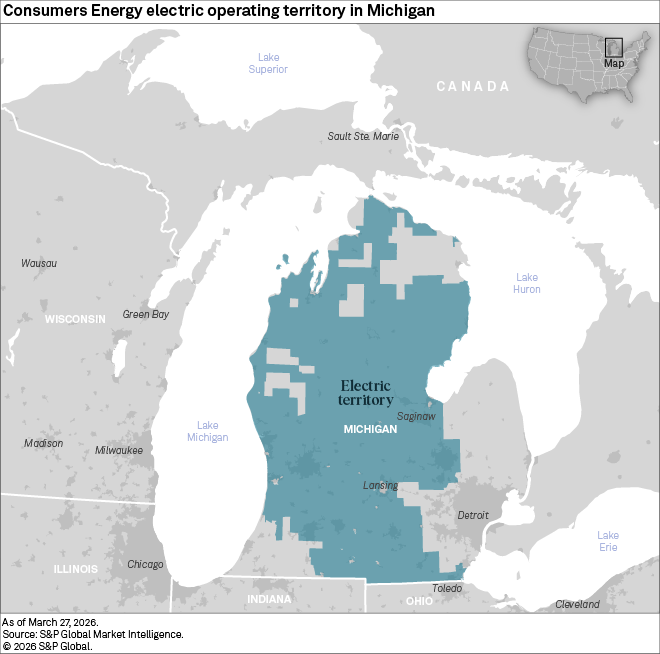
The rate request is primarily driven by investments intended to provide safe, reliable, resilient, clean, equitable and competitive energy to customers, in alignment with the company's Clean Energy Plan and Reliability Roadmap. These investments aim to improve the System Average Interruption Duration Index, excluding major event days, to the second quartile by 2029. Other factors contributing to the need for increased revenues include investments in electric generation assets, safety and legal‑compliance requirements, fleet and facilities, operating and maintenance expenses and higher financing costs to attract capital.
CE's electric rate case includes the continued recovery of the net book value of the J.H. Campbell Plant, which has been required to continue operating beyond May 31, 2025, due to US Energy Department orders. The filing does not include additional costs related to the impacts of any DOE order.
The rate request supports capital expenditures for new battery energy storage system (BESS) projects, specifically the Iosco BESS and Weadock BESS projects, as part of a program under which the company agreed to add 75 megawatts of battery capacity between 2024 and 2027. The Weadock BESS Project reflects projected total capital expenditures of $90.1 million, and the Iosco BESS Project includes projected total capital expenditures of $51.2 million. Both are scheduled for commercial operation by Dec. 21, 2026.
The application also includes recovery of associated amortization expense for the retention, decommissioning and ash‑disposal costs related to Consumers Energy’s D.E. Karn coal units 1 and 2.
CE is requesting continued approval of investment recovery mechanism (IRM) surcharges designed to recover distribution capital spending over a two‑year period beginning May 1, 2027. The primary objective of the IRM is to fund investments that enhance the reliability and resiliency of the electric distribution system and to prevent funds from being redirected away from these projects. The company proposes $314.7 million in IRM expenditures annually for each of the two years, a 39.3% increase over the previous IRM due to a new high‑voltage distribution line subprogram.
The company is also investing in wildfire risk mitigation and plans to complete 11.3 miles of undergrounding in the bridge period and to underground about 50 miles in the test year.
CE's requested rate design changes include incorporating an electric heating rate with a six‑month implementation period; adjusting the Large Economic Development Rate to include a power‑factor adjustment and updated production capacity charges; closing the General Service Unmetered Lighting Rate; and removing the credit offered to the Peak Time Rewards control group. The company also proposes to increase its residential income assistance credit to $12.00 from $8.00 per month to mitigate the impact of rate increases on vulnerable customers.
CE seeks approval of a range of deferral accounting treatments, which would allow the company to recognize certain costs as regulatory assets or liabilities for recovery or refund in future periods rather than immediately affecting current rates.
The company requests continued regulatory accounting deferrals due to the uncertain future of its 13 river hydro facilities. CE is negotiating the sale of its hydroelectric fleet, which includes 13 dams. If the sale does not materialize or receive regulatory approval, the company may reconsider decommissioning or relicensing these assets.
Other deferral requests include the Staking and Locating Program to account for volume variability; operating and maintenance expense for the SAP S4/HANA information technology project, amortized over 15 years; storm‑related costs; and expenditures for the PowerMIDrive and PowerMIFleet electric vehicle programs. CE also requests continued use of its pension/other post‑employment benefits volatility mechanism to manage expense fluctuations, and to defer Michigan income tax expense if its apportionment methodology is unsuccessful, along with recovery of Illinois state income tax expense in future cases.
CE is a CMS Energy Corp. subsidiary.
Previous rate case
On March 27, the commission authorized CE a $276.7 million increase in electric rates, primarily for reliability improvements, including accelerated tree trimming across its distribution network, in Case U-21870. The increase became effective May 1.
The rate increase was based upon a 9.90% return on equity (42.30% of regulatory capital structure) and a 6.12% return on a $15.02 billion rate base.
With a focus on reliability, the commission authorized measures in line with recommendations from a 2024 third-party audit of Michigan's two largest electric utilities. It approved $186 million for CE's line-clearing program to trim trees and vegetation around power lines, aiming to shorten the clearing cycle from 10.2 years to every five years by 2030–2031.
The commission directed the company to analyze the costs and benefits of a four‑year trimming cycle and full canopy removal in high‑risk zones for its next rate case. It also approved $30 million for the Vulnerable Communities Resiliency Plan, intended to reduce outage durations, with a requirement that the utility demonstrate reliability improvements and integration with broader distribution goals. The commission also approved additional investment in Underground Cable Rejuvenation to address degrading cables in downtown areas and reduce failure risks.
The commission granted an extra year of IRM authorization to fund electric distribution upgrades that improve reliability. The IRM allocated $226 million for programs targeting low‑voltage distribution, resiliency and system protection and required CE to verify spending on approved projects in a future review, with unspent funds subject to potential refund. The company had proposed continuation of the IRM over a two‑year period beginning May 1, 2026, aligned with the start of the test year in that case.
In authorizing the rate increase, commissioners noted that the final order balanced the need to make reliability investments across CE's distribution network with ratepayers' affordability concerns. "Reliability and affordability are not competing objectives," Commissioner Katherine Peretick said, pointing out that they are "fundamentally linked."
Mich. regulatory environment
RRA views the regulatory climate in Michigan as somewhat constructive from an investor perspective. In our last rating change for the state, on July 31, 2024, RRA reduced its ranking of Michigan regulation to Average/1 from Above Average/3.
The commission maintains several constructive practices, including a streamlined rate case process, a framework for using forecast test years to reduce regulatory lag and a framework that permits a cash return on certain construction work in progress, reducing cost recovery uncertainty. Retail competition for electric generation is in place, but limited, and attempts to raise this limit have not been successful. Electric utilities have retained their generation assets, and customers who do not select a competitive supplier receive service on a regulated, traditional cost-of-service basis. Adjustment mechanisms are in place for fuel costs for customers served under bundled service.
For more details, refer to the Michigan commission profile page.
Regulatory Research Associates is a group within S&P Global Energy.
S&P Global Energy produces content for distribution on S&P Capital IQ Pro.
For a full listing of past and pending rate cases, rate case statistics and upcoming events, visit the S&P Capital IQ Pro Energy Research Home Page.
For a complete, searchable listing of RRA's in-depth research and analysis, please go to the S&P Capital IQ Pro Energy Research Library.
This article was published by S&P Global Market Intelligence and not by S&P Global Ratings, which is a separately managed division of S&P Global.