Research — May 21, 2026
Women’s sports update 2025-26: Momentum builds, work remains
By Michael Johnson and Richard Berndes
After years of fighting for visibility and investment, women's sports have arrived. The question is no longer whether they matter — it's how fast they can scale. The emphasis is shifting from proving legitimacy to creating storylines, building rivalries, and engaging fans. Teams, leagues, broadcasters, sponsors, and athletes are working together to connect with audiences through both live events and ongoing content. Today, women's sports are highly visible, commercially strong, and a key part of the sports industry.

➤ Women's sports in the US and globally have reached a major turning point, moving beyond the fight for legitimacy to becoming vibrant, commercially successful, and culturally significant sectors.
➤ Rapid growth in attendance, media rights, sponsorship and athlete visibility is driving new investment, expansion and fan engagement across leagues like the WNBA, NWSL, PWHL and more, setting new standards for the future of sports.
➤ Innovative league structures and new initiatives like revenue sharing, expanded free agency and athlete-driven storytelling are reshaping women's sports, creating new opportunities for athletes, teams and fans.
➤ Challenges remain, including disparities in media rights, compensation and infrastructure, but the momentum and collective efforts across teams, leagues and partners signal a lasting impact and continued growth for women's sports.

As women's sports in the US experience unprecedented growth and innovation, these trends are mirrored and amplified on the international stage, with major tournaments and leagues breaking records and expanding the global footprint.
WNBA: A new economic era and cultural milestone
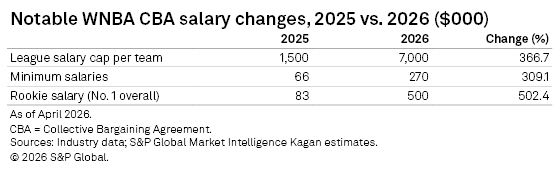
The WNBA's 2026 season represents a watershed moment, with the league's new collective bargaining agreement (CBA) ushering in unprecedented financial and structural reforms. The CBA signals institutional maturity, transforming women's basketball from a cultural asset into a financial powerhouse. Key advances include:
➤ Revenue sharing & salaries: Players now receive a 20% revenue share, with maximum individual salaries set to reach $1.4 million in 2026 and projections for greater than $2.4 million by 2032. The average salary will surpass $1 million by the end of the deal, a leap that positions the WNBA alongside global sports leagues.
➤ Player conditions: Charter air travel, expanded health and retirement benefits, increased roster sizes, and improved facilities underscore the league's commitment to athlete welfare.
➤ Season expansion and free agency: The regular season will grow to 52 games by 2029. The "EPIC" provision accelerates rookie stars' access to max contracts, and veterans enjoy unfettered free agency.
➤ Legacy recognition: Enhanced championship bonuses and payments for retired veterans reinforce respect for the league's history.
The WNBA's momentum has translated into lucrative media rights deals. The league's first 11-year, $2.2 billion media agreement ensures games are broadcast and streamed nationally, with Paramount Skydance Corp.'s CBS (US) airing a record 20 games, including every Indiana Fever game featuring Caitlin Clark. Walt Disney Co., Comcast Corp.'s NBC (US), Amazon.com Inc. and The E.W. Scripps Co. have all committed to significant coverage, totaling over 200 games and events. Local innovation is also increasing: the Minnesota Lynx's deal with A Parent Media Co. Inc.'s Victory+, a free ad-supported streaming platform, targets younger, digital-native audiences.
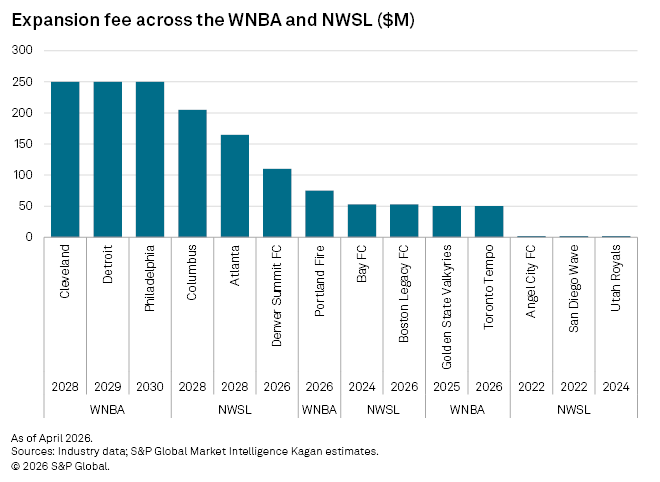
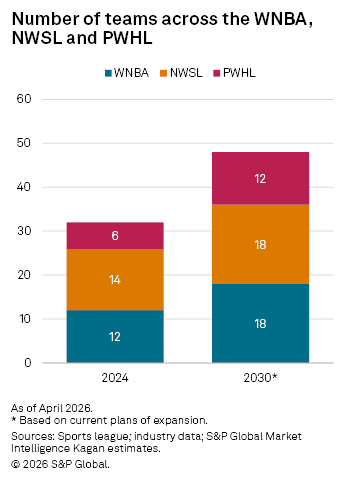
Commercial growth is evident in franchise valuations and expansion. The Connecticut Sun's $300 million sale (the highest in league history) and relocation to Houston in 2027 revives the legendary Comets brand. New teams in Toronto, Portland, Cleveland, Detroit and Philadelphia will expand the league to 18 teams by 2030.
The WNBA is now a model for the maturation of women's sports, with athletes as global brands and sponsors eager to connect with a diverse, engaged fan base. Challenges remain, but the league's trajectory is clear: setting the standard for women's sports in the US and beyond.
NWSL: Breaking records and shaping the future of women's soccer
The National Women's Soccer League (NWSL) is experiencing exponential growth. The 2025 championship game set a new TV audience record (1.2 million viewers), with postseason matches averaging 550,000 viewers and a cumulative audience of 3.36 million. The league's appeal to younger, diverse audiences is fueling expansion and investor confidence.
Attendance records have also been shattered. Denver Summit FC, one of two new expansion teams in 2026, drew over 60,000 fans to its inaugural home match at Mile High Stadium, topping the previous record of just over 40,000 set by Bay FC in 2025. Boston Legacy FC, the other expansion club, set its own record, drawing over 30,000 fans to Gillette Stadium for its debut. Both teams are tapping into a wave of interest in women's sports, targeting new demographics attracted to the values and community of women's athletics.
Expansion teams are paying record fees, and existing franchises like Angel City are valued in the nine figures. The league will reach 18 teams by 2028, with further expansion on the horizon.
The NWSL's "High Impact Player" (HIP) mechanism allows select players to earn up to $1 million above the salary cap, helping retain top talent like Trinity Rodman. The base salary cap will rise from $3.3 million in 2025 to $4.7 million by 2028, but labor disputes over compensation models persist.
Expanded deals with CBS, ESPN (US), and Victory+ are testing new fan rituals, while the Women's Sports Network partnership expands athlete-driven storytelling. Local broadcast deals and strategic scheduling (e.g., Challenge Cup during the men's World Cup) are capturing broader audiences.
Denver Summit FC's planned stadium and entertainment district ($50 million city investment) and Columbus's upgraded facilities reflect the league's commitment to infrastructure. The new Manhattan headquarters doubles the league's footprint, supporting growth.
The NWSL is attracting nontraditional sports fans, building grassroots support, and creating spaces for new audiences drawn by its values and inclusivity. The NWSL faces ongoing challenges in player compensation, calendar alignment and operational logistics during global tournaments. Yet with record-breaking expansion, viewership and sponsorship, it is poised to lead the global women's sports movement.
PWHL: Women's hockey surges into the mainstream
The Professional Women's Hockey League (PWHL) has rapidly established itself as a commercial and cultural force, achieving sell-out crowds and record-breaking attendance in the 2025-26 season — the league's third. The New York Sirens and Seattle Torrent drew just over 18,000 in attendance at Madison Square Garden (MSG), the highest-attended women's hockey game in US history. Recent high attendance figures also include 14,958 fans in Vancouver and 15,225 in Winnipeg.
Takeover Tour games in cities like Winnipeg and Vancouver are informing expansion, with the league targeting 12 teams by 2027. Vancouver's dedicated arena offers major perks for players and fans, while debates continue in Ottawa over venue sizes. The league is balancing intimacy with scalability as fan demand grows.
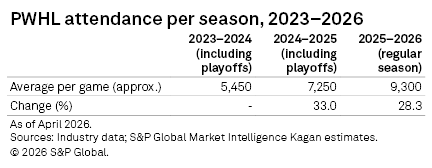
Growth metrics highlight a significant increase in attendance and a remarkable 101% surge in merchandise sales, reflecting the league's rising popularity. Post-Olympic momentum surged following Team USA's gold medal win at the Milan-Cortina Games, where 61 PWHL players competed. The gold medal game drew over 5 million viewers. PWHL media and visibility have also grown significantly, with the league's first nationally televised US game on ION marking a milestone.
The league's expansion is data-driven, weighing venue availability, youth hockey support, and economic opportunity. While partnerships with NHL franchises remain under consideration, the PWHL is prepared to operate independently. Innovative rules like the Gold Plan — which awards the No. 1 draft pick to the team that earns the most points after elimination from postseason contention — help maintain competitive balance.
The PWHL is tracking ahead of schedule, with planned losses as it invests in growth, sponsorship and media rights. This May, the league is poised for another breakthrough as its Walter Cup finals will be broadcast nationally in the US for the first time, reflecting surging interest following the USA Women's Hockey team's Olympic gold and record cumulative attendance of over one million fans for the 2025-26 regular season.
Additional leagues continue gaining steam
Beyond basketball, soccer and hockey, other women's sports in the US are seeing significant growth and momentum. Volleyball, led by League One Volleyball (LOVB), has raised substantial investment, expanded to six pro teams with more on the way, and has built a strong youth pipeline. College volleyball continues to set viewership and attendance records, attracting major sponsors and broad media coverage.
In softball, Athletes Unlimited Softball League (AUSL) is gaining traction with new investment, expanded media exposure, and improved player salaries, while the Japan Diamond League remains a top destination for elite US athletes. The college game is fueling professional growth and breaking records in name, image and likeness (NIL) rights and attendance.
Women's golf is also advancing, with the LPGA Tour offering record prize money, enhanced technology, and live broadcasts across major networks. The launch of the Women's Team Golf League (WTGL) and the expansion of global partnerships further highlight the sport's rising profile and competitiveness.
Women's European Soccer Championships
The 2025 Women's Euros was the leading women's soccer tournament of the year. The final pitted the World Champions, Spain, against the current European Champions, England, with the England Lionesses winning in a penalty shoot-out. The tournament reportedly achieved record levels of fans, viewing and revenue, as well as economic benefits for host country Switzerland.
Euro 2025 — by the numbers
➤ 657,291 fans attended in stadiums, breaking the previous record of 574, 865 set in England during the 2022 tournament
➤ 35% of ticket holders were international visitors, and 9 of 31 matches sold out
➤ Average attendance per match for the Women's Euros surpassed 20,000 for the first time
➤ 412 million worldwide audience watching live TV coverage, with a cumulative audience of over 500 million across all programming
➤ Hosts Switzerland enjoyed a CHF 205 million (€220 million) boost in economic activity
➤ 21 tournament sponsorship brands, driving a 150% increase in sponsorship revenue compared to 2022
➤ Brands included Adidas, Amazon, Carlsberg, Walkers, Lidl, Vodafone, Euronics, AXA, booking.com, EA, Grifols, Hublot, Just Eat, Lays. PlayStation, Unilever, Visa, Volkswagen
Women's Rugby World Cup
The tenth playing of the women's rugby world cup finals took place in England between August and September, with the host nation taking the title for the second time. The final, played at Twickenham Stadium, was watched by a crowd of 81,885 — a record for a women's match.
The final was shown by the British Broadcasting Corp. and watched by a TV audience of 5.8 million, another women's game record. The sport's governing body, Rugby Football Union (RFU), also reported 147 million viewing hours globally across the tournament, up 336% compared to the 2021 tournament.
Rugby World Cup — by the numbers
➤ £294.7 million positive economic impact
➤ 444,465 tickets sold
➤ 1 billion impressions on owned tournament platforms
➤ 850 million video views, with 270 million views from player accounts
➤ The second-most socially engaged Rugby World Cup and the most engaged Women's Rugby World Cup in history
➤ A 330% increase in sponsorship revenue, with brands including Mastercard, Capgemini, Gallagher, Dry Asahi, Landrover Defender, Mitsubishi, HSBC, O2, Emirates and Child Fund Rugby
Cricket World Cup
The World Cup is regarded as the most prestigious competition in women's cricket and is played every four years. The 2025 event was held in India and Sri Lanka, and the host, India, was the winner, defeating South Africa in the final. Cricket's governing body, the International Cricket Council (ICC), reported it as "the most digitally engaged women's cricket event in history," with 279 million social media interactions, more than triple the previous figure of 84 million.
Cricket World Cup — by the numbers
➤ The tournament generated 5.2 billion video views, up from 1.5 billion from the 2024 ICC Women's T20 World Cup
➤ The ICC website and app drew in 8.5 million unique visitors, up from 3 million that came from the 2024 ICC Women's T20 World Cup
➤ Sponsors included Google, the State Bank of India, Unilever and the International Gemological Institute
2026 Sports – more progress made
Winter Olympics
This year's Winter Games saw the number of female athletes participating increase once again. During the 2022 Beijing Games, 44.7% of athletes were women, rising to 47% in 2026. 50 of the 116 events will be women's events, the most ever, and there were four new events for women to compete in, including freestyle skiing dual moguls, luge doubles, ski jumping large individual hill, and ski mountaineering sprint. Women and men competed over the same distance in all the cross-country skiing events for the very first time.
AFC Women's Asian Cup
This was the 21st running of the leading women's soccer competition for the APAC region. It was held in Australia, and the host nation was one of the favorites alongside Japan. Both teams reached the final, where Japan won 1-0, bringing Japan's tournament total to three out of four victories. There were some reports of poor ticket sales during the early stages of the tournament, but ticket sales and TV audiences grew toward the latter stages of the tournament, including a crowd of 17,367 watching Japan's semifinal win over South Korea, setting a record for the highest attendance at a Women's Asian Cup game between two non-host-nation teams.
Women's Champions League
Europe's leading soccer club competition, the UEFA Champions League, continues to grow in attendance and associated media value. The league has media rights agreements with Disney, the BBC and the EBU, among others.
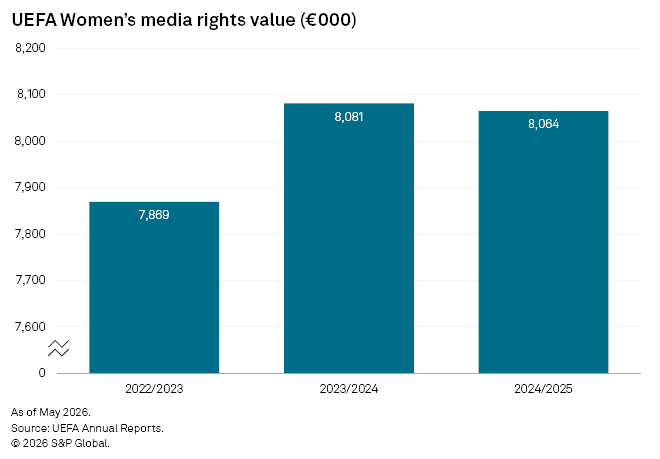
In 2007, the competition was called the UEFA Women's Cup before being rebranded as the Women's Champions League for the 2009-10 season. In 2007, just over 6,000 attended the final; for the 2024/25 final 40,00 fans were in attendance.
Future Events
Later this year, women's sports will see more major events, including the FIBA Women's Basketball World Cup 2026, which takes place in September, and the Women's T20 Cricket World Cup, from June to July. Sky, the tournament's UK-based pay TV broadcaster, has recently committed to trying to widen the scope of the T20 by offering a range of games, including the final free-to-air.
In 2027, the biggest women's sports tournament will be the tenth Women's Soccer World Cup, to be held in Brazil. The US has won four titles — the tournament's top ranking. The event's media rights distribution has changed significantly, with Netflix acquiring exclusive US and Canadian rights to the 2027 and 2031 Women's World Cups — another example of streamers moving into live sports rights.
Challenges to meet in the future
Women's sports have developed extensively in the last five years and grown in appeal and value. However, until recently, the media rights for women's sports were given away as part of the deal for the men's version of the same tournament.
Despite major women's tournaments attracting substantial audiences, broadcasters have often submitted low bids for events they believe will be accepted by sports bodies that need exposure. The bidding for the 2023 Women's World Cup was an example of this, with bids from many leading European nations rejected by FIFA.
The WSL
Arsenal Women are among the leading teams in the Women's Super League (WSL), winning the Champions League during the 2024/25 season and finishing runners-up in the WSL. The team's accounts for the financial year ending May 2025 show a turnover of £21.5 million, up from £15.2 million in the previous year. But the accounts also show that the women's team is "reliant on the backing of Arsenal Football Club Limited, which contributes a support fee to supplement the Company's own reserves." At a reported £11.9 million, this demonstrates the challenges even the biggest teams in women's sport must surmount.
It's not just finances that need examination: despite the success of the WSL and the England Lionesses, attendance at WSL matches is dwarfed by the Premier League. Arsenal is the most successful and watched women's team — regularly selling out the Emirates Stadium and reporting an average attendance of 36,450 up to game week 12, according to verta.uk — but the men's team sells more than 60,000 tickets for every game. Looking at the wider picture across all WSL teams, the BBC reported that the average attendance for the 2023-24 season was 7,366, dropping to 6,662 in the 2024-25 season. While not all women's teams play in men's stadiums, audiences have declined.
Despite this, hopes for WSL growth continue, with the league expanding to 14 teams for the 2026-27 season. Chelsea and Arsenal still lead the way in revenue growth, with growth for Barcelona and Bayern Munich also significant.
The wider women's sport market
Market forecasts indicate continued growth for top women's sports, with media rights still trailing men's levels but revenue surging through sponsorships, partnerships and merchandising. This momentum is driven by compelling storytelling, powerful athlete brands, and highly engaged fans who demonstrate loyalty to supporting brands. Recent highlights such as the Milan-Cortina Olympics showcase the growing influence of women's sports across soccer, basketball, volleyball and more. The focus has shifted from proving legitimacy to scaling, investing, and ensuring lasting impact, powered by the stories, stars and rivalries that captivate audiences and propel the movement forward.
Economics of Networks is a regular feature from S&P Global Market Intelligence Kagan.
This article was published by S&P Global Market Intelligence and not by S&P Global Ratings, which is a separately managed division of S&P Global.
Economics of Networks is a regular feature from S&P Global Market Intelligence Kagan.
This article was published by S&P Global Market Intelligence and not by S&P Global Ratings, which is a separately managed division of S&P Global.
Content Type
Segment
Language