Research — May 28, 2026
Regulatory hurdles await massive NextEra, Dominion Energy merger
By Dan Lowrey and Monica Hlinka
The Virginia State Corporation Commission, the North Carolina Utilities Commission and the Public Service Comm. of South Carolina will get to weigh in on plans by NextEra Energy Inc. and Dominion Energy Inc. to merge and form the world's largest regulated electric utility business by market capitalization.
The combined company will be more than 80% regulated, serve about 10 million utility customer accounts across Florida, Virginia, North Carolina and South Carolina and own 110 gigawatts of generation across a broad mix of energy sources. The companies plan to maintain dual headquarters in Florida and Virginia, with operational headquarters in South Carolina.

➤ The proposed merger of NextEra Energy and Dominion Energy will require review by multiple state commissions, including the Virginia State Corporation Commission, the North Carolina Utilities Commission, and the Public Service Commission of South Carolina. The utilities will continue to be regulated by their respective state commissions if the merger closes.
➤ The companies appear to be front-loading customer, employment and community commitments in anticipation of detailed scrutiny from state regulators, particularly in jurisdictions where commissions have historically focused on customer protections, rate impacts and demonstrable public benefit.
➤ The proposed merger is occurring against a broader backdrop of an unprecedented surge in power demand from AI data centers, the need to modernize aging grid infrastructure, and a strategic shift toward dispatchable natural gas and renewable energy platforms.
➤ Regulatory standards vary by jurisdiction. North Carolina emphasizes "public convenience and necessity," with benefits needing to at least match costs; South Carolina considers rate and service impacts; Virginia requires applicants to demonstrate that the transaction will not impair or jeopardize the provision of adequate service to the public at just and reasonable rates; Florida has limited statutory authority to review mergers directly but oversees territorial agreements.

Transaction overview
On May 18, the companies announced the deal for NextEra to acquire Dominion in an all-stock deal that will create the world's largest regulated electric utility.
Under the terms of the merger agreement, each share of Dominion Energy common stock will be converted into the right to receive 0.8138 share of NextEra Energy common stock, plus a pro rata share of $360 million in cash, distributed equally across all outstanding Dominion Energy shares. NextEra Energy shareholders will own approximately 74.5% of the combined company, while Dominion Energy shareholders will own about 25.5%.
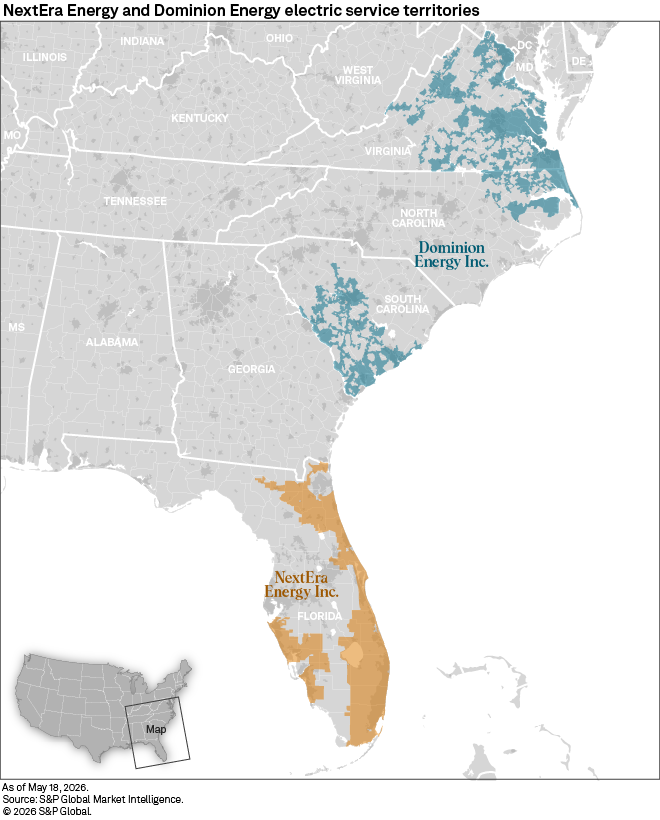
NextEra operates in Florida through its Florida Power & Light Co. (FP&L) utility. Dominion operates in Virginia through its Virginia Electric and Power Co. (VEPCO) unit, in North Carolina through its VEPCO unit doing business as Dominion Energy North Carolina and in South Carolina through its Dominion Energy South Carolina Inc. unit. The utilities will continue to be regulated by the respective state commission if the transaction closes.
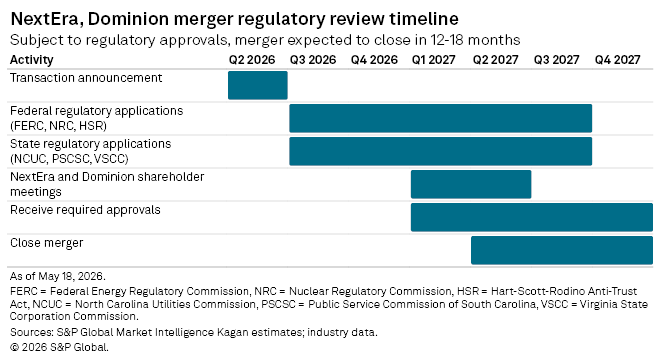
The companies hope to secure shareholder approvals by early 2027. They anticipate receiving state and federal regulatory approvals and the merger closing by the fourth quarter of 2027.
The proposed transaction includes $2.25 billion in bill credits spread out over a two-year period for Dominion's customers in Virginia, North Carolina and South Carolina. The bill credits are allocated approximately as follows: 79% to Virginia customers, 17% to South Carolina customers and 3% to North Carolina customers.
The companies have also pledged to maintain dual headquarters in Florida and Virginia and operational headquarters in South Carolina, while providing robust employee protections and enhanced charitable giving, including a $10 million increase annually for five years. In addition, they will continue the commitment to low-income customer assistance across Virginia, North Carolina and South Carolina. The companies also commit to maintaining local operations, employment protections and the continued use of the Dominion Energy name in their respective states. Regulatory Research Associates anticipates that these commitments will be further discussed in filings for regulatory approvals.
Below, RRA reviews the merger review standards in Florida, North Carolina, South Carolina and Virginia.
Merger review standards
Florida
The Florida Public Service Commission is not statutorily authorized to directly review proposed mergers and acquisitions of regulated utilities. However, the PSC does have statutory authority over territorial agreements.
In 2018, the PSC voted to terminate a territorial agreement, providing for the acquisition of the Vero Beach municipal utility by FP&L for $185 million. The decision was the culmination of many years of effort by Vero Beach to sell its utility.
North Carolina
In approving a merger or combination affecting a public utility, the North Carolina Utilities Commission (NCUC) must determine whether a proposed merger is justified by "the public convenience and necessity," which the commission has interpreted to mean that a determination that rates and service will not be adversely affected by the transaction.
In addition, the NCUC has concluded that for the public convenience and necessity standard to be met, expected benefits must be at least equal to known and expected costs so that customers are not negatively affected. Other factors to be considered by the NCUC include maintenance of or improvement in service quality, the extent to which costs can be reduced and rates maintained or reduced and the continuation of effective state regulation.
Under the law, a public utility is defined "to include all persons affiliated through stock ownership with a public utility doing business in this state as parent corporation or subsidiary corporation to the extent the commission finds that such affiliation has an effect on the rates or service of such public utility."
The most recent merger approved by the NCUC occurred by order issued May 1, 2026. Duke Energy Corp. received approval from the NCUC to merge its two Carolina-based subsidiaries, Duke Energy Carolinas LLC (DEC) and Duke Energy Progress LLC (DEP). This approval follows a similar decision in South Carolina and paves the way for a single, more efficiently operated utility serving both states. The core of the approval centered on ensuring customer savings and protecting consumers from the costs of the merger. Specifically, the approved settlement quantified the total financial impact to North Carolina retail customers at $286 million. The $286 million impact consisted of the up-front costs to facilitate the merger ($136 million for North Carolina ratepayers' share) and a contribution to ensure fairness and unified approval across both states, with a contribution of $150 million from North Carolina ratepayers to those in South Carolina to ensure the merger is beneficial to all parties.
On Sept. 5, 2022, Dominion announced it was selling three natural gas utilities, including Public Service Co. of North Carolina Inc. (PSNC), to Enbridge Inc. The announcement followed a strategic business review Dominion launched in November 2022. On Nov. 20, 2023, the NCUC approved a corporate reorganization of PSNC, resulting in PSNC becoming a wholly owned direct subsidiary of a new holding company, Fall North Carolina Holdco LLC (NC Holdco). PSNC previously was a wholly owned direct operating subsidiary of SCANA Corp., which Dominion formally acquired Jan. 1, 2019. The reorganization was necessary to complete the sale of PSNC to Enbridge. PSNC argued that the proposed reorganization would be in the public interest, as it would have no adverse effect on PSNC's customers, the commission's ability to exercise its jurisdiction, or PSNC's service and rates. The sale of PSNC to Enbridge closed Oct. 1, 2024.
Several years earlier, the NCUC approved the sale to Dominion of SCANA Corp., parent of then-South Carolina Electric & Gas. That deal was completed in 2019. The commission required bill credits, a two-year base rate case filing moratorium and certain other conditions to be met.
In 2016, the NCUC adopted a settlement approving Duke's acquisition of Piedmont Natural Gas Co. Inc. Bill credits were among the conditions the commission imposed on the companies in its review of that transaction.
RRA accords North Carolina energy utility regulation an Above Average/3 ranking.
South Carolina
Mergers involving utilities operating in South Carolina have historically been addressed by the PSC. State law does not specify PSC approval of corporate holding entity mergers and acquisitions. However, in filings initiated by utilities, the commission has sought to ensure that South Carolina retail customers are protected from any adverse effects of a proposed transaction. The PSC has considered factors such as whether the proposed transaction would have any adverse effect on the utility's rates; whether the utility's cost of service and jurisdictional revenues or expenses would be adversely affected by the transaction; and whether the transaction would result in any benefits to South Carolina customers.
In 2018, Dominion agreed to acquire SCANA Corp., parent of South Carolina Electric and Gas Co. (SCE&G) in an all-stock transaction. The deal closed in January 2019 following conditional approval by the South Carolina PSC. After closing, SCE&G, now a Dominion subsidiary, was renamed Dominion Energy South Carolina.
In South Carolina, the acquisition was closely tied to the ratemaking treatment for SCANA's abandoned V.C. Summer nuclear project, units 2 and 3. As a condition of PSC approval, Dominion accepted a freeze in SCE&G's base rates until Jan. 1, 2021, and a freeze in base rates for affiliate PSNC until at least Nov. 1, 2021. Dominion also agreed to provide customer refunds in the form of monthly bill credits totaling more than $2 billion, amortized over 20 years, and to absorb about $2.5 billion in financing obligations, regulatory assets and a natural gas-fired power station.
The remaining regulatory asset associated with the Summer project, about $2.8 billion, is recoverable over a 20-year period, including a return on investment. A related rider took effect in February 2019. Other conditions included Dominion committing to increase SCANA's historical corporate charitable contributions by $1 million per year for five years; maintaining SCE&G's headquarters in Cayce, South Carolina, PSNC's in Gastonia, North Carolina; and seeking to minimize reductions in local employment by allowing some Dominion Energy Services employees who support shared and common services to be located in Cayce when it was economically and operationally practical to do so.
Most recently, the commission approved the merger of Duke's DEC and DEP utility subsidiaries on April 30, 2026. Primary terms of the approved settlement agreement center on unlocking significant customer savings, estimated at over $1 billion by 2038 and potentially $2.3 billion by 2040, through the elimination of separate grid and generation resource planning. As a key provision of the agreement, Duke has also committed to a 14-year period of tracking and annually reporting the realized merger-related savings, ensuring transparency and accountability.
RRA accords South Carolina energy utility regulation an Average/2 ranking.
Virginia
Under Virginia's utility code, any entity seeking to acquire control of a public utility or its assets must first obtain approval from the Virginia State Corporation Commission (SCC), in which a change of control is defined as acquiring 25% or more of a utility's voting stock or exercising substantial influence over its policies and operations. Similarly, the state's utility code provides that utilities themselves cannot buy or sell utility assets or securities within Virginia without commission authorization.
To secure approval of a proposed merger involving a utility operating in the state, the merging entities must demonstrate that the transaction will not impair or jeopardize the provision of adequate service to the public at just and reasonable rates. The commission has the authority to impose conditions on any transaction to ensure these standards are met. Historically, the SCC has been amenable to proposed mergers and has not imposed onerous conditions.
The commission must rule on a proposed merger within 60 days from the filing date, although the SCC may extend that period by up to 120 additional days for a maximum review period of 180 days. The application is deemed approved if the SCC fails to act within the 60 days or any extended period ordered by the commission.
The most recent major energy merger approved by the commission involved Alta Gas Ltd.'s proposed acquisition of WGL Holdings Inc., parent of Washington Gas Light Co. In 2017, the SCC conditionally approved the proposed transaction, subject to various accounting, financial and safety conditions offered by the companies. Notably, the commission's order did not include a requirement that Washington Gas Light customers receive up-front rate credits. The merger closed in July 2018.
Regarding an electric-specific merger, the most recent acquisition approved by the SCC occurred in 2014, when the commission approved Exelon Corp.'s acquisition of Pepco Holdings (PHI), subject to certain conditions, including merger-related reporting requirements. While PHI indicated that it had divested its distribution operations in the state several years prior, its subsidiaries — Delmarva Power & Light and Potomac Electric Power Co. — continued to own certain transmission assets in Virginia. The SCC required the companies to maintain a "high degree of cooperation" with the staff, stating the companies "shall take all actions necessary to ensure timely response[s] to Staff inquiries with regard to any Virginia facilities or regulatory matters." The merger was officially completed in 2016.
Prior to the Exelon/PHI merger, in 2013, the commission approved American Electric Power Co. subsidiary Appalachian Power Co.'s (APCO's) proposal to merge into a single entity with affiliate Wheeling Power Co., subject to the implementation of a company-proposed $3.3 million annual rate credit to Virginia ratepayers.
The SCC also approved APCO's request to acquire the remaining 66% of the 1,300-megawatt Unit 3 of the 2,900-MW John E. Amos coal-fired generating facility from affiliate Ohio Power. APCO had already owned the rest of the Amos station's three units. However, the commission denied APCO's request to acquire from Ohio Power a 50% ownership share of the two-unit, 1,560-MW Mitchell coal-fired generating facility. Ultimately, APCO elected not to pursue the authorized merger with Wheeling Power, which remains a separate subsidiary of American Electric Power.
RRA views the energy regulatory climate in Virginia as somewhat more constructive than average for investors and accords the jurisdiction an Average/1 ranking.
Federal approvals needed
In addition to the previously mentioned approvals, the transaction is subject to the expiration or termination of the waiting period under the Hart-Scott-Rodino Antitrust Improvements Act, approval by the Federal Energy Regulatory Commission under Section 203 of the Federal Power Act and approval by the Nuclear Regulatory Commission.
Federal law grants FERC authority over mergers involving electric utilities and utility holding companies, and FERC must determine whether a proposed transaction would be "consistent with the public interest." FERC determines whether a merger is in the public interest by analyzing the transaction's effect on competition, rates and regulation.
Regulatory Research Associates is a group within S&P Global Energy.
S&P Global Energy produces content for distribution on S&P Capital IQ Pro.
For a complete, searchable listing of RRA's in-depth research and analysis, visit the S&P Capital IQ Pro Energy Research Library.
For a full listing of past and pending rate cases, rate case statistics and upcoming events, visit the S&P Capital IQ Pro Energy Research Home Page.
This article was published by S&P Global Market Intelligence and not by S&P Global Ratings, which is a separately managed division of S&P Global.