Research — May 25, 2026
Icotyde forecast to reach $1.6B by 2028 as J&J builds psoriasis franchise
By Disha Rajawat
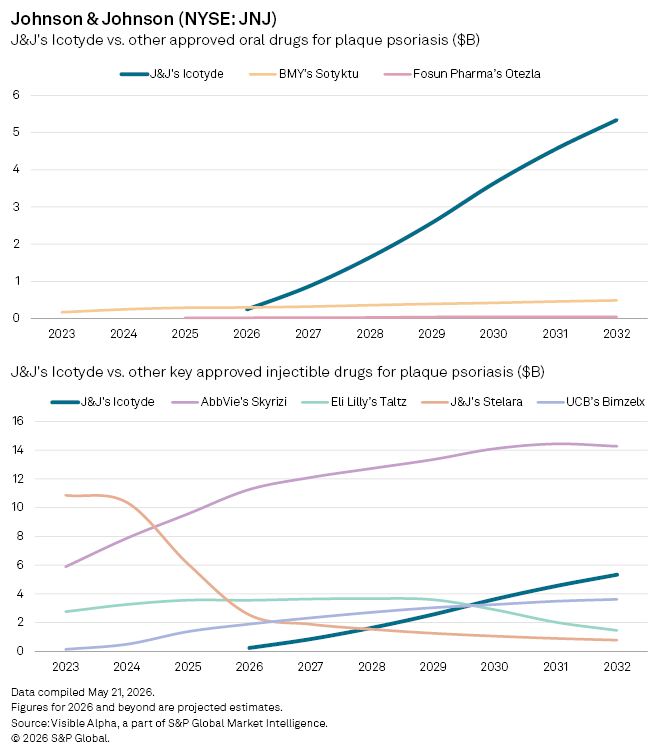
Johnson & Johnson (NYSE: JNJ) has secured a timely addition to its immunology portfolio with the recent U.S. Food and Drug Administration approval of Icotyde (icotrokinra), a once-daily oral therapy for moderate-to-severe plaque psoriasis in adults and paediatric patients. The drug is the first targeted oral peptide designed to block the IL-23 receptor, a mechanism long validated by injectable biologics, but until now largely absent in pill form.
The approval comes as J&J prepares for the loss of exclusivity on Stelara, one of its top-selling therapies. Icotyde is positioned as a successor asset, offering biologic-like efficacy with the convenience of an oral treatment. Visible Alpha consensus estimates suggest Icotyde could generate about $243 million in psoriasis sales in 2026, rising rapidly to more than $1 billion and reaching roughly $1.6 billion by 2028.
Icotyde competes in the market with other oral and injectable treatments for plaque psoriasis. In the oral category, Bristol-Myers Squibb Co.’s (NYSE: BMY) Sotyktu, approved in 2022, is expected to generate about $299 million in 2026 psoriasis sales. Meanwhile, Shanghai Fosun Pharmaceutical’s (HKEX: 2196) Otezla, approved in 2014, is poised for $20 million in sales.
In injectables, which is still the dominant class for moderate-to-severe disease cases, Icotyde faces competition from entrenched biologics including AbbVie Inc.'s (NYSE: ABBV) Skyrizi, Eli Lilly’s (NYSE: LLY) Taltz, J&J’s own Stelara and Tremfya, and UCB SA’s (EBR: UCB) Bimzelx. These therapies have a high efficacy bar, but require injections; a factor Icotyde aims to exploit.
This article was published by Visible Alpha, part of S&P Global Market Intelligence and not by S&P Global Ratings, which is a separately managed division of S&P Global.
Content Type
Products & Offerings
Segment
