Research — April 30, 2026
US solar fleet takes in ample sunshine; winds near 20-year average in Q1

By Adam Wilson
The US basked in excess sunshine in the March quarter of 2026, with solar insolation levels exceeding the 20-year average by 5.8%. Average wind speeds for the quarter were near normal, with a negative deviation from the norm of just 0.2%. This is despite a breezy March, as countrywide winds were 6% above average. North of the US border, a cloudy March led to quarterly radiation levels 2.7% below normal in Canada, while winds were 2.2% higher than the 20-year average.
The Southern and central US regions, from Texas and Louisiana up through Missouri and Illinois, experienced radiation surpluses ranging from 11% to 13% above normal in the March quarter. Seven states experienced double-digit positive deviations from the 20-year average, with the installed photovoltaic capacity of these states surpassing 48 gigawatts.
Just six of the 49 states with operating grid-scale solar capacity in the US experienced below normal insolation from January to March. Within the contiguous US, the largest negative quarterly deficit was 3.9% in New York — home to the largest solar fleet — that had below average sunshine in the first quarter at 3.4 GW. March was especially cloudy in New York, with a deviation of 11.4% below the norm.
|
Download data details in Excel
|

Conditions for wind generation in the US were less optimal, though still close to average across the country, with 22 of the 44 states reporting operating grid-scale wind capacity experiencing above-average wind speeds in the first quarter of 2026. Wyoming and Montana — with a combined 7 GW of wind capacity — had the largest positive departure from the norm with March-quarter winds 8.5% and 7.3% higher than normal, respectively.
Conversely, the Western US took in sub-par breezes from January through March. Arizona, California, Oregon and Washington all experienced quarterly deviations 10.2%-11.8% lower than the 20-year average. Oregon and Washington maintained double-digit negative deviations from the norm in the first quarter, despite a breezy March with average winds between 14% and 15% higher than normal.
In Canada, the majority of solar capacity is located within two provinces, Alberta and Ontario, with 2.0 GW and 1.8 GW, respectively. Both experienced radiation shortfalls in the March quarter, but Ontario had the largest deficit at 5.3% below the 20-year average, while Alberta was just slightly below normal (-0.4%).
Wind projects fared better in Canada in the first quarter of 2026, with the top two wind generating provinces, Ontario and Alberta, both experiencing above average winds between January and March. Quebec's 4.1 GW of wind power were not as fortunate, however, with winds 3.6% below the 20-year average in the first quarter. British Columbia, on the other hand, was exceptionally breezy during the quarter, with wind speeds 11.5% higher than normal but across a comparatively small 743-megawatt portfolio.
At the project level, multiple Texas projects experienced March-quarter insolation 20% higher than the 20-year average. The Nebula Solar Project (Rayos Del Sol) and Vancourt Solar Project (Rayos Del Sol), owned by Shell PLC, led all US projects with first-quarter radiation 20.9% higher than normal.
The 265.4-MW Ocotillo Wind Energy Facility (Ocotillo Express), owned by Pattern Energy Group LLC, stood out among wind projects with winds 20.5% below average in the first quarter. In terms of positive deviations, the 248-MW Beaver Creek Wind Project in Montana took in winds 16.7% higher than normal from January through March. Additionally the 136-MW Summerview & Wind Charger Project was the most abnormally windy project on the continent at 16.9% above the norm.
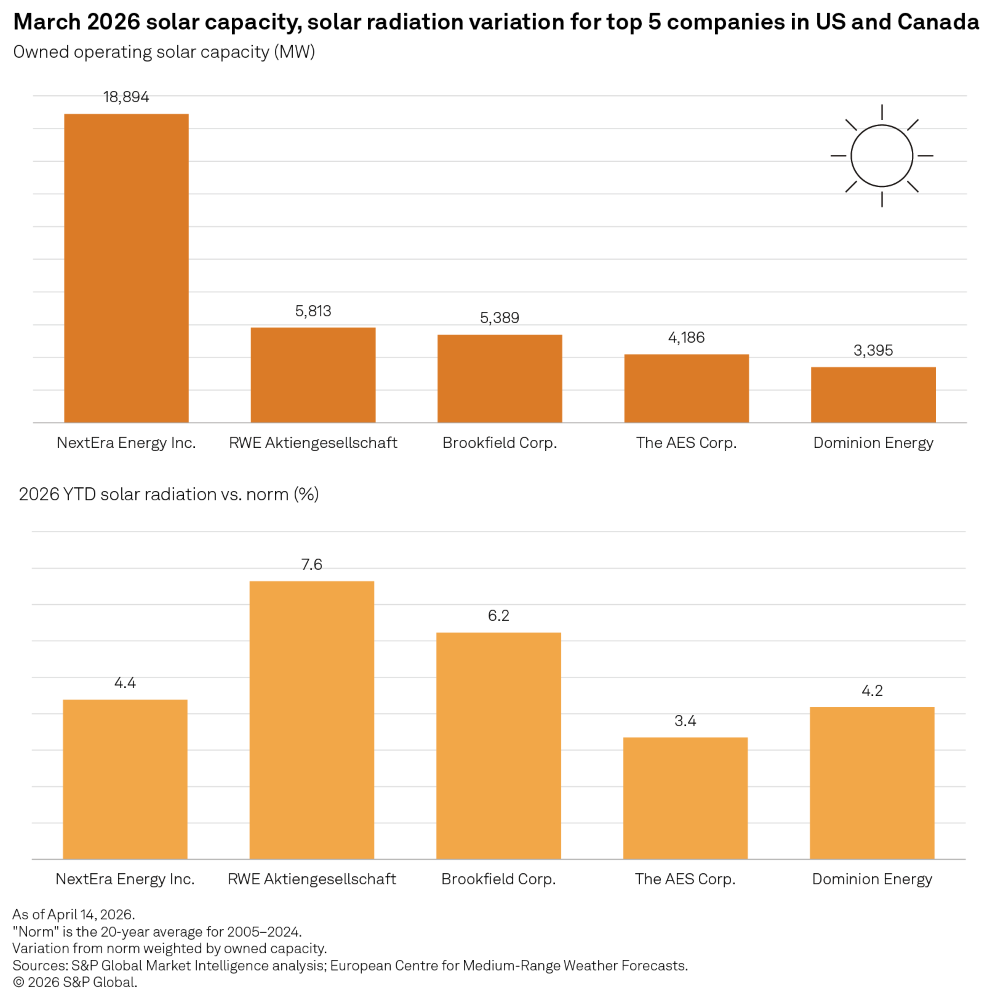
NextEra Energy Inc. led the US and Canada in solar power at 18.9 GW operating across more than 30 states. This sprawling solar fleet took in excess sunshine in the March quarter at 4.4% higher than normal. In fact, every one of the top 40 solar owners in the US and Canada had abundant radiation across their solar portfolios from January through March.
Among top 10 owners, Enel SpA's 2.7-GW solar fleet experienced insolation 12.7% higher than the 20-year average. Roughly three-quarters of their solar projects had double-digit positive deviations from the norm during the quarter, all in Texas. Axium Infrastructure Inc. owns the largest solar portfolio with a negative first-quarter deviation from the norm, but at just 1.6% below average across 895 MW, the systemwide impact is minimal.
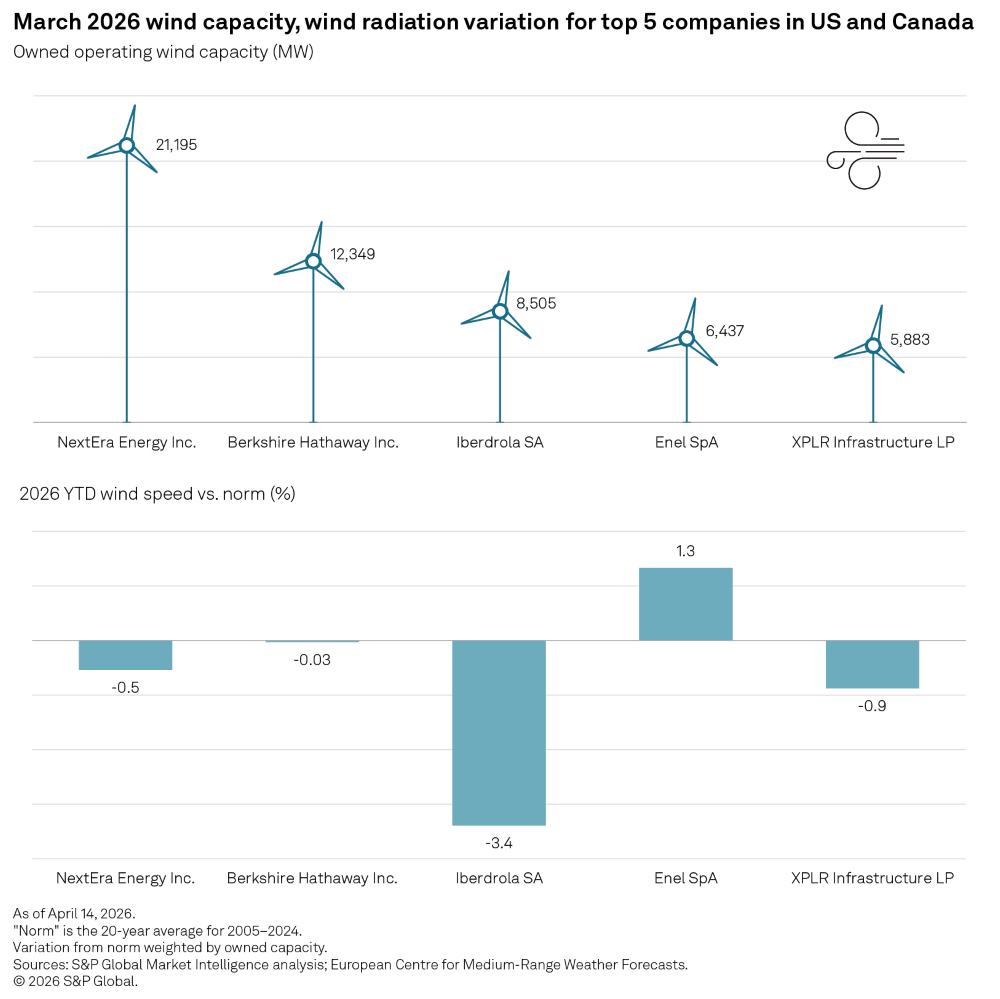
Wind was more diversified in terms of average winds in the March quarter. NextEra led the US in wind generation at 21.2 GW, with slightly sub-par winds at 0.5% below the 20-year average. Second place owner Berkshire Hathaway Inc.'s wind fleet experienced normal winds. In the first quarter, 12 of the top 20 wind owners in the US and Canada had above average winds, though deviations were minor at 1-3% above normal. TransAlta Corp.'s 2.6-GW wind portfolio had the highest positive deviation at 5.1%.
Iberdrola SA had the largest negative deviation across its wind portfolio, with measured winds being 3.4% below average in the first quarter. The company's wind assets in the West largely drove the quarter's underperformance. The 143-MW Tule Wind Project (Reduced Ridgeline) in California and the 63-MW Dry Lake wind project in Arizona experienced the most sluggish breezes from January to March at more than 15% below average.
Solar radiation is the mean surface downward shortwave radiation flux, measured from the fifth-generation European Centre for Medium-Range Weather Forecasts reanalysis. This variable includes direct and diffuse solar radiation and is the model equivalent of global horizontal irradiance — the value measured by a pyranometer, a solar radiation measuring instrument. Wind speed is the value 100 meters above the ground from the same dataset. The data is available at quarter-degree latitudes and longitudes, with a spacing of slightly over 27.5 km. This analysis compares the March 2026 values with the 20-year average (2004–2023) for March, as well as the 20-year average for January through March, which covers the first quarter of the year.
Data visualizations by Jonathan Paul Lalgee and Chrisallen Villanueva.
For wholesale prices and supply and demand projections, see the S&P Global Market Indicative Power Forecast.
Regulatory Research Associates is a group within S&P Global Energy.
S&P Global Energy produces content for distribution on S&P Capital IQ Pro.
Kristin Larson contributed to this article.
This article was published by S&P Global Market Intelligence and not by S&P Global Ratings, which is a separately managed division of S&P Global.