Research — April 16, 2026
US coal rides wave of soaring global gas prices

By Steve Piper
The war in the Middle East and related disruptions to Qatari LNG exports have triggered fuel switching from gas to coal, especially in regions facing LNG supply risk. This has been particularly pronounced in Europe, where coal prices and demand spiked as utilities sought alternatives to expensive and less available gas. In the Pacific Basin, South Korea lifted coal-burning restrictions in response to LNG supply concerns, and Japan maintained high thermal coal imports, both supporting regional coal demand. India's government furthermore ordered increased coal-fired generation and the restart of major plants to meet expected peak power demand, with coal imports set to rise if LNG supplies remain tight and as the summer approaches. While these developments have pushed seaborne coal demand higher, resulting price increases also reflect growing dry bulk freight rates due to higher marine diesel costs, constraining margins on delivered coal.
US coal demand has strengthened modestly, as increased competitiveness against natural gas boosts power-sector consumption. This is attributed to higher power needs from sectors such as centers, delays in new gas generation deployments and elevated natural gas prices, making coal more attractive for utilities and supporting stable or rising coal production through at least 2027. Federal policy actions — including production credits for metallurgical coal, reduced royalty rates, delayed coal plant retirements, and funding for modernization — have underpinned a more stable demand and regulatory landscape for coal. Firmer natural gas prices are also expected to support stable coal generation via gas-to-coal switching through 2027. After 2027, the US coal market is forecast to face pressure from the expansion of zero-carbon electricity in regions with supportive economics and state policies.
In the longer term, the S&P Global Market Indicative Power Forecast projects coal plant retirements and reduced utilization. By 2035, 36.5 gigawatts of coal plants are forecast to retire. Coal-plant generation share through 2035 is forecast to decline to 8.4% from 18.3% of total generation in 2026.

➤ Coal prices rose markedly to end March, with international demand and higher shipping costs impacting US export prices.
➤ Near-term tailwinds for coal include anticipated electricity demand growth and supportive federal policies, while countervailing pressure includes elevated domestic coal inventories and competitive natural gas in some regions of the US.
➤ In the longer term, S&P Global Market Indicative Power Forecast projects 36.5 GW of coal plant retirements by 2035, amid market pressure to retain existing coal and natural gas generation. Market pressure is attributed to several factors, including elevated natural gas prices, high demand growth and delays in deploying new gas generation.

The expanding Middle East war drove US coal prices higher across the board during March, with gas-to-coal switching and higher seaborne freight costs both contributing. Export benchmarks saw the most price movement, as CAPP region export benchmarks gained $4.00/short ton to $87.00/short ton (4.8%); NYMEX CAPP added $3.50/st (4.3%) to $85.00/st; and NAPP Pittsburgh Seam 13,000 British thermal units/pound jumped $5.25/st to $70.75/st (8.0%). Gains to domestic coal were more measured, with Illinois Basin 11,500 mid-sulfur adding $1.25/st to $55.25/st (2.3%) and the NYMEX Powder River Basin benchmark holding at $15.00/st.
Although global natural gas prices surged, warmer weather in March led to an easing in US natural gas prices. On the Gulf Coast, stronger LNG demand was offset by growth in associated natural gas volumes as Gulf and Texas onshore oil producers ramped up to meet a globally constrained crude oil market. Henry Hub spot prices opened March at $2.99/million Btu and moved to a mid-month high of $3.27/MMBtu before falling to close the month at $2.88/MMBtu. Spot prices averaged $3.05 /MMBtu for the month. Storage withdrawals continued through March, more slowly than normal, with working gas at 1,865 billion cubic feet as of March 27. This was 54 Bcf above the five-year average and 96 Bcf above the same week of 2025.
As winter came to an end and natural gas demand shifted to the Gulf Coast, regional gas market discounts mostly held steady. Chicago Gate averaged $2.67/MMBtu, a 38-cent/MMBtu discount to Henry Hub. TCO Pool moved to a discount of 64 cents/MMBtu, for a monthly average of $2.41/MMBtu, while TETCO M3 moved to a discount of 57 cents/MMBtu for a monthly average of $2.48/MMBtu. The Western US began the year with mild weather and higher hydroelectric generation, to which a surplus of associated natural gas out of West Texas has been added. During March, these factors drove SoCal Border to a nationwide low of $1.24/MMBtu during the month, $1.81/MMBtu below Henry Hub.
The US Energy Information Administration (EIA) estimated December 2025 coal stockpiles at 109 million st, decreasing by 3 million st from November. While we forecast growth in coal demand during the year, this modest inventory surplus will tend to restrain production growth.
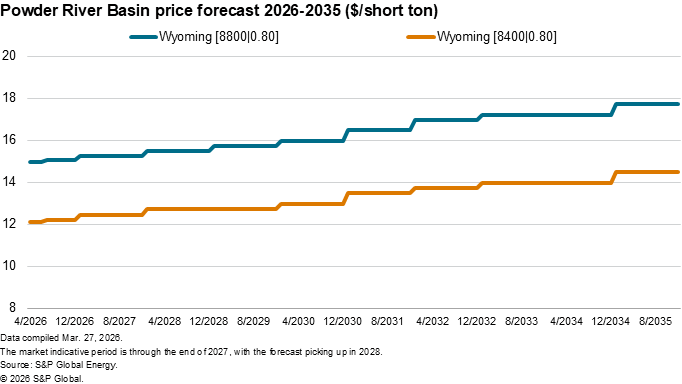
Current forward pricing for PRB coal has been flat and stable, reflecting sufficient inventories at power plants and mining capacity to increase production as needed against firmer natural gas prices. After 2027, lower natural gas prices and declining coal demand are forecast to restrain price growth.
Bituminous coal price levels are primarily influenced by export markets, with today's price levels making domestic coal generation generally less competitive against Northeast natural gas. The current disruption in international energy markets has elevated export coal prices, likely through 2027. As natural gas prices normalize after that, we project some easing in coal prices.
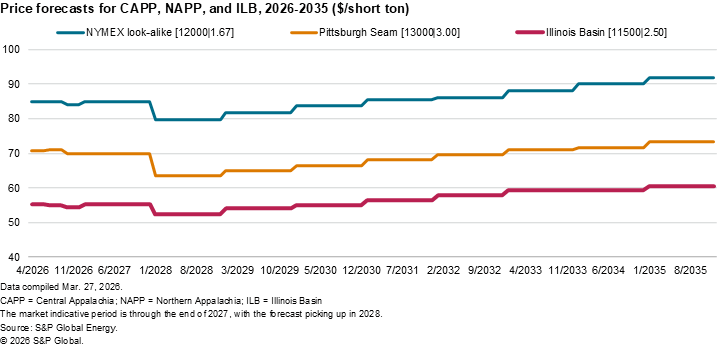
Pricing benchmarks exceeding $70/st suggest sustainable returns for eastern bituminous coal, with Atlantic Basin export coal above that threshold and coal competing in Pacific Basin export markets generally much closer. Bituminous coal demand for electric generation is expected to remain stable through 2027 on higher electricity demand and supportive natural gas prices. Declines in steam coal demand are expected to resume after 2027, and overall Eastern US coal demand is forecast to decline 47 million st in 2025–30.
Outlook for US coal production, demand
For the four weeks ending March 28, coal shipments averaged 10.4 million st, just 2.1% below the same week in 2025. Heading into spring, sufficient inventories and low seasonal demand appear likely to constrain production and shipments to levels at or below 10 million st per week.
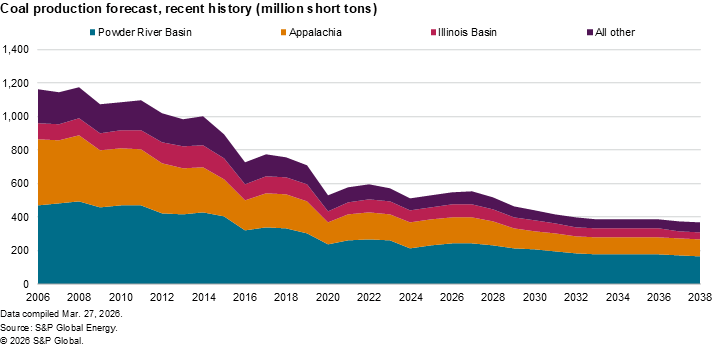
The chart below compares the current production forecast with recent history. We forecast increased coal demand against higher natural gas prices through 2027, with annual production at 550 million st. Beginning with 2028, relative normalization of coal and gas pricing and growth in green generation is forecast to pressure coal generation lower. The overall coal market, including domestic demand and exports, is forecast to decline by 139 million st between 2026 and 2031.
Production outlook — Powder River Basin
Production reports of the Mine Safety and Health Administration (MSHA) covering the fourth quarter of 2025 indicate total 2025 production of 230.0 million st. Production for 2026 is forecast at 243 million st, 5.7% higher than 2025. Production is forecast to remain elevated through 2027 against higher natural gas prices. By 2030, S&P Global Energy projects that coal retirements in the Midwest and expansion of wind generation in PRB's core markets will gradually shrink the coal demand to 204 million st, declining further to 177 million st through 2035.
Production outlook — Illinois Basin
MSHA's 2025 fourth-quarter production reports indicate total 2025 production of 66.2 million st. We forecast production will grow to 75 million st through 2027, after which the expansion of wind generation and announced coal retirements are forecast to erode the ILB coal demand. Coal production in the ILB is forecast to fall to 65 million st by 2030, declining further to 50 million st by 2035.
Production outlook — Appalachian basins
MSHA's production reports for the year's fourth quarter indicate year-end production at 159.3 million st. Appalachian coal demand tends to be more sensitive to global seaborne markets than to domestic natural gas prices, compared to the PRB or the ILB, which are forecast for improved demand against natural gas generation; therefore, gains in Appalachian coal will be more limited. We forecast modest declines from 2025 levels through 2027. As remaining domestic demand erodes after 2027, with only modest offsets from export growth, Appalachian production is forecast to fall to 112 million st by 2030.
Further information
Market Indicative coal forecasts by S&P Global Energy represent forward curves for spot-traded instruments, analogous to a strip of contracts. The shorter tenors — current year and prompt year, plus additional years, if available — are driven by the observed/assessed marker prices. The longer tenors — typically forecast years three to 20 for physically assessed markers — are driven by fundamental estimates of cash costs of production, accepted returns to capital, regional productive capacity, and forecast supply and demand. For the long-tenured portion of the curve, S&P Global Energy forecasts prices for specific coal markers and defines the remaining markers via historical spreads.
Regulatory Research Associates is a group within S&P Global Energy.
S&P Global Energy produces content for distribution on S&P Capital IQ Pro.
For further details on coal prices, supply and demand, visit the S&P Coal Forecast Summary page.
This article was published by S&P Global Market Intelligence and not by S&P Global Ratings, which is a separately managed division of S&P Global.