Research — April 16, 2026
SVOD's new math: how ad tiers are reshaping the pricing landscape

By Seth Shafer
Average monthly retail pricing for the top subscription video services in the US has risen steadily in recent years, although not all services and service tiers have been impacted equally. Price hikes across ad-free tiers have been larger and more frequent for most services, while entry-level plans — the majority of which are now ad-supported — have seen fewer price bumps.

➤ Most SVOD operators held pricing steady through the pandemic and into 2022, with a major shift in strategy beginning in earnest in 2023 and 2024. Netflix Inc. and Walt Disney Co.'s Disney+ rolled out ad-supported tiers late in 2022 in the US, following in the footsteps of Warner Bros. Discovery Inc.'s HBO Max service which launched its ad-supported tier in 2021. Amazon.com Inc.'s Prime Video joined the ad-supported fray in early 2024, leaving just Apple Inc.'s Apple TV and Starz Entertainment Corp.'s Starz (OTT) as the only major US SVOD services without a more affordable subscription tier with ads.
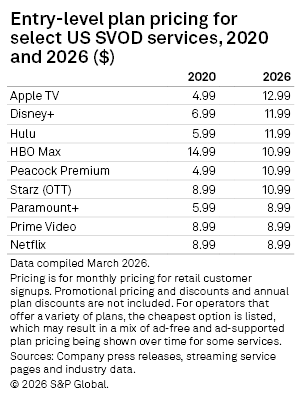
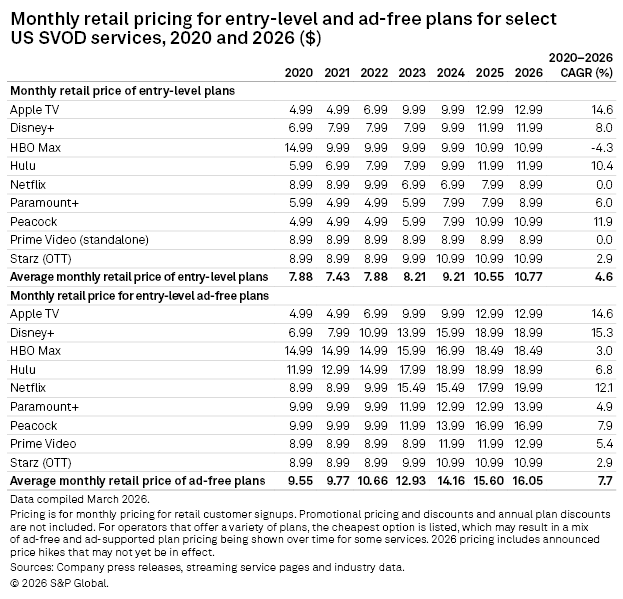
➤ Cheaper ad-tiers initially resulted in a price drop for entry-level plans at Netflix and HBO Max when they were introduced, while tiers with ads at Disney+ and Prime Video served as a new entry-level pricing floor with subscribers paying more to watch ad-free. The average monthly retail price across entry-level plans for the nine operators analyzed here was flat from 2020-2023 but began rising steadily in 2024 and stood at $10.77/month at the close of the first quarter of 2026.
➤ Pricing for ad-free tiers rose at an even faster clip as operators with ad-supported tiers were often more aggressive with price hikes, with price-conscious subscribers able to move down to the cheaper tier with ads versus churning out completely. Average retail monthly pricing for ad-free plans saw a 7.7% CAGR from 2020-2026, well above the 4.6% CAGR for entry-level plans.

2020 was a noteworthy year for the US SVOD sector as it marked the first full year of operation for Disney+ and Apple TV as well as the full launch of Comcast Corp.'s Peacock in July 2020. Services also saw outsized subscriber gains through much of 2020 and 2021 as the pandemic raged and several services were priced as low as $4.99/month, with HBO Max the only service with an entry-level price over the $10/month mark. By early 2026, the majority of entry-level plans eclipsed the $10/month mark and some plan prices had increased by 100% to 160%.
Access Excel data for historical US SVOD pricing for selected services from 2015-2026.
2023-2024 marked a major inflection point in pricing strategy, coinciding with the introduction of ad-supported tiers at Netflix, Disney+ and Prime Video, as well as a push towards streaming profitability for service owners including Apple, Comcast, Disney, Paramount Skydance Corp. and Warner Bros. Discovery.
Ad-free plans saw a spike in price in 2023 as new ad-supported offerings debuted, while most entry-level plan prices jumped higher in 2024. With subscriber growth harder to come by as the SVOD market matured, regular price hikes across both ad-supported and ad-free plans have become the norm in recent years as service owners strive to boost revenue and streaming profitability. Netflix was the latest to announce price hikes in March across all of its tiers in the US, with Paramount+ rolling out similar hikes in January and Prime Video unveiling plans to increase the cost of its ad-free plan by $1 in April to $12.99/month.
Average pricing across entry-level plans rose by a 4.6% CAGR from 2020-2026, paced by Apple TV (14.6% CAGR), Peacock (11.9%) and Hulu (10.4%). Overall average pricing across entry-level plans was flat from 2020-2023 but saw big increases in 2024, 2025 and through the first quarter of 2026 to reach an average price of $10.77.
Service owners have been even more aggressive with price hikes across their ad-free plans, which saw average pricing rise at a 7.7% CAGR over the 2020-2026 period. Among operators with a mix of ad-free and ad-supported offerings, Disney+ and Netflix have been the most aggressive in bumping up ad-free pricing with a 15.3% CAGR and 12.1% CAGR, respectively. Price hikes announced in the first quarter of 2026 for ad-free offerings from Netflix, Prime Video and Paramount pushed the average ad-free plan cost to just over $16.
Despite the rapidly increasing costs of SVOD services, American consumers haven’t yet churned out of services en masse. Most major services saw their US subscriber bases swell in 2024 and 2025, although distribution pacts with pay TV operators such as Charter Communications Inc. and DirecTV LLC that offer complimentary access to select SVOD services could be offsetting some of the retail pricing pinch. Bundle offerings can also deliver savings, as can discounted annual plans and one-time promotional offerings and discounts.
Please note that entry-level pricing presented here is for the lowest cost plan available for retail customers (excluding promotions, discounts and bundle deals) and may reflect a mix of ad-free and ad-supported plans. Entry-level pricing for ad-free tiers is for the cheapest ad-free tier available. Amazon Prime Video pricing is for the stand-alone subscription option, and Peacock Premium pricing excludes the Peacock Select tier, which includes more limited content versus Peacock Premium tiers.
Economics of Streaming Media is a regular feature from S&P Global Market Intelligence Kagan.
This article was published by S&P Global Market Intelligence and not by S&P Global Ratings, which is a separately managed division of S&P Global.
Content Type
Segment
Language