Research — May 6, 2026
Pearl Abyss revenue to jump 130% YOY on Crimson Desert before 2027 slowdown

By Akash Jishnu
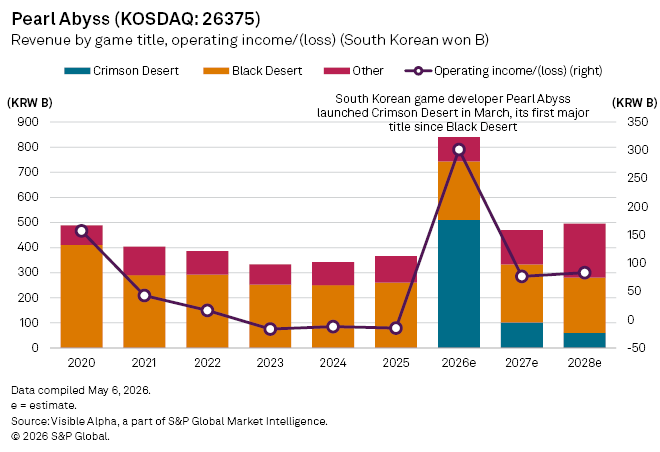
South Korean video game developer Pearl Abyss Corp. (KOSDAQ: 263750) launched its long-awaited title Crimson Desert in March, marking its most significant release since Black Desert debuted in 2015. Black Desert, once the backbone of the company’s earnings through its live-service model, is in its mature phase. Slowing player growth and rising churn are expected to push sales down 11% year-on-year to KRW233 billion in 2026.
Early indicators for Crimson Desert suggest a strong start. The company has reported 4 million package sales as of April 1, less than two weeks after its March 20 launch. Visible Alpha consensus show analysts expect the title to generate KRW511 billion in revenue in 2026, accounting for roughly 61% of group sales. This would drive total revenue to KRW840 billion, a 130% year-on-year increase, while lifting the company back to profitability with expected operating income of KRW301 billion after three consecutive years of losses.
However, unlike Black Desert, which is a live-service game, designed to generate ongoing engagement and revenue, Crimson Desert follows a buy-to-play model, concentrating revenues around the initial launch window. Analysts therefore expect momentum to fade quickly. Consensus points to a sharp revenue contraction in 2027 to KRW470 billion, with Crimson Desert sales falling 80% to KRW102 billion and operating income declining to KRW77 billion.
The company is shifting strategic focus towards DokeV, an open-world action-adventure title built on its proprietary BlackSpace Engine. While updates could emerge in the second half of 2026, the commercial contribution remains uncertain. As a new intellectual property, DokeV is expected to take several years of development, content scaling and player acquisition before generating meaningful revenue.
This article was published by Visible Alpha, part of S&P Global Market Intelligence and not by S&P Global Ratings, which is a separately managed division of S&P Global.
Content Type
Products & Offerings
Segment
