Research — April 2, 2026
New headwinds for offshore: states face affordability, renewable target pressure

By Tanya Peevey
State renewable portfolio standard targets for offshore wind were set in an environment of robust tax credit availability, declining capital costs and active permitting procedures. That environment has now shifted, and both planned and existing offshore wind projects are under federal scrutiny, with significant implications for states pursuing offshore wind development.
With states already struggling to meet their offshore wind development targets, further setbacks also threaten affordability. The loss of offshore wind is projected to hit ISO New England hardest, with the highest increase in around-the-clock (ATC) energy prices, upward of $9/MWh, and delays in achieving state renewable portfolio standard (RPS) targets of up to 12 years. New York ISO is projected to meet its RPS target, but the region contends with higher energy prices, which compromise future energy affordability.
PJM Interconnection and California ISO remain relatively unimpacted, as the change in energy prices is minor. RPS targets for some states in PJM are delayed by upward of four years, which may be an amenable trade-off to avoid further escalation of prices, which is already an issue for ratepayers.

➤ Ambitious state offshore wind commitments currently exceed 65 GW by 2040, while projects under construction total only about 6 GW. New federal policy headwinds are poised to widen this already-substantial gap, elevating regulatory uncertainty and reliability risk, with developers cautious despite recent court victories.
➤ In our planning case for a situation in which no new offshore wind projects are developed, around-the-clock power prices increase. ISO-NE and NYISO stabilize at $6-$9/MWh higher than the Q4 2025 base case by 2031–35; PJM rises $1.3-$1.6/MWh; CAISO remains largely unaffected.
➤ RPS timelines slip in constrained states under the No Offshore Wind planning case, led by Rhode Island (an additional 12 years), Connecticut and New Jersey (nine years apiece), and Maryland and Delaware (four and two years, respectively).
➤ An increased build-out of other technologies would partially offset the 35.68 GW of lost offshore wind capacity, with solar up 11.41 GW, onshore wind up 10.25 GW, storage up 7.11 GW, and natural gas up 4.04 GW, for a net system capacity change of negative 3.54 GW.
➤ Gas plants help to fill the gap and shoulder more reliability duty. PJM gas generation grows 54.6 TWh by 2035 as offshore wind falls 76.7 TWh. Gas capacity factors rise 2-4 percentage points in PJM and NYISO.
➤ The current war in the Middle East has highlighted US states' exposure to global shocks and fluctuating gas prices, which the now-decelerated clean energy build-out could mitigate.

As of February 2026, five offshore wind projects remain under construction, all previously approved and now protected by court-ordered injunctions against the December 2025 US Department of the Interior's stop-work orders that halted project construction. The five projects under construction represent about 6 GW of capacity, while the aggregate state RPS offshore wind commitments across ISO-NE, PJM, NYISO and CAISO exceed 65 GW by 2040 — a significant gap between what is being built and state commitments.
Recent actions by the Trump administration to halt offshore wind development through a $1 billion buyout of federal leases have gained some traction. TotalEnergies SE has agreed to cancel its US-based offshore wind projects and invest in fossil fuel development. This adds to the federal policy shift that has sent chilling signals to investors in renewables and made it impractical to enter into an offshore wind energy purchase agreement, elevating near-term reliability risks as replacement capacity may not be immediately available.
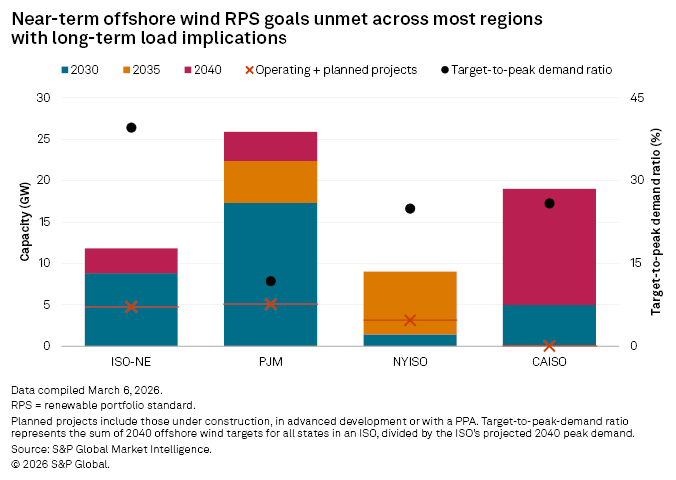
Despite the federal policy headwinds, state-level commitments to offshore wind remain unchanged. All but New York will struggle to meet near-term offshore wind targets with operating and planned projects. ISO-NE has the highest exposure, as offshore wind mandates within the region account for 40% of its peak load by 2040. PJM states face the largest mismatch between target ambitions and near-term deliverability. Still, with targeted offshore wind accounting for just 12% of PJM's load, the ISO may be in the most comfortable position to navigate the frequently changing federal policy landscape.
New Jersey's target of 11 GW by 2040 is jeopardized by multiple project cancellations, including Invenergy LLC's 2.4-GW project in November 2025, leaving the state far short of its RPS target, with only Attentive Energy Two Offshore Wind Project under development. In contrast, Virginia's 2.59-GW Virginia Beach Offshore Wind Project (Coastal Virginia Offshore Wind) project, due online in 2026, will satisfy PJM's 2030 target. However, future Virginia procurements are unlikely to progress at the same pace given the current policy climate.
ISO-NE is about halfway to meeting its aggregate offshore wind targets due to multiple projects either under construction or in advanced development. Massachusetts aims for 5.6 GW by June 30, 2027, but as of early 2026, only 0.8 GW from Vineyard Offshore Wind Project is near-term deliverable. Another 3.2 GW from SouthCoast Wind Energy Offshore Project (Mayflower Wind) and New England Wind (Park City Wind Offshore) is due in 2030, leaving a 1.6 GW shortfall. Connecticut, which requires 2 GW by 2030, has contracted only 304 MW from Revolution Wind Offshore Project. Furthermore, the state has declined new awards, resulting in a 1.7-GW gap with no clear strategy or projects in place.
Perhaps counterintuitively, New York finds itself in a relatively stronger position in the near term despite being at the center of the federal conflict. The state's 9-GW offshore wind target by 2035 is supported by 2.9 GW from Boardwalk Offshore Wind (Empire Wind 1 & 2) (Rockaway Peninsula) and Sunrise Wind I & II Offshore Farm (Holbrook), meeting New York's 2025 goal. However, its 2035 target is in jeopardy due to rising costs and project terminations, such as the 2.4-GW Beacon Offshore Wind Project, prompting the governor to urge the legislature to extend the timeline for the state's climate goals.
California's 25-GW total target is heavily backloaded, with 19 GW of it due in 2040. Meeting this target is uncertain, as the 2040 commitment relies on floating offshore wind technology, which is commercially unproven in US federal waters. Additionally, near-term projects utilizing conventional bottom-fixed technology remain in the planning stage, highlighting significant hurdles for the state's ambitious long-term offshore wind goals.
The offshore wind headwinds are unfolding against a geopolitical backdrop of global energy instability as the Middle East war disrupts energy markets. The disruption to shipping around the Strait of Hormuz has tightened oil, gas and refined product markets, removing roughly 17 million barrels per day of oil and about 20% of global LNG supply, while escalating Iranian attacks on regional energy infrastructure have sent prices sharply higher. This volatility highlights the strategic importance of a domestic clean energy build-out, yet the federal pause on offshore wind now leaves states more exposed to global shocks at a time when geopolitical risk is reshaping supply chains and energy security planning.
Supply mix shift
To understand the consequences of federal policy undermining offshore wind development, we created a No Offshore Wind planning case. The model modifies our Q4 2025 base case by removing all state offshore wind mandates — assuming they are not met — and retaining planned offshore wind projects that are under construction or have a power purchase agreement (PPA). Projects that did not meet these criteria — including Empire Wind 1 & 2, SouthCoast Wind Energy Offshore Project, Attentive Energy Two Offshore Wind Project, Momentum Offshore Wind Project, New England Wind and Ocean City Offshore Wind Project (Marwin) — were removed. The impacts are highlighted by comparing the two cases.
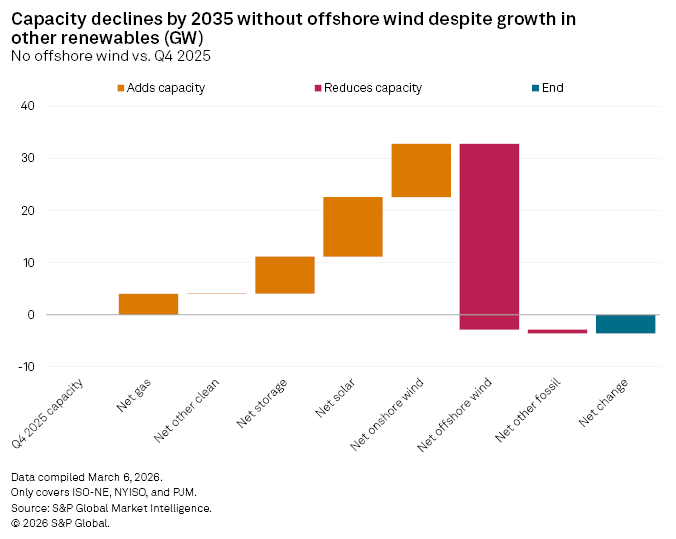
With no new offshore wind allowed to advance, offshore wind capacity is reduced by 35.68 GW relative to the base case, prompting the system to compensate with alternative technologies. New solar and wind capacity account for the majority, each covering about 30% of the reduced capacity, at 11.41 GW and 10.25 GW, respectively. Storage comes in third, accounting for 20% (7.11 GW), and natural gas at 10% (4.04 GW).
The overall net change of negative 3.54 GW in total capacity underscores that the scale and system value of offshore wind cannot be fully replaced under current federal restrictions. For investors, developers and grid operators, these results highlight a near-term environment defined by regulatory uncertainty and a growing need for diversified renewable and firming resources as states attempt to bridge the gap between federal constraints and long-term decarbonization requirements.
For all ISOs except PJM and NYISO, the change in generation occurs in step with the change in capacity, as capacity factors remain relatively unchanged in the No Offshore Wind planning case.
By 2035, gas-fired generation in PJM grows a significant 54.6 TWh, while offshore wind generation decreases 76.7 TWh, as solar and onshore wind alone cannot keep up with demand growth. With 2 GW of additional capacity, this equates to an increase in capacity factors of 4 percentage points for combined-cycle power plants and 2 percentage points for simple-cycle — highlighting the importance of more gas capacity to reduce reliability risk and a higher runtime for all gas-fired power plants in the region. Both economic advantages and strong RPS targets in many of the PJM states support increases of 21.4 TWh in onshore wind and 8.2 TWh in solar generation.
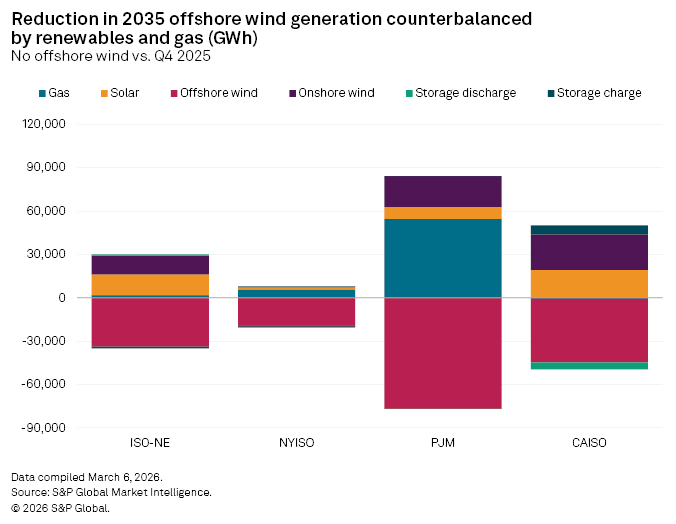
Solar is more prominent in ISO-NE, with 14.4 TWh of generation, which incentivizes about 1 TWh of battery storage charging and discharging to the grid. Gas generation also increases in ISO-NE, but at 1.7 TWh, it is a drop in the bucket compared with the 33.7-TWh decrease in offshore wind generation. However, New England policymakers are again trying to tap Maine's onshore wind potential. In other ISOs, wind generation outpaces solar generation. This erodes the duck curve and arbitrage opportunities, diminishing the economic incentive for battery storage generation.
In NYISO, existing gas capacity benefits from the pullback in offshore wind, as these power plants do not retire and are needed to maintain grid reliability, equating to an increase in their capacity factors by two to four percentage points.
Coal generation remains unchanged, as there are cheaper sources of replacement power, and the administration's emergency orders to keep coal plants from retiring are unlikely to reduce reliability risks without PPAs to guarantee their use.
State energy implications
As the growing need for diversified renewable and firming resources in an uncertain policy environment translates into increased generation, energy revenues for existing resources could be bolstered and investment in replacement resources could be incentivized.
Annual ATC energy prices increase in the No Offshore Wind planning case, as gas is on the margin for more hours of the day with diminished offshore wind generation. The uplift accelerates in the later 2020s as the loss of offshore wind capacity driven by RPS carve-outs tightens reserve margins and increases reliance on thermal units and storage to meet demand.
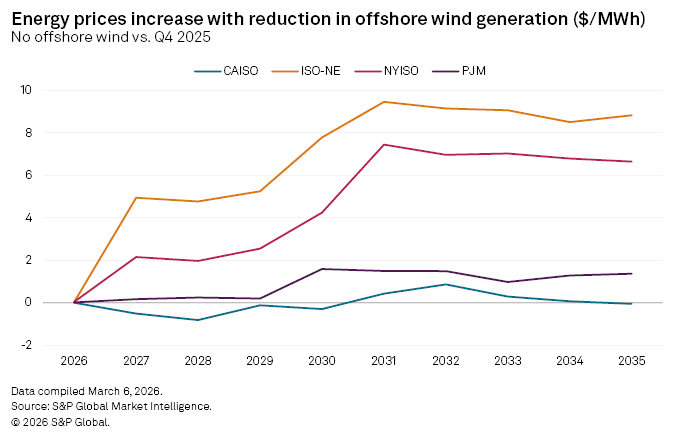
This increase relative to the Q4 2025 base case is strongest in ISO-NE and NYISO, where offshore wind would otherwise have provided winter-peaking supply to regions with high target-to-peak demand ratios of 40% and 25%. By 2031, ATC prices increase in ISO-NE and NYISO, then stabilize in the range of $6-$9/MWh above the Q4 2025 base case, while PJM sees increases of $1.3-$1.6/MWh over the same period. The impact is larger for ISO-NE because storage is on the margin more often, whereas other zero-variable-cost resources, such as hydroelectric, cannot fully compensate for the loss of offshore wind generation.
After 2031, energy prices in ISO-NE and NYISO soften as solar and wind resources are built — driven in part by state RPS mandates — and bend the price curve down. In PJM, new capacity can keep up with the 3.5% growth in peak demand but not exceed it, keeping prices elevated throughout the forecast.
CAISO remains largely unaffected, reflecting its resource independence from offshore wind due to a renewable-heavy supply mix. Depending on the location, either onshore wind or hydroelectric resources — both competitive zero-variable-cost resources — typically set the marginal price. However, California is still impacted by the federal policy shift in support of fossil fuels by other mechanisms, as highlighted by a recent Trump administration lawsuit that prompted two cities to repeal gas bans.
The reduction in offshore wind has a meaningful impact on achieving RPS targets for states that are geographically restricted due to shorelines and/or dense populations. States with more available land can pivot, building additional resources elsewhere and then moving power to population centers.
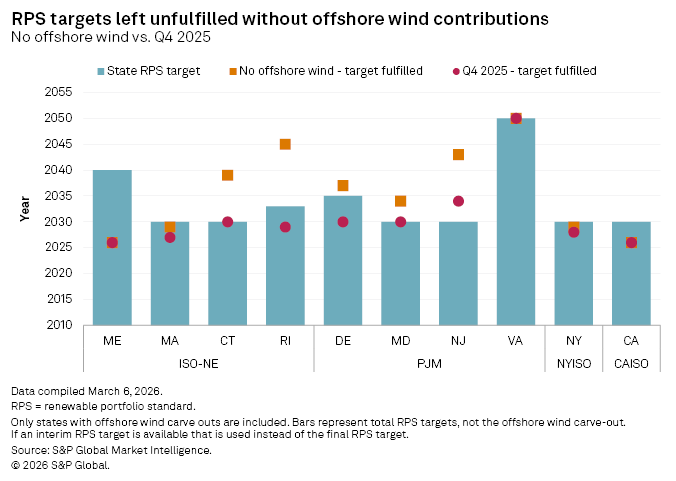
With the highest target-to-peak demand ratio at 40%, ISO-NE states are most at risk of missing their RPS targets. Connecticut and Rhode Island could experience the largest impact, as they reach their RPS target nine and 12 years later, respectively, in the No Offshore Wind planning case.
Maine has a long runway to adjust to changing federal policy, as both the state RPS target and offshore wind carve-out do not need to be fulfilled until 2040, allowing ample time for other resources to develop. Massachusetts has an aggressive target of 40% renewable generation by 2030, which is satisfied in the No Offshore Wind planning case with ample wind and solar builds that compensate for the unmet offshore wind.
In the Q4 2025 base case, PJM states New Jersey and Virginia already struggle to meet their state RPS targets. Without the 5 GW of state-mandated offshore wind capacity, and without renewable builds being able to compensate while keeping up with load growth, New Jersey does not meet its RPS target until 2043 — nine years later than in the Q4 2025 base case and four years after the mandated deadline.
Delaware and Maryland are at risk of failing to meet their state RPS targets in two and four years, respectively, as both states rely heavily on offshore wind to meet their renewable energy requirements. In the No Offshore Wind planning case, the additional 4 GW of renewables in Delaware and 2 GW in Maryland are insufficient to offset the respective losses of 1.2 GW and 8.5 GW of planned offshore wind capacity by 2030, leaving both states with significant compliance gaps.
According to the No Offshore Wind planning case, New York could still reach its 2030 target by 2029, just one year later than in the Q4 2025 base case and may not need to extend its decarbonization timeline. This is supported by 3.1 GW of offshore wind projects that are operating or under construction — Boardwalk Wind, South Fork Offshore Wind Project and Sunrise Wind — which leaves 1 GW of unmet offshore wind capacity that is fulfilled with additional solar and wind capacity in neighboring coastal zones.
However, the risk of unmet RPS targets is now heightened by the recent agreement between the US Department of the Interior and TotalEnergies SE, under which the company is stopping its New York Bight and Carolina Long Bay offshore wind leases, pledging not to develop any new offshore wind in the US, and redirecting its capital into US oil and LNG projects in exchange for reimbursement of its lease fees. The settlement removes about 4 GW of anticipated offshore wind capacity from the pipeline and signals a broader federal pivot away from offshore wind development.
S&P Global Energy provides content for distribution on Capital IQ Pro.
For wholesale prices and supply and demand projections, see the S&P Global Market Indicative Power Forecast.
This article was published by S&P Global Market Intelligence and not by S&P Global Ratings, which is a separately managed division of S&P Global.