ECONOMICS COMMENTARY — 24 Apr, 2026
Monthly PMI Bulletin: April 2026

The following is an extract from S&P Global Market Intelligence's latest Monthly PMI Bulletin. For the full report, please click on the 'Download Full Report' link.
The following analysis describes the economic landscape through the lens of PMI surveys compiled by S&P Global in over 40 economies.
The content reflects the PMI team’s analysis of business metrics collected from around 30,000 companies and does not necessarily reflect the views of S&P Global Market Intelligence’s economic forecasters or S&P Global Ratings.
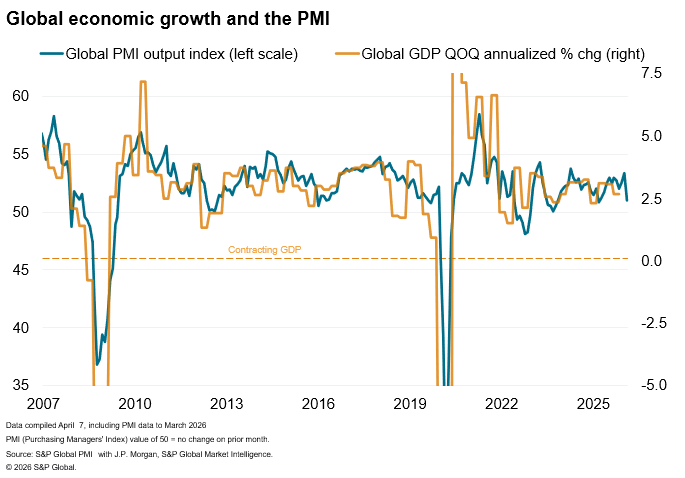
- March’s PMI surveys, produced by S&P Global, provided the first indication of changing economic conditions since the outbreak of war in the Middle East, and signalled an unwelcome combination of markedly slower growth and accelerating inflation.
- Output growth moderated worldwide to one of the greatest extents seen since the global financial crisis of 2008-9, cooling to its weakest since last April. New orders inflows slowed sharply and business expectations about the year ahead slumped lower.
- Worsening conditions reflected one of the most elevated levels of business uncertainty seen over the history of the PMI surveys, in turn reflecting wide-ranging concerns over the economic impact of the war.
- Growth slowed most notably in the services economy, with consumer facing businesses especially hard hit. Manufacturing output growth also moderated, albeit supported by stock building, the latter linked to a spike in supply concerns. Supplier delivery delays hit the highest since 2022.
- Average selling prices rose sharply for both goods and services thanks principally to firms passing surging energy and other raw material costs on to customers, rising globally at the fastest rate since January 2023.
- Growth rates slowed across the board among the major economies. Downturns were seen in both Canada and Australia while activity came close to stalling in the US, UK and eurozone. That left Japan as the best-performing advanced economy, though even here growth softened. In the major emerging markets, slower growth rates in India and mainland China were accompanied by downturns in Russia and Brazil.
© 2026, S&P Global. All rights reserved. Reproduction in whole or in part without permission is prohibited.
Purchasing Managers' Index™ (PMI®) data are compiled by S&P Global for more than 40 economies worldwide. The monthly data are derived from surveys of senior executives at private sector companies, and are available only via subscription. The PMI dataset features a headline number, which indicates the overall health of an economy, and sub-indices, which provide insights into other key economic drivers such as GDP, inflation, exports, capacity utilization, employment and inventories. The PMI data are used by financial and corporate professionals to better understand where economies and markets are headed, and to uncover opportunities.
Read our latest PMI commentary here.
This article was published by S&P Global Market Intelligence and not by S&P Global Ratings, which is a separately managed division of S&P Global.
Theme
Location
Products & Offerings