Research — April 8, 2026
Mich. commissioners say Consumers' rate order blends reliability, affordability

By Dan Lowrey
The Michigan Public Service Commission on March 27 voted to authorize Consumers Energy Co. a $276.7 million increase in electric rates primarily to make reliability improvements including accelerated trim trimming across its distribution network in the state.
The increase, which was roughly 65% of the amount sought by Consumers, is premised upon a return on equity (ROE) that slightly exceeds national averages tracked by Regulatory Research Associates but is equal to the utility's previous ROE. New rates will become effective on or after May 1.

➤ The Michigan Public Service Commission authorized a $276.7 million electric rate increase for Consumers Energy Co. (CE), explicitly tied to reliability improvements — most notably a major acceleration of vegetation management across the distribution system. The biggest single reliability item is $186 million for line clearing to reduce outage events and duration.
➤ The commission maintained CE's authorized ROE at 9.90%, matching prior cases and landing modestly above recent national averages tracked by Regulatory Research Associates. A key takeaway from RRA's perspective is that Michigan is not limiting capital attraction, but rather pairing allowed returns with higher expectations for performance and justification.
➤ The Michigan regulatory climate is viewed as somewhat constructive but was downgraded in 2024 to average due to tighter outcomes in rate proceedings.

The rate increase is based upon a 9.90% return on equity (42.30% of regulatory capital structure) and a 6.12% overall return on rate base of $15.02 billion for a test year ending April 30, 2027.
The 9.90% ROE is modestly above the 9.66% average of returns accorded to electric utilities in all rate case decisions issued through the first nine months of 2025 and the 9.74% average for the full year 2024. For vertically integrated utilities such as CE, the average was 9.84% for the full year 2024. The commission has maintained CE's authorized ROE at 9.90% in several rate cases filed since 2019.
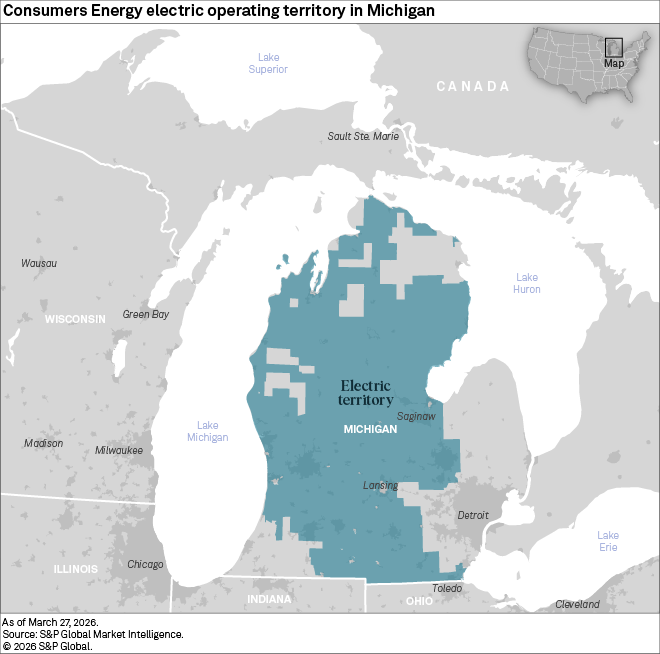
With a focus on reliability, the commission authorized measures in line with recommendations from a 2024 third-party audit of Michigan's two largest electric utilities. It approved $186 million for CE's line-clearing program to trim trees and vegetation around power lines, aiming to shorten the clearing cycle from 10.2 years to every five years by 2030–2031.
CE was also directed to analyze the costs and benefits of a four-year trimming cycle and full canopy removal in high-risk zones for its next rate case. Additionally, $30 million was approved for the Vulnerable Communities Resiliency Plan to reduce outage durations, with a requirement for the utility to demonstrate reliability improvements and integration with broader distribution goals. The commission also approved increased investment in Underground Cable Rejuvenation to address degrading cables in downtown areas and reduce failure risks.
The commission approved an extra year for CE's investment recovery mechanism (IRM), which funds electric distribution upgrades to improve reliability. The IRM allocates $226 million for programs targeting low-voltage distribution, resiliency and system protection. The IRM requires CE to verify spending on approved projects in a future review, with unspent funds possibly refunded to customers. CE had proposed continuation of the IRM over a two-year period beginning May 1, 2026, consistent with the start of the test year in this case.
The commission also approved the company's Repetitive Outages Low-Voltage Distribution program, which will identify locations on its grid where customers experience frequent outages and target improvements and repairs to trouble spots.
The commission allowed the company to defer $21.7 million in costs for operations and maintenance associated with ramping up efforts to trim trees, and $14.6 million for cloud computing costs associated with the company's SAP S4/HANA information technology project. These deferrals are intended to spread the recovery of larger operations and maintenance costs over time, reducing the immediate rate impact for customers.
CE is currently negotiating the sale of its river hydro generation fleet, which includes 13 hydroelectric dams. Should the sale fail to materialize or receive regulatory approval, the company may need to reconsider decommissioning or relicensing these assets. CE's proposal to extend deferred regulatory accounting treatment of the assets through the test year elicited no exceptions in the proceeding, and it was so authorized.
Approved funding will support CE's transportation electrification programs — which are centered on optimizing the charging load from electric vehicles to the benefit of all customers — and investments, incentives, programs and expenditures that are reasonably expected to increase transportation electrification in the company's electric service territory. These programs include PowerMIDrive Residential, PowerMIDrive Public Charging and PowerMIFleet.
With respect to rate design, the commission approved CE's proposals to update residential advanced metering infrastructure opt-out fees and update the production capacity charge. CE withdrew its proposal to include a power factor adjustment for Rate LEDR during the proceeding. Accordingly, in its next general electric rate case, CE was ordered to propose a power factor adjustment for that rate that is sufficient to cover the cost of power factor correction on the company's system.
The commission also authorized CE to update new service connection fees, including a new overhead service connection fee and adjustment to the underground service connection fee, and increase the eligibility for the Shut Off Protection Plan from 200% to 400% of the federal poverty line.
In authorizing the rate increase, commissioners noted how the final order balanced the need to make reliability investments across CE's distribution network, while also addressing affordability concerns of ratepayers. "Reliability and affordability are not competing objectives," Commissioner Katherine Peretick said, pointing out that they are "fundamentally linked."
CE is a CMS Energy Corp. subsidiary.
Rate case background
CE on June 2, 2025, filed a formal rate case application with the Michigan Public Service Commission seeking an increase in electric rates of $460.2 million, which included $24.3 million that will be collected on a distribution deferral through a separate 12-month surcharge.
The company requested (in Case U-21870) a $435.9 million increase in electric base rates, which included $77.5 million for a return on a regulatory asset attributed to the J.H. Campbell plant over the projected 12-month period ending April 30, 2027. The commission previously approved a 9% return on equity for the remaining net book value of the plant after the retirement of the coal-burning units in May 2025.
The increase was premised upon a 10.25% return on equity (42.94% of regulatory capital structure) and a 6.35% return on an average rate base valued at $15.368 billion for a test year ending April 30, 2027.
The application emphasizes the importance of funding CE's Reliability Roadmap, which outlines necessary investments in infrastructure to enhance reliability amid severe weather challenges highlighted in a third-party audit. The Reliability Roadmap presents a strategy for improving reliability through four key categories of work: forestry line clearing; hardening the system to address infrastructure in poor health and at risk from severe weather impact; inspections to identify and fix failures; and digital automation that includes technological solutions to increase the efficiency of distribution planning, service restoration and line clearing. CE is also proposing a ramp-up in line clearing to achieve a five-year clearing cycle on the low-voltage distribution system as compared to the company’s previous goal of a seven-year cycle. The ramp-up to a five-year cycle is planned to occur through 2031.
The company projected higher operations and maintenance expenses required to support long-term investments and ensure service reliability, along with increased financing costs to attract capital for these necessary investments.
Compliance with federal orders, such as the US Department of Energy's May 23 directive to continue operating the Campbell Plant beyond May 31, 2025, adds to the financial considerations in the rate case. CE indicated it is coordinating with Midcontinent Independent System Operator and complying with the DOE order. The costs presented in this electric rate case have not been adjusted to reflect the impacts of the DOE order. CE plans to request recovery of the costs associated with the order through a Federal Energy Regulatory Commission process.
The application also addressed future retirement of units at the D.E. Karn coal plant, whereby the company is seeking to recover costs incurred for maintaining these facilities, as well as for their eventual decommissioning and environmental responsibilities associated with the facility.
Staff testimony and company revised request
On Sept. 30, 2025, staff of the commission filed testimony supporting a $322.7 million increase in electric rates, plus an additional $24.3 million for a distribution deferral to be recovered through a separate 12-month surcharge. Staff's recommendation was premised upon a 9.75% return on equity and a 6.06% overall return on rate base valued at $15.21 billion and test year ending April 30, 2027.
CE filed subsequent testimony revising its requested rate increase. Lastly, it filed a brief on Dec. 5, 2025, supporting a $422.8 million increase, premised upon a 10.25% return on equity (42.94% of regulatory capital structure) and a 6.30% overall return on rate base valued at $15.33 billion and test year ending April 30, 2027.
A staff brief also on Dec. 5, 2025, supported a $317.1 million rate increase for CE, premised upon a 9.75% return on equity (42.31% of regulatory capital structure) and a 6.03% overall return on rate base of $15.21 million and test year ending April 30, 2027.
On Jan. 29, an administrative law judge recommended a $168.3 million rate increase for CE, premised upon an 8.20% return on equity (42.30% of regulatory capital structure) and a 5.39% overall return on a rate base of $15.02 billion and test year ending April 30, 2027.
Mich. regulatory environment
RRA views the regulatory climate in Michigan as somewhat constructive from an investor perspective. However, on July 31, 2024, RRA reduced its ranking of Michigan regulation to Average/1 from Above Average/3. The jurisdiction remains more constructive than average from an investor viewpoint.
RRA had placed the state on watch following a 2022 rate case decision in which the PSC authorized DTE Electric Co. (DTE-E) an increase in rates that was less than 10% of that requested, but did not lower the ranking at that time. RRA viewed the decision as an anomaly, as a large part of the revenue requirement difference stemmed from reliance on a higher post-COVID-19 sales forecast than the utility had used in its revenue requirement calculations. DTE-E has now had three rate cases decided since then, and outcomes have generally been more constructive.
The commission has several constructive practices in place, including a streamlined rate case process, a framework for using forecast test years to reduce regulatory lag and a framework that permits a cash return on certain construction work in progress, thereby reducing the uncertainty of cost recovery. Retail competition for electric generation is in place but is limited, and attempts to raise this limit have not been successful. Electric utilities have retained their generation assets, and customers who do not select a competitive supplier receive service on a regulated, traditional cost-of-service basis. Adjustment mechanisms are in place for fuel costs for customers served under bundled service. For more details, refer to the Michigan commission profile page.
Regulatory Research Associates is a group within S&P Global Energy.
S&P Global Energy produces content for distribution on S&P Capital IQ Pro.
For a full listing of past and pending rate cases, rate case statistics and upcoming events, visit the S&P Capital IQ Pro Energy Research Home Page.
For a complete, searchable listing of RRA's in-depth research and analysis, please go to the S&P Capital IQ Pro Energy Research Library.
This article was published by S&P Global Market Intelligence and not by S&P Global Ratings, which is a separately managed division of S&P Global.