Research — April 8, 2026
Manganese mining costs amid global oil price spikes

Global oil price increases in the wake of the recent Middle East war are significantly raising costs across the mining sector, with manganese producers among the most impacted. Manganese-related mining operations depend heavily on diesel for extraction, ore transport and backup power generation. As diesel prices surge, mining margins are compressed and upward pressure on manganese prices is likely in the near term.

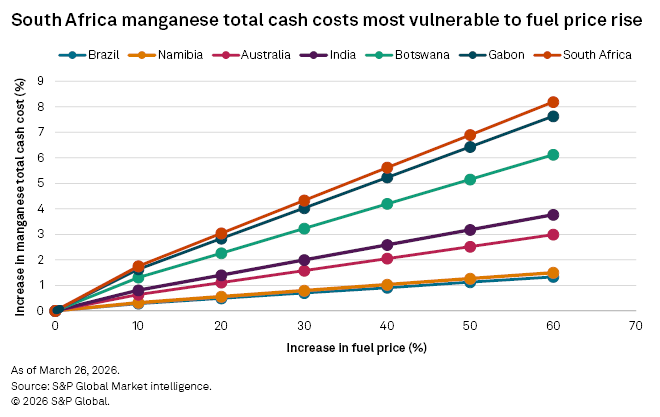
– A scenario of 60% increase in fuel prices raises manganese mining cash costs by an average of $7.59 per dry metric ton, a 6.55% increase in the global manganese cost base.
– Manganese producers in South Africa and Gabon are the most vulnerable due to diesel-intensive operations and long inland transport distances to ports.
– Most producers still have positive margins, but further price hikes may risk unprofitability in major producers.

Manganese is a new commodity being covered by the S&P Global Mine Economics and Emissions group. Manganese mining is energy-intensive, primarily conducted through open-pit methods that depend on diesel-powered haul trucks and drilling equipment. Higher fuel costs directly raise the cost per metric ton of ore, with exporters facing additional exposure through long-distance shipping and fuel surcharges. Brent crude prices already rose more than 50% in March, and are forecast to average $125 per barrel in April, as reported by S&P Global Energy. Diesel prices have increased 34%, now averaging $5 per gallon due to disruptions in global oil supply in the wake of the recent US-Israel war with Iran and Iran's retaliatory actions.
According to our scenario, which assumes a 60% increase in fuel prices with all other factors remaining constant, manganese producers in Gabon and South Africa — top producers of manganese ore — are most susceptible to the price jump. Total cash costs (CFR) are shown to rise as much as 8.2, amounting to around $7.11/dmt for South Africa and $12.63/dmt for Gabon.
Fuel price spike hit South Africa operations on multiple fronts
South Africa's manganese sector is intrinsically exposed to oil and diesel price volatility due to the country's dependence on imported crude oil. Most of the production occurs in the remote Kalahari Manganese Field, which requires long-distance, diesel-dependent transport — both by rail and truck to ports — making fuel a major cost driver. The case is similar for Gabon, where its major manganese mines are located deep inland that requires ore to be hauled 600 kilometers to the export port on the diesel-powered Trans-Gabon Railway, making delivered cost per metric ton highly sensitive to diesel price movements. When international fuel benchmarks rise, rail and logistics costs increase disproportionately, tightening mining margins.
Frequent and widespread grid blackouts due to the national power crisis in South Africa, commonly referred to as load shedding, also materially raises operating costs and risk. This is because it forces many operations to run diesel generators for primary and backup power, increasing diesel burn beyond transport into processing and other stationary loads. Mines in South Africa are vulnerable to be hit simultaneously on multiple fronts — haulage, on-site power generation, contractors — amplifying margin pressure and increasing vulnerability to sudden cost inflation.
Namibia's limited scale, stable power supply minimize impact
Compared to South Africa, Namibia benefits from a more stable power supply so less need to run generators for primary power, mines in Namibia mainly use diesel for mobile equipment instead of sitewide electricity supply, avoiding the "double exposure" of fuel volatility affecting transport and processing energy costs.
Namibia's manganese sector is characterized by smaller, niche producers, compared to the large-scale operations found in South Africa and Gabon. This results in a different cost profile: while mining remains energy-intensive, overall fuel consumption is lower due to smaller fleets, less mechanization and shorter internal haul routes.
A major advantage for Namibia is logistics, as manganese deposits are located relatively close to the deep-water port of Walvis Bay, significantly shortening transport distances. This proximity keeps diesel's share of delivered cost lowered and limits the impact of fuel price increases into delivered ore prices.
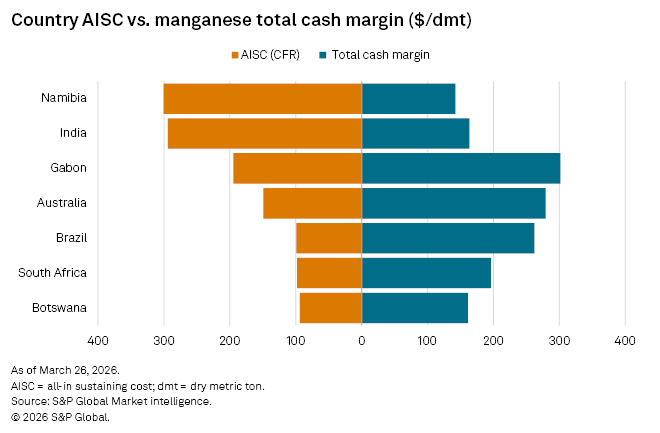
Based on our scenario, the majority of manganese production is still found to be cash positive but with tightening margins. Despite manganese ore prices rising due to cost pressures, the impact varies by region. Namibia is the least impacted by fuel price spikes in our scenario, but it operates with narrower cash margins and higher all-in sustaining costs (AISC). In contrast, Gabon, which contributes a large portion of global production, is more exposed to rising costs. With its relatively high AISC, Gabon's profit margins are at a greater risk of decline. If cost increases outpace ore price gains, a substantial portion of manganese production — and potentially other high-cost operations — could become unprofitable.
For questions or more information, please contact:
Princess Rochelle Gan, Principal Analyst, Metals and Mining Research, p.gan@spglobal.com
This article was published by S&P Global Market Intelligence and not by S&P Global Ratings, which is a separately managed division of S&P Global.