Research — April 30, 2026
How advancements in AI are reshaping paid, owned and earned media

By Zach Ciampa
The world of paid, owned and earned media has undergone rapid transformation in just a few short years. From the rise of the creator economy to the acceleration of generative and predictive AI technologies, marketers are now navigating an increasingly complex execution environment that simultaneously demands speed, personalization and measurable outcomes. At the same time, many brand teams are being asked to do more with fewer resources. In response, vendors are embedding AI across their platforms to help brands create content faster, optimize performance more precisely and increasingly automate cross-channel decision-making. As a result, AI is not simply enhancing paid, owned and earned media strategies — it is also redefining how marketers plan, activate and measure.

AI is becoming the operational backbone of the modern media mix. As enterprises increase investment in advertising infrastructure, user-generated content activation, generative content tools, and personalization engines, AI is shifting from a tactical enhancer to a structural layer embedded across paid, owned and earned environments. The next phase of this evolution is increasingly agentic, with AI systems beginning to initiate, execute and optimize multistep workflows across channels with reduced human intervention. Rather than optimizing individual channels in isolation, organizations are deploying AI to connect content creation, audience targeting and performance measurement into a continuous feedback system. The competition is therefore shifting from feature-level enhancements to agentic orchestration capabilities that coordinate the full media ecosystem.

Why AI is transforming the media mix now
Paid, owned and earned media (the media mix) have always evolved alongside shifts in consumer behavior and technology. The past two decades alone have moved at a breakneck pace. What's different about the current ecosystem is how the speed and breadth of said changes are now occurring simultaneously. The rapid expansion of retail media networks, the continued rise of the creator economy and the increasing fragmentation of digital touchpoints have made media execution more complex than at any point in the past decade.
Meanwhile, brands are under increasing pressure to demonstrate measurable outcomes across every channel, from analog to digital. Paid media must drive awareness, owned channels must deepen relationships and retention, and earned media must influence perception and extend reach. AI is emerging as a response to each channel's caveats, as all three are necessary for a well-rounded media strategy. Advances in generative AI are accelerating content production across formats.
Predictive models are improving audience targeting, personalization and budget allocation. Emerging agentic systems are beginning to automate multistep workflows across platforms. The three form a sort of holy trinity, shifting AI from a productivity enhancer to an operational layer embedded throughout the media life cycle. As a result, paid, owned and earned media no longer reside in separate buckets. They are becoming interconnected components of a continuous system — one that is increasingly optimized by AI-driven decision-making.
Enterprise investment signals a structural shift
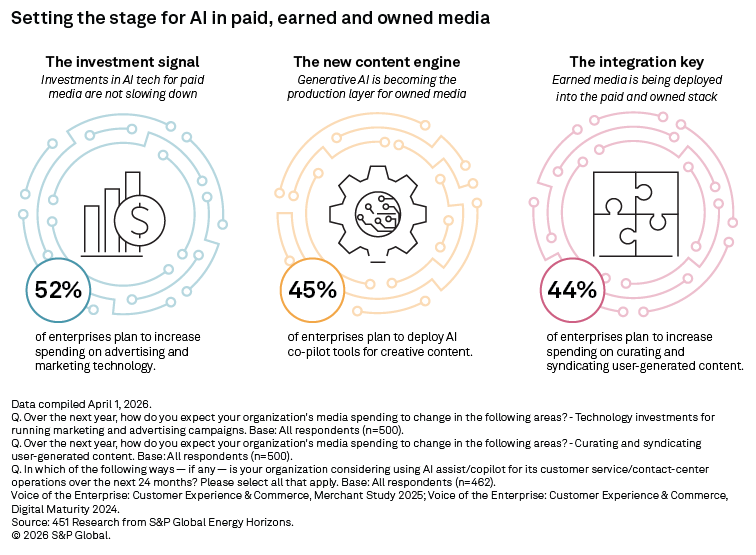
The central finding across our survey data is that enterprise AI investment is not happening channel by channel. It is happening simultaneously across paid infrastructure, owned content production and earned media activation, a pattern that signals structural reorganization of the media execution stack, not incremental experimentation. Each dataset below reinforces a different dimension of this convergence.
According to 451 Research's Voice of the Enterprise (VotE): Customer Experience & Commerce, Merchant Study 2025, 52% of respondents plan to increase spending on technology to run advertising and marketing campaigns. This reflects sustained prioritization of paid media enablement, even amid cost curtailment in other areas. At the same time, 30% intend to incorporate user-generated content from customers to improve relationships, and 44% plan to boost spending on curating and syndicating UGC. These figures indicate that earned media assets are not being treated as passive brand signals, but rather as strategic inputs into broader paid and owned programs.
Furthermore, according to our VotE: Customer Experience & Commerce, Digital Maturity 2024 survey, AI is moving into operational workflows. Nearly one-quarter of enterprises report currently deploying AI to improve customer experience via ad content generation and targeting. Among organizations utilizing AI for this, human oversight varies. While full autonomy remains limited, the share of organizations reporting low or no human involvement reflects early movement toward agentic advertising workflows in which AI is not merely assisting, but actively executing components of campaign management.
AI adoption is also accelerating within owned media environments, with 45% of enterprise customer experience and commerce respondents planning to employ AI assist or copilot tools for assistance with creative content generation. This indicates growing reliance on GenAI to scale content production and personalization across websites, email and digital engagement surfaces.
Strategic prioritization data reinforces this convergence. When we asked respondents to our VotE: Digital Maturity survey which CX technologies have the greatest game-changing potential over the next two to three years, 49% selected CX analytics and intelligence platforms, and 49% cited GenAI. Intelligent personalization followed at 42%, with digital advertising and marketing technology close behind at 41%. Separately, 39% identified marketing campaign content personalized to individuals at scale as an important AI-driven use case. These responses cluster around capabilities that span content creation, audience targeting, data integration and cross-channel activation.
Taken together, the data signals a coordinated shift. Enterprises are increasing investment in paid media infrastructure, operationalizing earned media through UGC integration, scaling owned media content with generative AI, and prioritizing analytics and personalization to connect these efforts. Demand does not center on stand-alone AI tools, but on integrated systems capable of managing content, targeting and optimization across the full paid, owned and earned media mix — with increasing levels of agentic coordination embedded into those workflows.
AI is becoming the connective tissue
AI is reshaping media execution not at the individual channel level, but at the capability layer that sits across paid, owned and earned environments. Generative models, predictive analytics and increasingly automated workflows are influencing how content is created, how audiences are identified, and how performance is optimized across the entire media ecosystem.
The first shift is occurring in content production. Generative AI is increasing the speed and scale at which marketing assets can be developed. In paid environments, this enables rapid creative variation, dynamic ad generation, and ongoing testing. In owned channels, AI supports personalized email, landing page and website content tailored to individual behaviors and preferences. In earned environments, AI assists with UGC moderation, summarization, tagging, and response drafting. Rather than supporting a single channel, generative systems are creating a shared content engine that feeds the full media mix.
The second shift centers on intelligent targeting and personalization. Predictive models are expanding beyond advertising platforms and influencing segmentation and decision-making across channels. In paid campaigns, AI drives audience expansion and bid optimization. In owned channels, it powers next-best-action recommendations and life-cycle personalization. In earned strategies, it helps prioritize influencer partnerships, surface high-performing UGC, and identify emerging narratives. Personalization at scale is becoming a coordinated functionality across the entire customer experience.
The third and most structural shift involves continuous optimization and cross-channel feedback loops. Paid campaigns generate performance data that informs owned engagement strategies. Earned media signals such as sentiment, reviews and social engagement inform paid amplification decisions. Owned channels contribute first-party data that augments targeting models in acquisition campaigns. As feedback loops become more automated, AI systems move closer to agentic automation, dynamically reallocating budget, adjusting creative, sequencing engagement, and refining targeting with reduced manual micromanagement.
These developments indicate that paid, owned and earned media are becoming less siloed and more systemically integrated. AI is functioning as connective tissue and increasingly as an agentic layer linking content production, targeting intelligence and performance optimization into a unified execution model.
Vendor landscape: AI platforms evolve across the media mix
As enterprises seek more AI-enabled media capabilities, vendors are adopting two distinct approaches: embedding AI tools into existing platforms and building AI-native operating layers designed to integrate across channels and workflows.
Embedded AI in established platforms
Mainstream advertising and media platform providers are increasingly working to layer AI functionality into their core tools. For example, Amazon.com Inc. continues to evolve its retail media stack with AI-driven creative templates and automated optimization features that streamline paid campaign execution within its Ads ecosystem. Similarly, Target Corp. and NBCUniversal Media LLC have incorporated predictive targeting and performance measurements to make media planning more efficient across retail and cross-screen contexts.
In owned media workflows, customer engagement specialists such as Braze Inc. and Iterable embed both generative and predictive AI to help marketers create personalized journeys, automate segmentation, and accelerate the production of creative assets. These vendors prioritize areas such as enterprise governance, compliance and depth to help brands adopt AI gradually while still operating within familiar interfaces.
Meanwhile, earned media and social intelligence platform developers like Sprinklr Inc. and Brandwatch apply advanced AI in areas such as sentiment analysis, narrative detection and customer signal processing. They typically deal with large volumes of content spanning social media and user-generated assets. Similarly, Bazaarvoice, Inc. and Yotpo Ltd. deploy AI for review analytics, content moderation and UGC tagging to help brands better track earned signals within broader CX contexts to boost speed without radically altering existing workflows.
AI-native entrants and orchestration layers
A second set of vendors treats AI not as a feature, but as the operating core. These AI-native entrants are building platforms designed from the ground up to unify content, execution, targeting and optimization across channels. Enterprise buyers should note that this segment is still maturing: the cross-channel orchestration these players promise is compelling, but it remains unproven at scale in large enterprise environments. Due diligence on integration depth, data governance and client reference cases is warranted.
Omneky Inc. is one of the more visible vendors in this space. It uses generative AI to automate the production of ad creative content at scale and optimize it via performance feedback loops. The company integrates creative generation, testing and iteration across ad networks, aiming to reduce manual creative cycles and improve results through rapid experimentation and optimization.
Uplane's AI-driven marketing automation platform generates complete campaign stacks, automates audience targeting, and manages spending across channels such as Meta Platforms Inc., Google LLC and TikTok Inc. The vendor emphasizes reducing manual agency work so smaller teams can operate more sophisticated campaigns via AI-guided execution.
AdsGency AI focuses on unifying the ad stack with large language model-powered systems that handle an array of functions, from campaign planning and creative generation to audience segmentation and automated optimization. Positioned as an AI advertising operating system, the company's key driver is tighter coordination between messaging, targeting and performance discovery.
LTV.ai emphasizes AI-backed engagement automation in owned channels. Its platform autonomously ideates, personalizes and executes messaging sequences for email and short message service, helping brands scale life-cycle communications without proportional increases in staff.
Alternatively, commerce and shoppable media providers like MikMak, Fireworks.ai Inc. and Kerv.ai represent hybrid models. Their platforms are long-standing and combine interactive content, commerce signals and embedded AI to facilitate discovery and conversion across digital and social surfaces to connect earned engagement, paid outcomes and owned conversion pathways.
Strategic fault lines in the vendor landscape
What defines vendor differentiation in this emerging environment is not simply whether AI exists in a product, but how deeply and holistically it is embedded. For example:
– Established platforms emphasize governance, scalability and incremental augmentation inside familiar workflows, making them attractive to enterprises prioritizing control and integration.
– AI-native entrants focus on automation, cross-channel orchestration and outcome-driven optimization, appealing to organizations seeking performance velocity and reduced manual overhead.
– Hybrid commerce and media platforms bridge media channels by embedding AI into both experience and conversion worlds.
As AI continues to unify content production, targeting intelligence and optimization loops across the media mix, the competition will increasingly center on the ability to operate as a coordinated system rather than as isolated tools.
What this means for enterprise buyers
The central question for enterprise buyers is no longer whether to invest in AI-enabled media capabilities — after all, they already are. Top-of-mind questions include where to begin, how to connect investments across channels, and which vendor model fits the organization's risk profile and maturity level.
There are three priorities that currently stand out for the next 12 to 18 months. First, organizations should assess whether their paid, owned and earned media tools share data or operate in silos, as integration readiness will determine how much value AI can actually unlock. Second, generative AI for content production is the most mature and lowest-friction entry point — building internal competency here now will accelerate readiness for more agentic workflows ahead but should be approached with customer tolerance in mind. Third, when evaluating AI-native providers, buyers should look beyond feature demonstrations for real-world enterprise-scale use cases, data governance frameworks, and evidence of cross-channel orchestration in true production environments rather than pilot conditions.
451 Research from S&P Global Energy Horizons provides technology industry research, data, and advisory solutions. For more information or to contact us, please visit 451 Research.
This article was published by S&P Global Market Intelligence and not by S&P Global Ratings, which is a separately managed division of S&P Global.
Content Type
Language