ECONOMICS COMMENTARY — 10 Apr, 2026
Global PMI: tracking the sectors hit hardest by the Middle East war

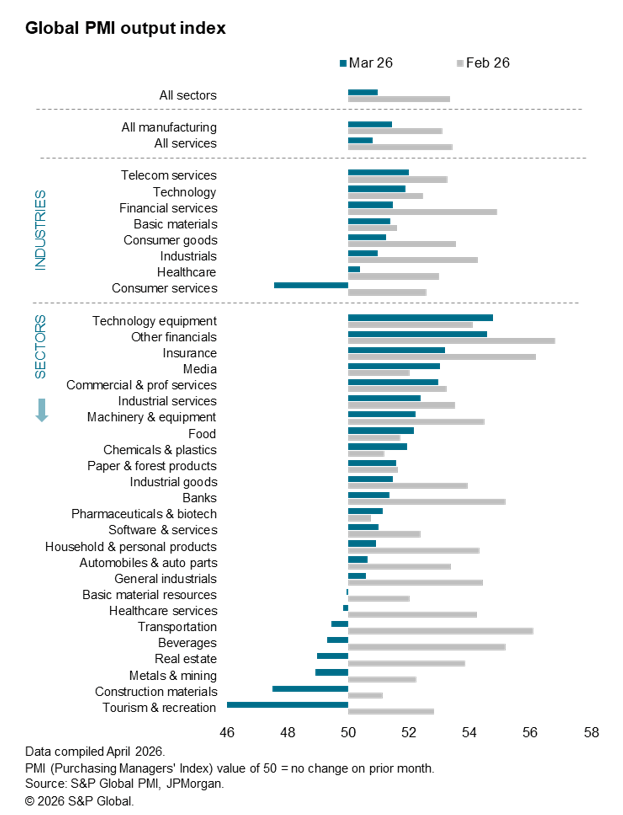
Global PMI survey data provide unique and timely insights into changing economic trends at the detailed sector level, helping policymakers and investors analyse the impact of events in near real time. In this respect, March’s PMI data provided the first insights into which sectors have been most affected by the outbreak of war in the Middle East. The data show that the economic impact on business growth was felt across all major industries, though consumer services – and tourism and recreation companies in particular – were hit the hardest.
Broad based industry impact from war
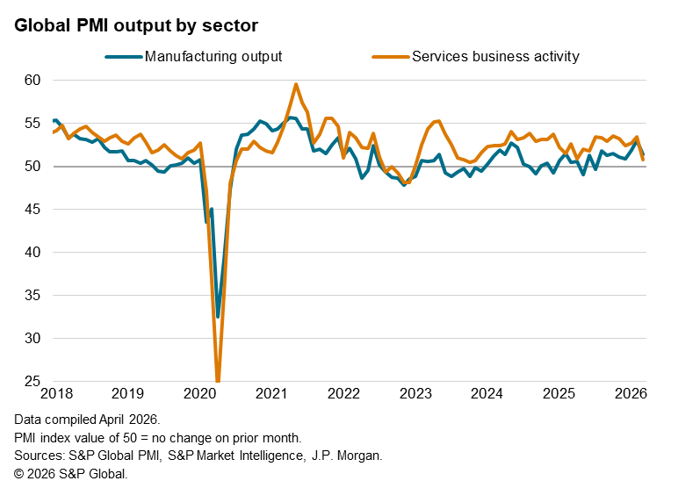
Survey data underscored how the war in the Middle East has already had a material impact on economic growth around the world. Growth slowed worldwide to its lowest since last April, cooling sharply across both manufacturing and services in March, according to the PMI numbers produced by S&P Global on behalf of J.P. Morgan, hinting at a broad-based slowdown. Factory production growth hit a three-month low while the service sector reported its slowest rise in activity since November 2023.
Consumer services hit hardest
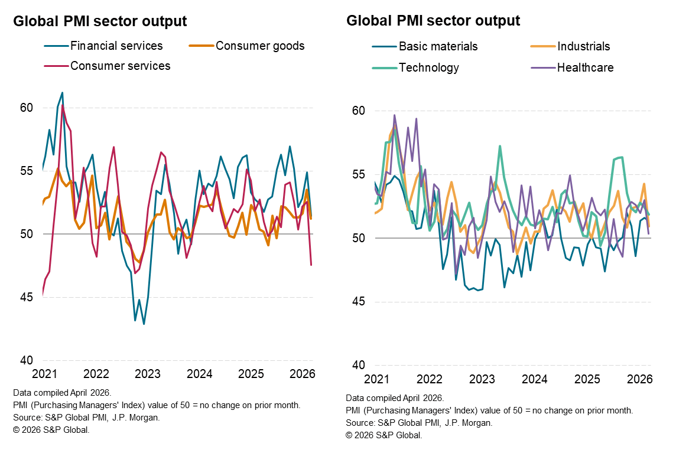
Drilling down deeper, the data showed weaker growth trends were recorded across all major industries globally. Only very modest expansions were consequently seen for basic materials, consumer goods and industrials (mainly comprising business services), and the recent upturn in healthcare growth ground almost to a halt. However, only the consumer services industry reported an actual drop in output, suffering its steepest downturn since November 2022.
The best performing industries were telecom services and technology, though even here rates of increase waned, the latter notably at its slowest since last May.
Financial services activity slows sharply
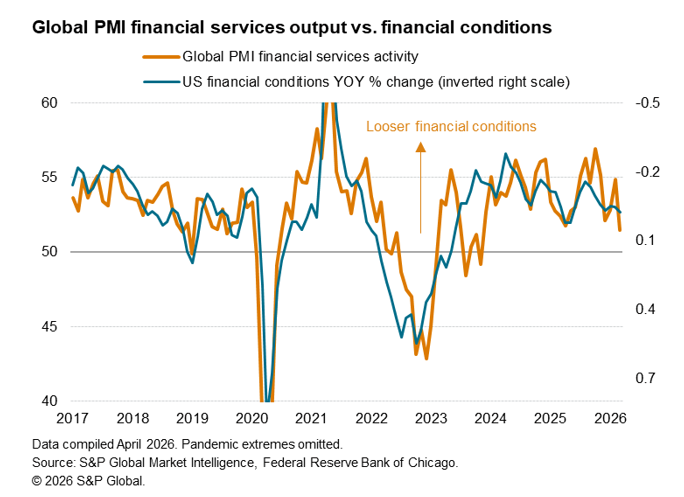
A particularly notable slowdown was also seen in financial services, reflecting financial market volatility and concerns over higher interest rates. Activity in the sector, which had been an important pillar of the global expansion in 2025, showed the smallest rise since November 2023.
Travel & tourism suffers steepest decline of all sub-sectors
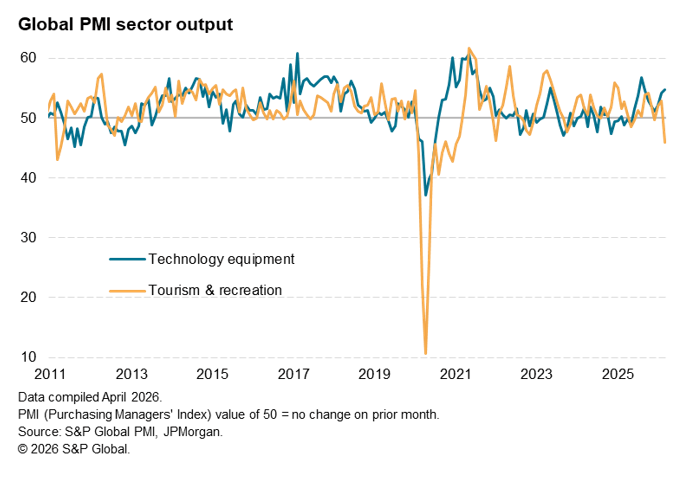
At the more detailed sector level, the steepest drop in activity was recorded for tourism & recreation amid war-related travel concerns and higher fuel prices. The drop in tourism & recreation activity was the sharpest since January 2021, during the COVID-19 lockdowns in many countries.
However, output also fell sharply in the manufacture of construction materials, and to lesser extents in metals & mining, real estate, beverages, transportation, healthcare services and basic material resources.
The decline in output in these eight sub-sectors during March contrasts with the universal rise in output reported across all 25 sectors covered by the PMI in February.
At the other end of the scale, the strongest performing sub-sector in March was tech equipment, followed by ‘other’ (non-banking) financials and insurance, though growth rates of the latter two sectors slowed sharply compared to February.
Access the press release here.
© 2026, S&P Global. All rights reserved. Reproduction in whole or in part without permission is prohibited.
Purchasing Managers' Index™ (PMI®) data are compiled by S&P Global for more than 40 economies worldwide. The monthly data are derived from surveys of senior executives at private sector companies, and are available only via subscription. The PMI dataset features a headline number, which indicates the overall health of an economy, and sub-indices, which provide insights into other key economic drivers such as GDP, inflation, exports, capacity utilization, employment and inventories. The PMI data are used by financial and corporate professionals to better understand where economies and markets are headed, and to uncover opportunities.
Read our latest PMI commentary here.
This article was published by S&P Global Market Intelligence and not by S&P Global Ratings, which is a separately managed division of S&P Global.
Theme
Location
Products & Offerings