ECONOMICS COMMENTARY — 01 Apr, 2026
Global manufacturers report safety stock building as war stokes supply and price concerns

Global manufacturers reported the steepest price rises and supply delays since 2022 on the outbreak of the war in the Middle East, with factories also building safety stocks amid a near-record spike in business uncertainty.
Manufacturing prices spike amid energy shock and supply delays
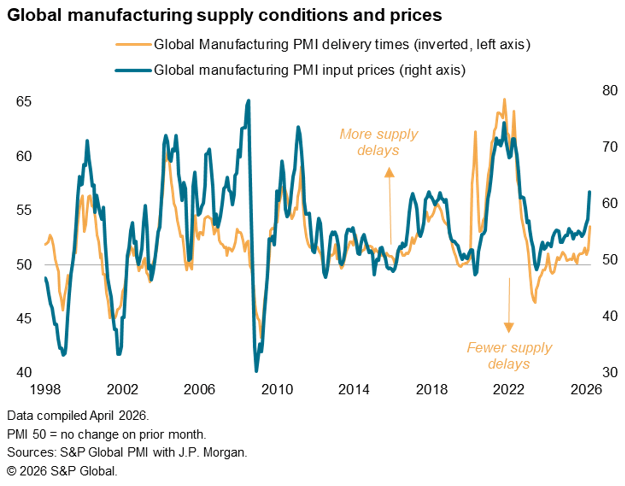
The global manufacturing Purchasing Managers’ Index (PMI), sponsored by J.P. Morgan and compiled by S&P Global Market Intelligence, indicated a surge in both prices and supply delays in March following the outbreak of war in the Middle East
Average factory input prices rose globally at the fastest rate since July 2022, the rate of inflation accelerating to a degree not seen since December 2009 outside the pandemic months. Supplier delivery delays meanwhile caused global lead times to lengthen to a degree not seen since October 2022.
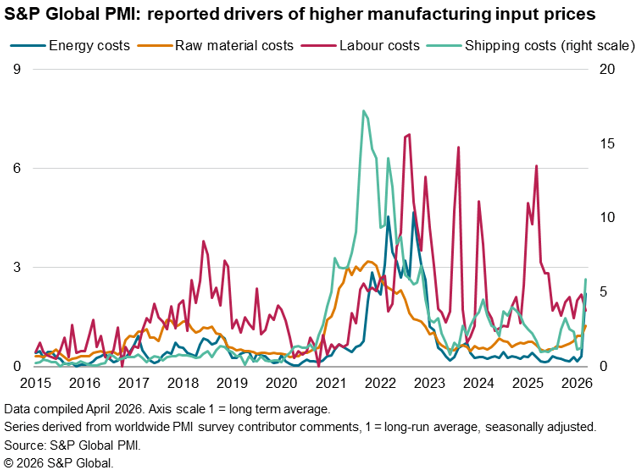
The two biggest drivers of higher prices were energy and shipping costs. According to worldwide PMI survey contributor comments, the impact of higher energy prices was the steepest recorded since December 2022. The inflationary impact of shipping costs was meanwhile at its highest since November 2022, both linked to the war in the Middle East and the closure of the Strait of Hormuz.
However, survey contributors also reported the pass through of higher energy and oil derivative prices to other inputs, such as food and chemicals. The inflationary impact of broader raw material prices also rose to the highest since December 2022 as a result.
A moderating factor on producer price inflation was meanwhile wages and salaries, which pushed up firms’ costs to one of the smallest extents seen over the past year and a half, helping alleviate the overall inflation uplift during the month.
Constrained production encourages safety stock building safety stock building
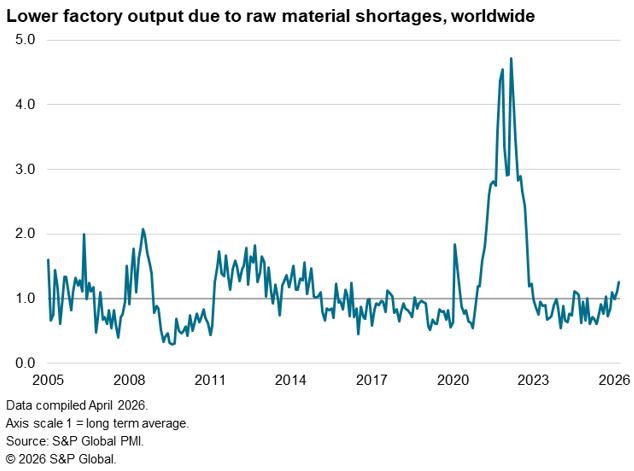
The escalation of supply delays has meanwhile caused production problems at increasing numbers of companies around the world. Reports of manufacturing output having been constrained by a lack of raw materials rose in March to the highest recorded since October 2022.
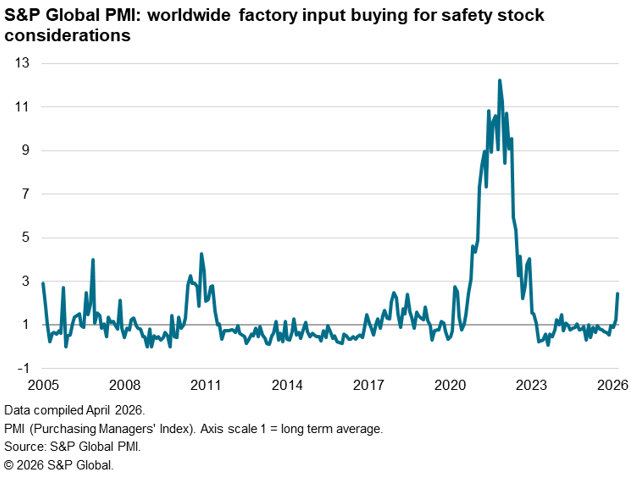
Although still running far below levels seen at the height of the pandemic, supply shortages and related production constraints contributed to a marked increase in the number of factories worldwide buying additional inputs for safety stock considerations. Such safety stock buying was the most prevalent since December 2022.
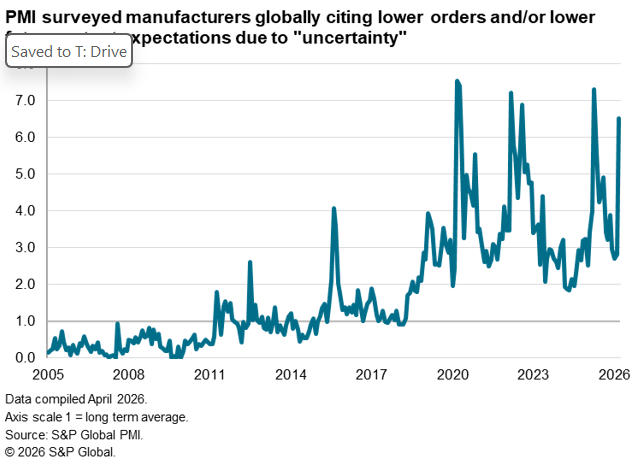
Uncertainty spikes to near-record level
Adding to the supply concerns is the spike in economic uncertainty caused by the war in the Middle East. Manufacturing survey contributor comments pointed to one of the most elevated levels of uncertainty seen since comparable data were first available over two decades ago (albeit just below the spike in concern caused by the announcement of US tariffs last April).
Access the latest global PMI press release here.
© 2026, S&P Global. All rights reserved. Reproduction in whole or in part without permission is prohibited.
Purchasing Managers' Index™ (PMI®) data are compiled by S&P Global for more than 40 economies worldwide. The monthly data are derived from surveys of senior executives at private sector companies, and are available only via subscription. The PMI dataset features a headline number, which indicates the overall health of an economy, and sub-indices, which provide insights into other key economic drivers such as GDP, inflation, exports, capacity utilization, employment and inventories. The PMI data are used by financial and corporate professionals to better understand where economies and markets are headed, and to uncover opportunities.
Read our latest PMI commentary here.
This article was published by S&P Global Market Intelligence and not by S&P Global Ratings, which is a separately managed division of S&P Global.
Theme
Location
Products & Offerings