Research — April 16, 2026
Generative AI Digest: AI drawn into geopolitics

451 Research from S&P Global Energy Horizons provides technology industry research, data, and advisory solutions. For more information or to contact us, please visit 451 Research.
As the war in Iran dominated headlines, AI was drawn into the geopolitical story. Reports suggested that Persian Gulf data center infrastructure linked to US cloud providers had come under attack, while Anthropic PBC's Claude was reportedly still being used in US military operations even as Anthropic remained in conflict with the Pentagon over safeguards around mass surveillance and fully autonomous weapons. Against that backdrop, the enterprise AI agenda continued to advance, with recent launches reinforcing the industry's shift toward agentic systems.

While Anthropic's dispute with the Pentagon escalated over guardrails on military use, OpenAI LLC struck its own publicized defense agreement. The timing helped generate a "Cancel ChatGPT" backlash online, with critics framing the episode as a test of AI ethics and acceptable-use boundaries. Commentators pointed to a sudden rise in interest in Anthropic's Claude following Anthropic's refusal to support uses tied to mass surveillance or fully autonomous weapons. OpenAI felt forced to respond, with CEO Sam Altman saying he "shouldn't have rushed" the announcement and acknowledging that the move had appeared "opportunistic and sloppy." While it would be a stretch to suggest this reflects broad consumer alignment with AI ethics, it does suggest that a visible segment of users is paying active attention to questions of acceptable use.

Product releases and updates
NVIDIA Corp. used GTC 2026 to argue that its opportunity now extends beyond AI training infrastructure into the software, model and simulation layers needed for agentic and physical AI. Alongside the Vera Rubin platform and related AI factory infrastructure, the company expanded its open-model portfolio for agentic systems. This included Nemotron 3 Super, a 120-billion-parameter hybrid mixture-of-experts (MoE) model with 12 billion active parameters and a 1-million-token context window that NVIDIA positions for long-context and multi-agent workloads. NVIDIA also used the event to reinforce a broader physical AI stack through new Cosmos and Isaac releases, an expanded robotics ecosystem, and additional automotive traction for DRIVE Hyperion. Finally, NVIDIA announced the NemoClaw stack, an enterprise-grade extension for the viral OpenClaw open-source platform that adds a critical security layer through the new OpenShell runtime to enable the safe deployment of always-on autonomous agents.
Adobe Inc. announced a public beta of AI Assistant in Photoshop for web and mobile, allowing users to describe edits in natural language, including by voice, in the app. It also introduced AI Markup in Photoshop web for more precise location-specific edits and expanded Firefly Image Editor with multiple generative tools and third-party models in a single workspace.
Perplexity AI Inc. announced Perplexity Computer, which appears to be an agentic orchestration capability that decomposes complex objectives into subtasks and coordinates sub-agents to execute them. Relative to the company's browser-based Comet Assistant, the main architectural extension appears to be support for longer-running asynchronous workflows and operation beyond browser contexts through access to a filesystem, browser runtime and tool integrations.
AI coding platform Cursor released its homegrown model Composer 2, which it claims is both faster and more cost-efficient than comparable models. Composer models also appear to sit in a separate, more generous usage pool than third-party models accessed through APIs. It appears to be based on Moonshot AI's Kimi K2.5, with additional tuning.
Forge is Mistral AI SAS's newly announced enterprise model-training stack for building custom models based on proprietary data. Similar in ambition to the not-dissimilarly-named Amazon Nova Forge, the concept is to move beyond merely fine-tuning models by supporting deeper model customization throughout the training life cycle. Presented as a full-life-cycle offering spanning data preparation, model training, alignment and evaluation, Mistral pitches the service as a way to support greater domain adaptation in industrial and other enterprise settings. The company also announced Mistral Small 4, a 119-billion-parameter MoE model (6 billion active) that accepts image and text inputs and supports both reasoning and lower-latency modes.
OpenAI shipped its new GPT‑5.4 model across ChatGPT, the API and Codex, with an announcement emphasizing that it combines recent gains in reasoning, coding, agentic workflows, computer use, tool search and 1-million-token context. The company also announced application security agent Codex Security. March 17 saw the release of smaller variants GPT‑5.4 mini and nano.
Microsoft Corp. announced Copilot Cowork, which shifts Microsoft 365 Copilot from a chat assistant toward a long-running, multi-step execution layer grounded in Microsoft 365 work context via Work IQ. Microsoft framed the launch as part of Wave 3 of Microsoft 365 Copilot.
Google LLC announced Gemini Embedding 2, a natively multimodal embedding model in public preview that maps text, images, video, audio and documents into a single embedding space. This shared semantic space enables cross-modal comparison and retrieval across text, audio and video. Multimodal retrieval has often relied on modality-specific pipelines — for example, separate optical character recognition, captioning, transcription or encoding steps — and Gemini Embedding 2 can simplify that architecture by consolidating embedding generation across content types. Cohere Embed v4 and Voyage Multimodal 3.5 are other multimodal embedding models on the market, but Gemini Embedding 2's support for audio as well as text, images, video and documents, along with its integration into the Gemini API and Vertex AI stack, is notable.
Databricks Inc. announced Genie Code, an autonomous AI agent for data work, positioned as purpose-built for Databricks. "Deep" integration with Unity Catalog, Lakehouse Federation and Model Context Protocol-based external tools enables it to reason over enterprise data and software artifacts. Databricks also announced the acquisition of Quotient, an agent evaluation and reinforcement learning company, suggesting the acquisition is to embed continuous evaluation directly into Genie and Genie Code.
Meta Platforms Inc. outlined an accelerated custom silicon road map, with plans to deploy four new generations of MTIA chips over the next two years. The company indicates that MTIA 450 and 500 are intended to support GenAI inference workloads. This sits within a broader multi-silicon strategy, with Meta emphasizing modular, reusable designs that it says should enable a faster release cadence than is typical for AI chips.
Airia Brands Inc. announced OpenClaw support via its AI Gateway, positioning the platform as a control layer that adds security, monitoring and policy enforcement around the open-source OpenClaw autonomous agent.
Funding and M&A
OpenAI announced a $110 billion funding round at a $730 billion pre-money valuation, implying an $840 billion post-money valuation, with backing from Amazon.com Inc., NVIDIA and SoftBank Group Corp. Amazon's $50 billion commitment includes $15 billion up front and a further $35 billion subject to undisclosed conditions reportedly linked to an IPO or AGI-related milestones. OpenAI also announced agreements to acquire AI security startup Promptfoo Inc. and Python tooling company Astral Ltd., which develops widely used open-source Python tools. Astral appears likely to strengthen Codex's integration with the Python development workflow, including environment management, code quality checks and verification.
Fireworks.ai Inc. acquired Hathora Inc., adding Hathora's orchestration and distributed infrastructure capabilities to strengthen the infrastructure layer behind its inference cloud. Hathora was initially known for its technology to help scale multiplayer game servers.
Advanced Machine Intelligence Labs (AMI Labs), Yann LeCun's new Paris-based startup, raised $1.03 billion at a $3.5 billion pre-money valuation, making it one of the largest seed rounds in Europe. The company is focused on building "world models" rather than conventional LLMs, aiming to create AI systems that better understand and plan in the real world. LeCun was formerly Meta's chief AI scientist and has long been skeptical that large language models alone are a path to human-level intelligence.
Meta announced on March 10 that it is acquiring Moltbook, an AI-only social network where autonomous agents post and interact with one another. Financial terms were not disclosed, but the deal has been presented as principally an acqui-hire into Meta Superintelligence Labs, with Moltbook co-founders Matt Schlicht and Ben Parr joining Meta's AI unit.
Anthropic has acquired Vercept, an AI startup specializing in computer-use agents whose vision-based technology allows AI to interact with software interfaces like a human at a keyboard. The deal represents a shift in Anthropic's product strategy, moving Claude beyond chat and toward a fully autonomous agentic interface. By integrating Vercept's specialized computer vision and user interface interaction technology into its ecosystem, Anthropic is looking to address the perception gap that has historically made autonomous computer use by AI models unreliable and prone to error.
Thinking Machines Lab Inc. announced a multiyear strategic partnership with NVIDIA, under which it will deploy at least 1 gigawatt of next-generation Vera Rubin systems. NVIDIA also made a significant investment in the startup.
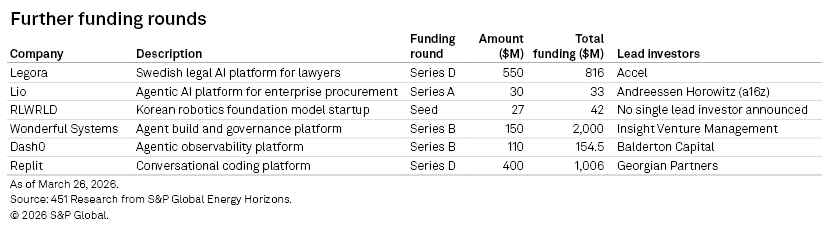
UK-based AI infrastructure company NScale Global Holdings Ltd. raised $2 billion in a series C round at a $14.6 billion valuation, with Aker ASA and 8090 Industries leading the round. The proceeds will help strengthen NScale's positioning ahead of a possible IPO, with the addition of Sheryl Sandberg, Susan Decker and former UK deputy prime minister Nick Clegg to its board adding further profile.
Politics and regulations
The current US administration defended the Pentagon's blacklist of Anthropic in court, arguing that Anthropic's refusal to allow "all lawful" military uses of Claude made it an "unacceptable risk" because the company could theoretically alter or disable its models during operations. At the same time, the Pentagon is actively building replacements for Anthropic's models and says engineering work is underway to move multiple LLMs into government-owned environments, suggesting it is actively targeting decoupling. The dispute began after Anthropic insisted on preserving two carve-outs: no mass domestic surveillance and no fully autonomous weapons. OpenAI's announcement that it had come to an agreement with the Pentagon generated significant public criticism. The backlash included the resignation of OpenAI Head of Robotics Caitlin Kalinowski.
The White House released a National AI Legislative Framework that argues for a single federal approach to AI regulation and explicitly backs preemption of state AI laws. The blueprint takes a relatively light-touch stance, while proposing legislation around child safety, data center energy costs, copyright, free speech and workforce readiness. Particularly notable was the instruction that the question of fair use would be left to the courts, despite the administration suggesting it believes training AI on copyright material was lawful. This is notable as it is in contradiction with The Republic Unifying Meritocratic Performance Advancing Machine Intelligence by Eliminating Regulatory Interstate Chaos Across American Industry Act, released by Senator Marsha Blackburn (R-Tenn.) two days earlier, which sought to codify the president's executive orders on AI and stated that unauthorized use of copyrighted works for AI training is not fair use under the Copyright Act.
The UK is launching a Fundamental AI Research Lab, offering grants up to £40 million over six years, plus access to large-scale national compute, with the intent to fund foundational research. Multi-institution and single-institution bids are solicited, with the expectation that successful applicants will be able to continue to grow their lab once funding is awarded.
In a notable copyright update, the US Supreme Court declined to hear Thaler v. Perlmutter, leaving in place lower-court rulings that works created entirely by AI, without meaningful human authorship, are not copyrightable under current US law.
India's Ministry of Electronics and Information Technology formally unveiled the India AI Governance Guidelines under the IndiaAI Mission. The guideline document outlines new institutional mechanisms, including an AI Governance Group, a Technology & Policy Expert Committee and an AI Safety Institute.
China formalized its 15th Five-Year Plan, which positions AI as a main focus of its national industrial upgrade. The plan mandates the integration of large models into core manufacturing sectors while aggressively pursuing technological self-reliance, bypassing Western export controls on high-end semiconductors. Crucially, the document introduces a "unified national computing network" to optimize the distribution of processing power across the country's data hubs. While the state emphasizes AI for economic resilience, the plan also codifies stricter governance, requiring that all generative models adhere to core socialist values and undergo rigorous security assessments.
This article was published by S&P Global Market Intelligence and not by S&P Global Ratings, which is a separately managed division of S&P Global.
Content Type
Language