Research — April 16, 2026
Consensus price forecasts – US, Israel war on Iran roils metals markets

By Anna Duquiatan
S&P Global Energy discusses consensus price forecasts for industrial and precious metals, including platinum group metals, amid broader market trends.
See S&P Global Energy's most recent market outlooks for aluminum, copper, gold, iron ore, lithium and cobalt, nickel and zinc.

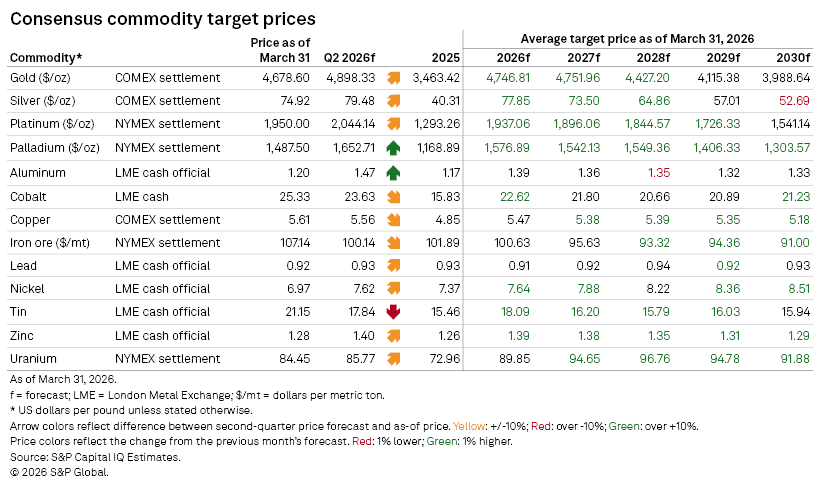
The war in the Middle East drove volatility across metals markets in March. As flight-to-safety interest and emerging macroeconomic headwinds vied for influence across the precious metals complex, supply shocks and demand pessimism swayed industrial markets. Consensus price targets in 2026–30 have been broadly upgraded.

The US-Israel war on Iran and Iran's retaliatory actions jolted metals markets in March. An early boost to safe-haven demand eventually gave way to macroeconomic pressures as oil-led inflation worries fostered concerns over a potential global economic slowdown.
In the wake of shipping disruptions in the Strait of Hormuz, Dated Brent crude vaulted to $141.37 per barrel as of April 2, up 99.3% since end-February, as assessed by Platts, a part of S&P Global Energy. Logistical disruptions and rising energy costs exposed supply chain vulnerabilities, while also driving risks to consumer spending. Major economies' manufacturing activity was broadly upbeat in February, but shipping bottlenecks and intensifying cost pressure could stifle business confidence in the near term.
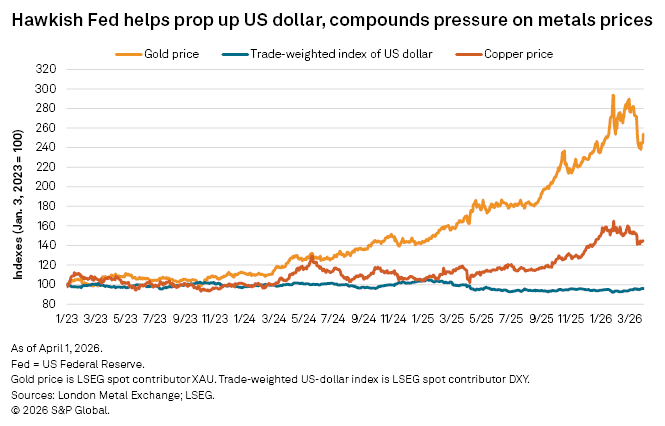
The trade-weighted index of the US dollar surpassed the 100 mark on March 13 for the first time since November 2025, underpinned by a hawkish US Federal Reserve. In its March 18 meeting, the Fed left interest rates unchanged and projected a slower pace of policy easing than initially anticipated. However, the Fed maintains that the implications of the ongoing Middle East war on the US economy remain uncertain.
Meanwhile, China's annual policy-setting Two Sessions meeting was held March 4–11, with mixed prospects for metals markets. China's leadership set the 2026 GDP target at 4.5%-5.0% — its lowest growth target since 1991 — with the policy narrative reflecting a shift away from traditional reliance on heavy industry and toward "high-quality development," emphasizing technological innovation. The industrial strategy pivot signals sustained demand support for technology-linked metals, such as copper, nickel and aluminum, but could drive headwinds for iron ore demand as property-sector recovery remains challenging amid a lack of large-scale stimulus.
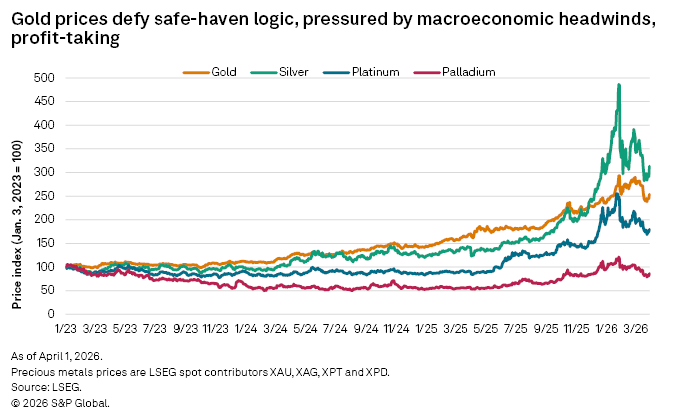
The London Bullion Market Association gold price briefly jumped to $5,313.90 per ounce on March 2, the first trading day following the US-Israeli war on Iran, but fell 16.9% to $4,413.55/oz on March 24, as profit-taking and bearish macroeconomics held sway even as risk headlines persisted. Liquidity demand prompted the recent unwinding, as growing anticipation of higher-for-longer US interest rates boosts the US dollar and Treasury yields, tempering the appeal of non-yielding assets like gold. However, structural support remains intact for gold, given sustained but slower central bank accumulation and ongoing active allocation in exchange-traded funds despite the recent price volatility. As gold retains its strategic appeal, consensus price targets have been raised 2.0% on average for 2026–28 but remain almost unchanged for 2029–30.
Macroeconomic headwinds also prevailed at the silver market, with the COMEX price unraveling in March to reach a three-month low of $67.98/oz on March 26. US dollar and Treasury yield gains diminished silver's investment appeal, while downside risks to global economic growth, fueled by heightened inflation worries, dim the prospects for industrial demand. Nevertheless, silver remains fundamentally supported, as it faces its sixth consecutive year of supply deficit in 2026. Consensus price expectations for silver were lifted 3.1% on average for 2026–28 and downgraded 2.5% for 2029–30.
NYMEX platinum and palladium prices also lost footing in March, falling to multi-month lows on March 27 at $1,845.00/oz and $1,388.00/oz, respectively. Consensus price targets across the five-year forecast horizon were upgraded 2.9% on average for platinum and 6.9% for palladium. Despite profit-taking and a recovering US dollar, structural supply constraints keep investor sentiments optimistic. The platinum market faces its fourth straight year of deficit in 2026, while palladium is forecast to swing into a surplus in the same year, though supply remains largely concentrated in Russia. The US' ongoing antidumping probe on imports of palladium from Russia could further complicate the supply picture, with initial reports of a 132.83% tariff rate being considered. A final decision is anticipated in late April.
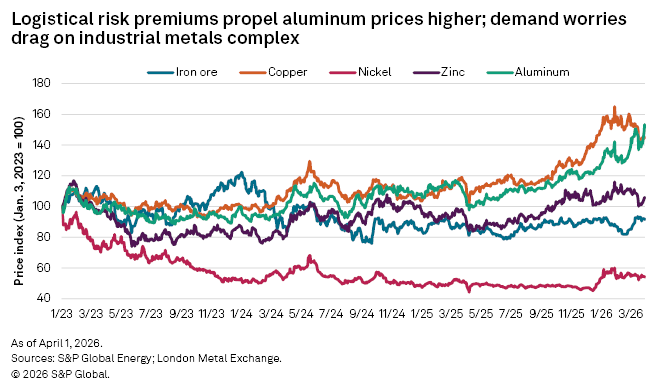
The London Metal Exchange three-month (LME 3M) copper price slumped to $11,929.50 per metric ton on March 20, its lowest level since December 2025. This came as early-March volatility yielded to compounding pressure from escalating macroeconomic risks and expanding refined supplies. Despite uplift in Chinese demand coming off the Lunar New Year holiday, market sentiments deteriorated as the escalating war in the Middle East fueled uncertainty over the global economy and prompted participants to adopt defensive positioning. Global visible copper stockpiles reached a multiyear high at 1.3 million mt in March, while the concentrate market remained undersupplied. As treatment charges remain suppressed, smelter operations derive support from elevated sulfuric acid prices, which have gained further momentum from tightening availability due to the constrained passage along the Strait of Hormuz. Copper consensus price expectations were lifted 2.1% on average across 2026–30, with green-economy demand helping to underpin the upside.
The LME 3M zinc price bottomed out at $3,042.00/mt on March 24, testing the psychologically important $3,000/mt mark. Worries over adverse demand implications of a prolonged war in the Middle East drove pressure, amplified by higher-for-longer US rates and China's cautious economic targets. Yet, supply vulnerabilities keep the upside viable; while the concentrate market squeeze persists, disruptions to shipping routes that tighten fuel availability and lift energy costs could result in potential curbs to smelter operations that would put refined supply levels at risk. Zinc consensus price outlooks were raised 3.7% on average across the five-year forecast horizon.
The LME 3M nickel price fluctuated during March but remained caught within its recent range at $16,800-$18,000/mt. Prices rallied early in the month on the back of post-holiday restocking in China and concerns over sulfur supply due to shipping disruptions in the Strait of Hormuz, then retreated in the latter half amid a firming US dollar and persistent market surplus. Constraints to sulfur supply — a critical component to high-pressure acid leaching (HPAL) operations — could tighten the availability of battery-grade nickel. Supply-side risks are compounded by rising energy costs that could hike input costs and prompt metal producers to curtail operations. As supply issues extend beyond the changing regulatory landscape for top producer Indonesia, nickel consensus price targets were lifted 1.3% on average for 2026–30. With China's shift in focus to quality-driven growth aided by technological advancement, battery demand for nickel is poised to remain supported, as the steel sector's role as consumption growth driver shrinks.
Escalating risks to aluminum supply amid Middle East smelter curtailments propelled the LME 3M price to a near four-year high at $3,516.50/mt on March 12, though gains were pared by surging energy costs jeopardizing consumption. Intraday price breached $3,500/mt anew on April 1, following reports of damages to smelting facilities — Emirates Global Aluminium PJSC's Al Taweelah site and Aluminium Bahrain BSC's plant — hit by Iran during attacks on March 28. The Strait of Hormuz shipping blockade is threatening metal availability to international markets and raw material supply to Middle East smelters, which account for about 8% of global aluminum production. Regional premiums in Europe, Japan and the US remained elevated, reflecting mounting supply anxieties and reliance on metal from the Middle East. However, the US Midwest premium pulled back from record levels, as imports breached 300,000 mt for the first time since steep US tariffs were introduced in March 2025. Uncertainty around the duration of the war is keeping the market volatile, with prospects of slowing global economy and the risk of demand destruction dragging on sentiments. Aluminum consensus price targets were downgraded 0.4% on average for 2026–30.
The Platts IODEX 61% Fe iron ore price rebounded in March to reach a monthly peak of $110/dry metric ton on March 17, but has since moderated to $107.65/dmt as the month ended. Seasonal restocking in China and risk premiums driven by the ongoing Middle East war drove gains, but China's robust portside iron ore inventories and a protracted slowdown in the domestic property sector capped the upside. Policy directions from Beijing's Two Sessions meeting reinforced bearish outlook for steel production, with the introduction a more moderate GDP growth target and renewed efforts to curb overcapacity in heavy industries. Potential demand drag from the US-Israel war with Iran further dim demand prospects. On the supply side, the Simandou mine in Guinea is facing transportation challenges likely to delay ramp-up, while conflict-driven energy inflation could lift mine production costs and tighten supplies in the near term. Consensus price forecasts for iron ore across 2026–30 have been upgraded 1.3% on average.
The Platts-assessed European cobalt metal price was broadly unchanged at $26.3-$26.5 per pound throughout March, as Democratic Republic of Congo's (DRC) export curbs remained the defining issue. The latest trade data shows China's cobalt imports from DRC have dropped to 331 mt of contained metal in December 2025. There are also reports of cobalt stockpiles at China's Wuxi exchange declining significantly since late January amid staggered shipments from DRC. Market reaction to the Middle East war was subdued, but a prolonged conflict could exacerbate supply risks. Logistical disruptions at the Strait of Hormuz threaten sulfur availability for cobalt production that relies on the HPAL route, particularly in Indonesia, whose supply has been critical to meeting global demand amid low DRC exports. Meanwhile, there is growing openness in DRC for strategic partnerships with the US, which would intensify competition for cobalt units. Cobalt consensus price outlooks have been upgraded 0.4% on average for 2026–29 and 5.9% for 2030.
For questions or more information, please contact:
Anna Duquiatan, Principal Analyst, Metals and Mining Research, anna.duquiatan@spglobal.com
S&P Global Energy produces content for distribution on S&P Capital IQ Pro.
This article was published by S&P Global Market Intelligence and not by S&P Global Ratings, which is a separately managed division of S&P Global.