ECONOMICS COMMENTARY — 23 Apr, 2026
April flash PMI signals eurozone economic decline and surging inflation as war impact intensifies

The flash Eurozone PMI indicates that the euro area is facing deepening economic woes from the war in the Middle East, presenting a headache for policymakers. The conflict has pushed the economy into decline in April, while driving inflation sharply higher. Increasingly widespread supply shortages meanwhile threaten to dampen growth further while adding more upward pressure to prices in the coming weeks.
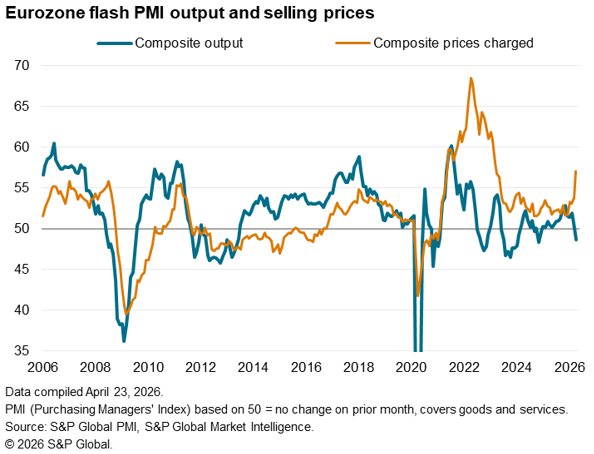
Output falls in April
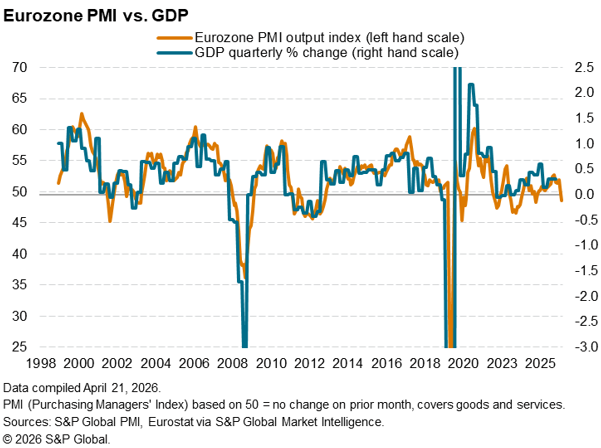
April’s flash Eurozone PMI, compiled by S&P Global, has moved into contraction territory for the first time since late 2024. The PMI’s headline output index dropped below the 50.0 no-change mark, posting 48.6 from a reading of 50.7 in March. The latest reading signals a 0.1% quarterly rate of GDP decline after a 0.2% gain had been signalled for the first quarter.
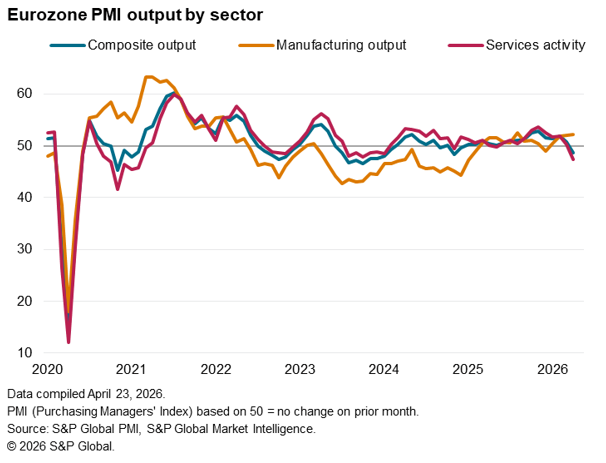
The survey shows the war is currently hitting the service sector hardest, where business activity is falling at a rate not seen since the pandemic lockdowns of early 2021. However, sustained growth of manufacturing output meanwhile seen in the April PMI comes with something of a sting in the tail, as demand for goods is being buoyed by stock building as companies scramble to secure purchases ahead of further price hikes or supply shortages.
Manufacturers have increased their buying of inputs to a degree not witnessed since early 2022 as supply chain delays have also risen to the most widespread since the pandemic.
Price pressures surge higher
Input costs and selling prices have already jumped higher not just in response to higher energy costs but in a reflection of a broader upturn in commodity prices and mismatch of demand against constrained supply. If the COVID-19 pandemic is excluded, this is the biggest surge in cost pressures that we have recorded since 2000.
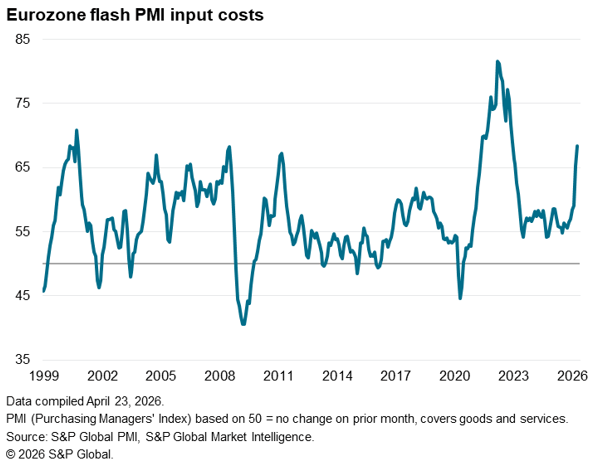
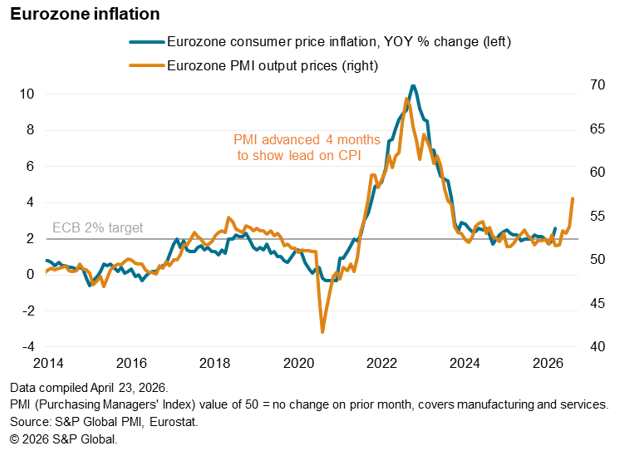
Input costs increased in April at the fastest pace since the end of 2022, as rates of cost inflation quickened across both goods and services. In turn, output (or selling) price inflation hit a 37-month high. At this level, the PMI’s prices charged index is indicative of consumer price inflation running near the 4% mark.
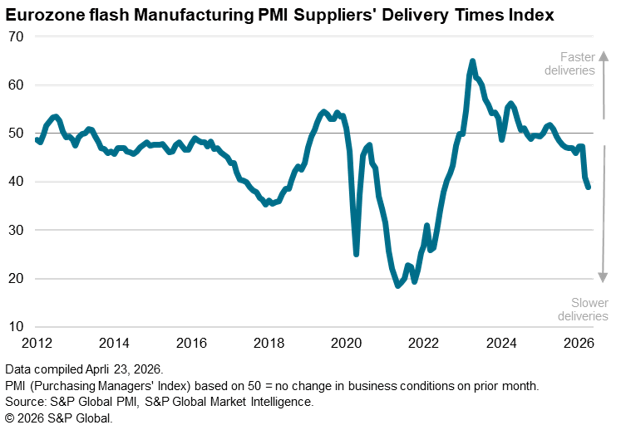
While high energy prices were widely cited in April, prices are rising for a wide variety of goods and services in part due to escalating supply shortages. Supplier delivery times – a key gauge of supply and demand imbalances and therefore of inflationary pressures in the pipeline – signalled the greatest lengthening of supplier lead-times since July 2022.
Gloomier prospects
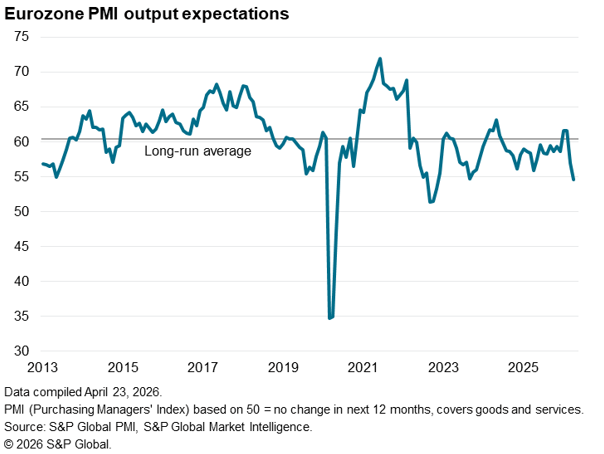
Not surprisingly, businesses are taking an increasingly gloomy view of the outlook, with sentiment now down to its lowest since late 2022.
Policy outlook
In this environment, the ECB once again has the unenviable task of deciding whether to raise interest rates in the face of the worrying inflation picture, or whether this price spike will prove temporary and its focus should instead be on the need to prevent the economy sliding into a deeper downturn. While postponing any decision could make either scenario worse, it would be understandable to see rate setters sit on their hands and await more clarity on the situation, both in terms of the conflict and the assessment of the eurozone’s economic health
Access the press release here.
© 2026, S&P Global. All rights reserved. Reproduction in whole or in part without permission is prohibited.
Purchasing Managers' Index™ (PMI®) data are compiled by S&P Global for more than 40 economies worldwide. The monthly data are derived from surveys of senior executives at private sector companies, and are available only via subscription. The PMI dataset features a headline number, which indicates the overall health of an economy, and sub-indices, which provide insights into other key economic drivers such as GDP, inflation, exports, capacity utilization, employment and inventories. The PMI data are used by financial and corporate professionals to better understand where economies and markets are headed, and to uncover opportunities.
Read our latest PMI commentary here.
This article was published by S&P Global Market Intelligence and not by S&P Global Ratings, which is a separately managed division of S&P Global.
Theme
Location
Products & Offerings