


Research — March 31, 2026
Michigan regulatory staff recommends smaller rate increase, return for DTE Gas

By Dan Lowrey
Staff of the Michigan Public Service Commission recently filed testimony supporting a $152.8 million rate increase for DTE Gas Co., which is about 64% of the amount sought by the utility. Staff recommended keeping the utility's return on equity unchanged at 9.80% rather than increasing it, which accounts for a portion of the revenue requirement difference.
A commission decision in the proceeding is expected by September, with new rates effective Oct. 1.

➤ Michigan Public Service Commission staff supports a $152.8 million DTE Gas (DTE-G) rate increase, about 64% of the $237.5 million request. The difference is partially due to keeping the return on equity (ROE) at 9.80% versus DTE Gas' requested 10.25% ROE. Staff estimates that ROE/return differences account for roughly $30.2 million of the $84.7 million gap between the company's and staff's revenue requirement positions.
➤ Beyond ROE differences, staff's biggest reductions come from net operating income adjustments ($50.7 million of the revenue requirement gap), including proposed disallowances tied to executive incentives and equity compensation, and a challenged forecast of Active Healthcare costs. At the same time, staff is broadly supportive of the Infrastructure Recovery Mechanism roll-in of roughly $74.8 million and the continuation of key safety/reliability programs.
➤ The Michigan regulatory climate is viewed as somewhat constructive but was downgraded in 2024 to average due to tighter outcomes in rate proceedings.

Staff's recommended rate increase, which includes the roll-in to base rates of $74.8 million being collected through an Infrastructure Recovery Mechanism (IRM), is premised upon a 9.80% return on equity (40.82% of regulatory capital structure) and a 5.91% overall return on rate base of $7.99 billion for a test year ending Sept. 30, 2027.
The 9.80% ROE is roughly in line with national averages tracked by RRA. An analysis conducted by RRA indicates that the average ROE authorized for gas utilities was 9.73% in rate cases decided in the first nine months of 2025, largely in line with the 9.72% average for full-year 2024. There were 26 gas ROE authorizations in the first nine months of 2025, versus 44 in full-year 2024. DTE-G is currently authorized a 9.80% ROE and has requested an equity return of 10.25% in the current proceeding.
RRA calculates that differences in the rates of return account for about $30.2 million of the approximately $84.7 million difference in the revenue requirement between the company's supported $237.5 million increase and the staff's proposed $152.8 million increase.
RRA calculates that the staff's rate base adjustments account for about $3.8 million of the $84.7 million revenue requirement difference, while the proposed net operating income adjustments account for the remaining $50.7 million.
Regarding net operating income items, staff testimony filed March 13 recommended disallowing $11.0 million in executive incentive plan expenses related to the achievement of financial performance measures, citing commission precedent. By a similar argument, the staff recommended disallowance of almost $1.9 million in restricted stock payments associated with financial measures.
Staff also took issue with DTE-G's forecast Active Healthcare expense and recommended a disallowance of $3.6 million. Staff testified that the company unreasonably increased its actual historic test year basis with multiple adjustments, including adding back prescription drug rebates it received in 2024, adding back accrued employee payments in 2024 that it claimed were excessive, and applying inflation factors "which are not reflective of the Company's actual expense trend and excessively high."
With respect to DTE-G's request to continue a Gas Revenue Decoupling Mechanism (RDM), staff recommended the company find an alternative method for calculating its weather normalization adjustment. The first issue staff found is regarding the actual and normal heating degree days (HDDs) the company used. In the Excel file used to weather-normalize load, the company labeled the HDDs as weighted; however, it appears that Detroit's HDDs were used instead. Staff also took issue with the utility's use of a yearly heating load factor. "While this may create an appropriate adjustment for normal HDD when looking at a year as a whole, the way that the adjustment is distributed throughout the months in the year is problematic," staff testified.
Staff supported continuation of DTE-G's IRM, which includes the Gas Renewal, Pipeline Integrity, Regulator Station Replacement, and Cathodic Protection programs. The IRM surcharge would be recalculated based on the final order in this case. These programs aim to enhance system reliability and safety.
Staff was generally supportive of several of DTE-G's accounting requests, including continued deferral accounting for low-income assistance credits, pension expense and increases in leak detection and repair costs above the amounts authorized in this case.
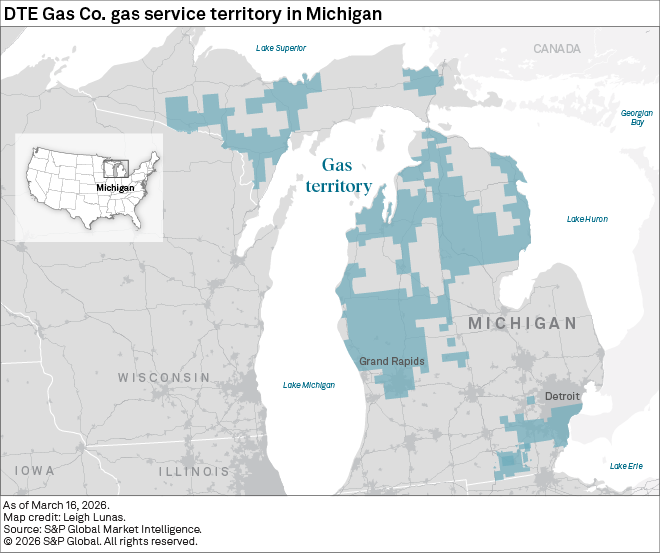
DTE-G is a subsidiary of DTE Energy Co.
Rate case background
On Nov. 13, 2025, DTE-G filed a general rate case application with the commission seeking approval for a $237.5 million rate increase, which is partially mitigated by the roll-in to base rates of $74.8 million from the IRM already being paid by customers. The company argues that the proposed rate adjustments are essential to cover increased operational costs, infrastructure investments, and to ensure a reasonable return on equity.
In its application (C-U-21973), DTE-G emphasized the need for these adjustments to maintain safe and reliable natural gas service while meeting regulatory compliance and customer service quality expectations. The proposed rate changes will affect various customer classes, with residential services projected to see an average increase of approximately 7.96%.
DTE-G's request reflects broader trends in the energy sector, where utilities are increasingly seeking to balance the need for infrastructure investment, operational efficiency and customer affordability.
The primary drivers of the application stem from the need to address a significant revenue deficiency driven by rising operational costs, extensive infrastructure investments, and regulatory compliance requirements. Key factors contributing to this situation include increased maintenance and upgrade expenses for aging infrastructure, compliance with state and federal regulations, market-driven wage increases, and lower-than-expected sales forecasts.
DTE-G calculated that requested additions to rate base account for $134 million of the $237.5 million revenue deficiency. An increase in its ROE to 10.25% accounts for $20 million, an increase in its equity ratio accounts for $21 million, inflation accounts for $23 million and higher operations and maintenance expense accounts for $56 million. A reduction in expenses associated with unaccounted-for lost gas and company-used gas of $13 million, and a sales margin of $4 million, slightly offset the revenue deficiency.
Notable projects include the East Petoskey Pipeline Reinforcement, which focuses on increasing pipeline capacity, and the Fort Street Main Replacement, involving upgrades to aging infrastructure. Additionally, the Oakland Resilience Interconnect Project and the Taggart Compressor Station Replacement are key initiatives aimed at improving operational efficiency and system resilience.
Mich. regulatory environment
RRA views the regulatory climate in Michigan as somewhat constructive from an investor perspective. However, on July 31, 2024, RRA reduced its ranking of Michigan regulation to Average/1 from Above Average/3. The jurisdiction remains more constructive than average from an investor viewpoint.
RRA had placed the state on watch following a 2022 rate case decision in which the PSC authorized DTE Electric Co. (DTE-E) an increase in rates that was less than 10% of that requested, but did not lower the ranking at that time. RRA viewed the decision as an anomaly, as a large part of the revenue requirement difference stemmed from reliance on a higher post-COVID-19 sales forecast than the utility had used in its revenue requirement calculations. DTE-E has now had three rate cases decided since then, and outcomes have generally been more constructive.
The commission has several constructive practices in place, including a streamlined rate case process, a framework for using forecast test years to reduce regulatory lag and a framework that permits a cash return on certain construction work in progress, thereby reducing the uncertainty of cost recovery. Retail competition for electric generation is in place but is limited, and attempts to raise this limit have not been successful. Electric utilities have retained their generation assets, and customers who do not select a competitive supplier receive service on a regulated, traditional cost-of-service basis. Adjustment mechanisms are in place for fuel costs for customers served under bundled service. For more details, refer to the Michigan commission profile page.
Regulatory Research Associates is a group within S&P Global Commodity Insights.
S&P Global Commodity Insights produces content for distribution on S&P Capital IQ Pro.
For a full listing of past and pending rate cases, rate case statistics and upcoming events, visit the S&P Capital IQ Pro Energy Research Home Page.
For a complete, searchable listing of RRA's in-depth research and analysis, visit the S&P Capital IQ Pro Energy Research Library.
This article was published by S&P Global Market Intelligence and not by S&P Global Ratings, which is a separately managed division of S&P Global.