Research — February 12, 2026
The rise and fall of the silver price

The silver price trajectory in January was like a shooting star — a bright but short-lived journey from the first to the penultimate trading day of the month. The London Bullion Market Association (LBMA) price climbed 60% since Jan. 2 to reach its all-time high of $118.45 per ounce before dropping 13% day over day and another 21% to $81.975/oz on Feb. 2.
The recent rise and fall of the silver price was caused by economic hedging and supportive fundamentals in a frantic bout of short positioning undone by the intense pressure of CME Group margin hikes. Some will recall the "speculative blow-off top" followed by a "sudden reality check" associated with the Hunt Brothers events of 1980.
The rise
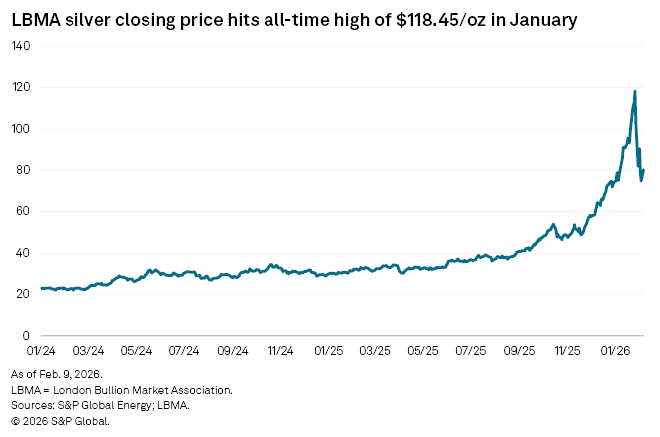
Like gold, silver has intrinsic value that investors seek in times of economic and geopolitical turmoil, yet the market is simultaneously quieter and more volatile. It is smaller, somewhat illiquid and with a lower price tag — all the makings of a highly leveraged commodity.
Ongoing geopolitical tensions, reduced expectations for global trade growth and some protection over currency debasement (especially with respect to a weakening US dollar amid rising debt, economic tensions as well as the anticipation of weaker Treasury bond yields) have been supporting the silver price, echoing the dynamics for gold. In addition, silver has industrial applications that account for approximately half of the demand. This proportion could rise with the clean energy push and AI revolution, as silver is widely used in solar panels, electric vehicles and electronics, particularly for data centers.
Fundamentals are also supportive of the silver price: The market has been in deficit, in part due to silver generally being a byproduct and therefore depending on other commodities' mined output. The supply deficit also meant that most of the "paper" silver traded on stock exchanges — i.e., futures contracts — typically outvalues the amount of silver metal available, and even more so during this bull run.
Tight supply, strong dual precious and industrial demand and a great deal of speculation drove the silver price to an all-time high.
The fall
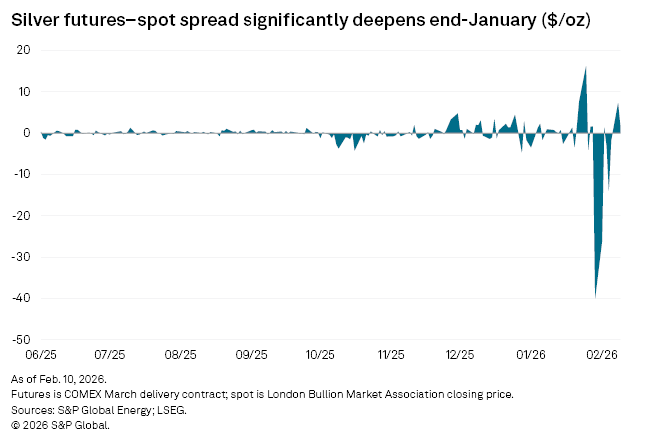
The first crack came in mid-January on the back of a physical run, as institutional investors pulled up their future deliveries, withdrawing about a quarter of COMEX's silver inventory. This event deepened the backwardation of the futures curve that started in late 2025, signaling increased scarcity and fueling the price rise. The higher leverage caused COMEX owner CME Group Inc. to implement a percentage-based margin system at the exchange to keep the market in check. CME raised the silver margin requirement a few times, with a Jan. 30 emergency hike causing a massive sell-off and triggering a bear market in two consecutive sessions.
Despite the simultaneous announcement of a new, hawkish US Federal Reserve Chair, the crash was a classic response mechanism within futures trading. CME Group's actions should have been anticipated given the extreme market volatility, but they do not predict any subsequent price trajectories.
However, the recent events indicate overall market resilience as demand is supported on two grounds. The first is the current global picture, with geopolitical instability, economic uncertainty and growing industrial demand amid a recurring supply deficit. The second is past experience, with the 2011 margin hikes merely having halted a price rise.
On Wednesday, Feb. 11, the LBMA silver price closed at $86.10/oz.
S&P Global Energy produces content for distribution on S&P Capital IQ Pro.
This article was published by S&P Global Market Intelligence and not by S&P Global Ratings, which is a separately managed division of S&P Global.