Research — February 13, 2026
The Milan‑Cortina Olympics arrive as NBC continues to raise the bar

HBO Max is on track to complete its expansion across Europe, a move taking place while Netflix Inc. and Paramount Skydance Corp. are battling for control of Warner Bros. Discovery Inc.'s prized assets. At the start of 2026, the service launched in Germany, Italy, Austria, Switzerland, Greece, Luxembourg and Lichtenstein, with the UK and Ireland scheduled for release in March.

➤ 2026 marks the final stage of HBO Max's European expansion, while Netflix and Paramount Skydance are locked in a duel to acquire Warner Bros. Discovery assets.
➤ Differences in current market share could determine who wins the battle when European regulators weigh in.

HBO Max is now available in more than 100 markets worldwide and has had years of presence in major European markets such as the Nordics, Spain, Portugal, Poland and France.

In early December, Netflix initially agreed to acquire Warner Bros. Discovery's studios and streaming divisions for approximately $82.7 billion in a cash-and-stock deal. However, Paramount Skydance remains firm in its revised all-cash tender offer of $30 per share for the entirety of Warner Bros. Discovery and has initiated legal action, challenging Warner Bros. Discovery's justification to proceed with Netflix. Netflix has since revised the deal to an all-cash offer in hopes that it would lead to a faster, smoother transaction.
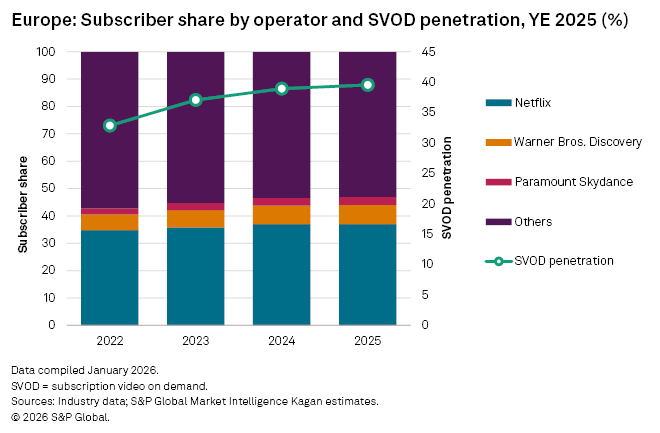
At the end of 2025, Warner Bros. Discovery accounted for 7% of European paid streaming subscriptions through HBO Max and Discovery+, the latter nearing phase-out in most markets. Netflix, on the other hand, is the leader in the region with a 37% market share in the same period. S&P Global Market Intelligence Kagan's consumer survey in France, where HBO Max launched in June 2024, reveals that over 80% of its subscribers also had access to Netflix. This suggests that a Netflix acquisition of Warner Bros. Discovery's streaming and studios division would likely have a marginal impact on overall subscriber numbers. The primary benefits would stem from increased engagement, reduced churn, access to valuable IP and the potential for future price increases.
Paramount Skydance has a joint venture with Comcast Corp. operating SkyShowtime in markets where Comcast does not have a pay TV presence via Sky, while Paramount+ is available in the DACH region (Germany, Austria and Switzerland), Italy, France and the UK. Considering Paramount Skydance's limited market share of 3% in the region, adding Warner Bros. Discovery's assets is more about survivability and making it into the top four streamers, which could threaten Walt Disney Co.'s Disney+ third spot.
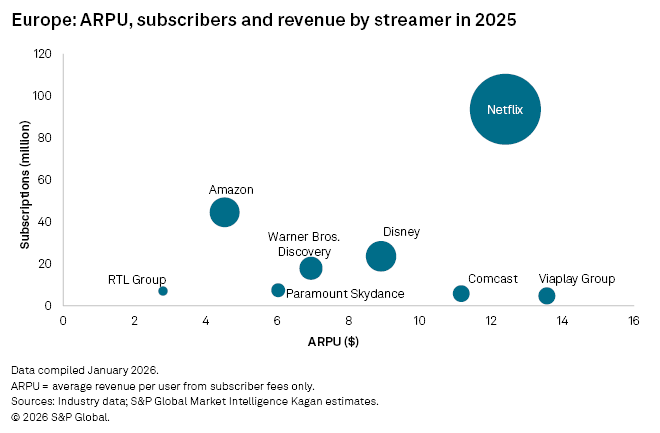
The following graph plots streaming providers in Europe by average revenue per user and reach with the bubble size indicating total revenue from subscription fees. Netflix sits at the higher end of the spectrum with both a dominant subscriber base at an estimated 93.7 million and a strong ARPU figure of $12.39. This is in contrast with Warner Bros. Discovery's premium offering, which until recently, had a limited footprint, with its ARPU eroded by both third-party distribution agreements such as Vodafone Group PLC in Greece and numerous introductory discounted offerings. Netflix could combine with Warner Bros. Discovery by fully integrating content at no extra cost, offering it as a premium add-on, or bundling a stand-alone HBO Max at a reduced price.
If Paramount Skydance were to become the owner of HBO Max, the impact in the market would be dramatically different, with the combined entity competing with Disney+ for the third spot in number of subscribers. Recent survey data reveals a disparity in cross-platform access between HBO Max and Paramount+ subscribers in France. Less than half (under 50%) of HBO Max subscribers also had access to Paramount+, while an even smaller percentage (30%) of Paramount+ subscribers had access to HBO Max. This suggests a limited overlap between the two services with each streamer possibly drawing distinct audience segments.
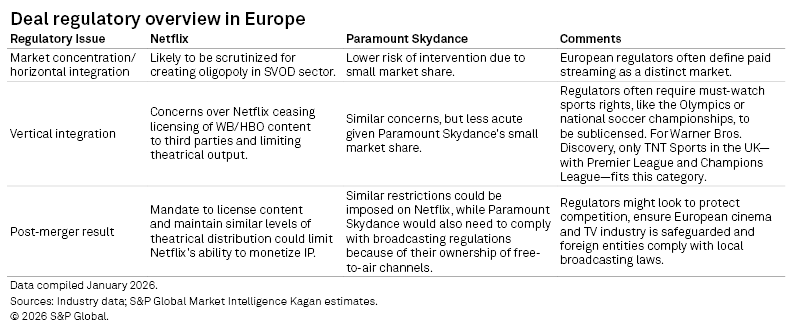
A Netflix acquisition of HBO Max and Warner Bros. Discovery's IP would likely face significant regulatory scrutiny in Europe, especially regarding market concentration in the SVOD sector, as regulators can become wary of formation of oligopolies. Vertical integration concerns would also arise, particularly if Netflix was to restrict licensing of WB/HBO content or reduce theatrical output. Post-merger, Netflix could be mandated to license content and maintain current levels of Warner Bros. Discovery's theatrical distribution, limiting its ability to fully monetize the newly acquired IP.
Paramount Skydance, with its smaller market share, would probably face lower intervention risk, though similar concerns exist. Notably, regulators often require must-watch sports rights, such as the Premier League and Champions League on Warner Bros. Discovery's TNT Sports in the UK, to be sublicensed. Paramount Skydance might also face mandates around content licensing and theatrical output and additional obligations due to acquiring Warner Bros. Discovery's free-to-air channels. Kagan believes that, despite regulatory scrutiny and potential restrictions, the deal will ultimately be approved regardless of the buyer, with prior precedents including Amazon.com Inc.'s acquisition of Metro-Goldwyn-Mayer Studios Inc. and Paramount Global's purchase of Channel 5 Broadcasting Ltd. (UK).
Economics of Streaming Media is a regular feature from S&P Global Market Intelligence Kagan.
This article was published by S&P Global Market Intelligence and not by S&P Global Ratings, which is a separately managed division of S&P Global.
Content Type
Segment
Language