Research — February 27, 2026
Generative AI funding: A sober retrospective and the trends shaping 2026
By Alex Johnston and Melissa Incera
In early 2024, we took a look at the unorthodox financing and influence structures that had emerged in the fledgling generative AI space. A limited number of investment opportunities had propelled valuations to new highs and created a tangled web of interests and unorthodox investment structures in a few early-stage players. Then, the story was the unprecedented investment behavior of incumbent technology vendors, looking to establish footholds in this transformative new market.
Two years later, these dynamics have only intensified. Billion-dollar valuations no longer shock; hundreds of billions are the new benchmark. Equity has gone from competitive to prohibitively expensive and dilutive; AI companies are growing asset-heavy, operating more like infrastructure than typical SaaS players. The stakes are higher, financing is more complex, and GenAI is as much about capital structure as it is innovation.

While the broader narrative suggests GenAI has gone up and up, a retrospective shows extreme volatility masked by aggregate growth. We see that first-mover advantage has been fragile, and that unfettered access to capital has served some as a catalyst and others as a yoke. Coming into 2026, investor sentiment remains bullish, but more discriminating. Value is shifting from model development and training toward inference and inference applications (agents), with road maps trending toward the physical infrastructure and real‑world operationalization required to run these systems at scale. Beneath this shift, increasingly complex financial engineering has enabled frontier labs to maintain growth while obscuring true fiscal demand. Frontier labs have committed to multi‑year buildouts of compute, energy and data center capacity that represent multiples of even their most optimistic long‑term revenue forecasts. These structures may hold if growth continues to be exponential, but the more likely scenario is that revenue projections never fully catch up to spending already locked in. Expect more hollowed‑out labs, "acqui‑hires" and recapitalizations framed as strategic pivots as the same forces that elevated the winners are now intensifying pressure on those without sustainable economics or differentiated infrastructure. GenAI has entered a phase where capital structure matters as much as technical sophistication, and where real utility, rather than momentum, will determine the winners.

Taking stock of the unicorns of yesteryear
Two years ago, the list of GenAI front-runners (assumed unicorns where valuations weren't disclosed) comprised 14 plucky startups, most of them model developers, all enjoying abundant access to capital — even if Anthropic PBC and OpenAI LLC were already out in front. Today, those two still dominate the funding narrative, running a continuous fundraising carousel at valuations in the hundreds of billions. Anthropic alone has closed 15 rounds in the past four years.
The rest of the picture looks radically different. Three of the 10 best-funded GenAI unicorns upon entering 2024 are now shadows of their former selves, either "acqui-hired", bankrupt or hollowed out (Stability AI alone appears to be successfully clawing itself out of a financial hole). Most others have not raised a dollar since, or have executed major strategy shifts once it became clear they could not keep pace with the leading foundation model providers. This is not to say they are failing, but by using valuation growth as a crude benchmark for growth and investor enthusiasm, most of yesterday's former front-runners (nine of 14) have stalled and been surpassed.
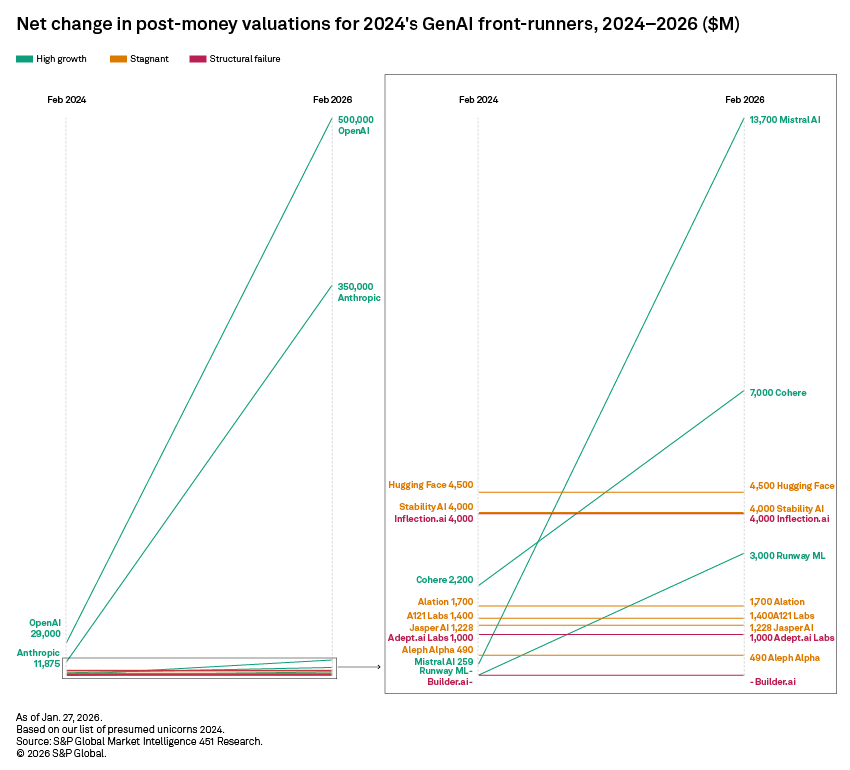
As a whole, the AI and GenAI markets have undeniably thrived. The list of AI unicorns minted in the GenAI era has soared to 239, according to data from S&P Global Capital IQ, while AI companies took in over $200 billion in funding in 2025 (half of all technology funding). Newcomers like World Labs, xAI and Perplexity AI Inc. have leapfrogged these former leaders.
Yet the full story is more nuanced. Our data show a bifurcating VC landscape, with capital concentrated on polar ends of the market. On one side, mega rounds continue into a selective group of foundation labs (e.g., Perplexity has raised nine times since 2024 and has 62 investors on its cap table). At the other end, seed and early-stage capital continue, but target specialists focused on specific domains like legal, healthcare or coding. This has left a middle class of AI players that raised during the 2024 hype cycle and now face a sorting process. We can expect to see a resulting wave of consolidations and "acqui-hires" by incumbents looking to talent-strip.
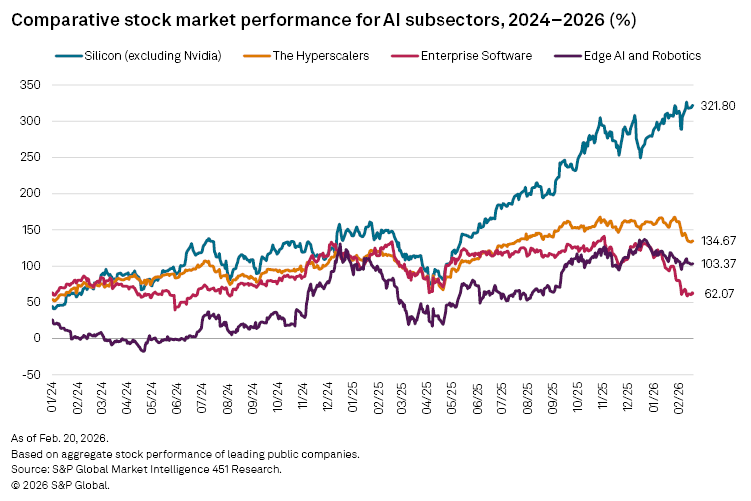
The same growing discernment is visible in public markets, where AI-related stocks have undergone several regime shifts over the past two years. An early "everything AI" phase in 2024, when most subsectors moved in lockstep, has given way to a fundamentals-driven environment marked by widening dispersion. Infrastructure-heavy segments such as silicon have consistently outperformed (even excluding NVIDIA Corp.), while enterprise software has lagged as revenue, pricing power and customer return on investment have come under scrutiny. Edge AI and robotics have emerged as episodic leaders (high volatility), while hyperscalers have delivered steadier midrange returns. Together, these shifts underscore a market that has moved from broad enthusiasm to selective judgment, rewarding position in the value chain and earnings visibility rather than broad AI exposure.
What can we expect in 2026 and beyond?
As we enter the new year, we cite several trends we anticipate will accelerate and shape the financing era ahead.
Geopolitics and sovereign strategies increase
Geopolitics is no longer a backdrop for AI development; it is a key driver of capital allocation. Governments have moved from passive grants to active equity participation, showing a desire not only to support but also to physically own and give their AI players an edge. The US, in 2025, saw a major shift toward state-backed industrial policy, with an $8.9 billion equity investment in Intel Corp. (taking a 9.9% stake) and a $150 million letter of intent to invest in semiconductor company xLight. China, meanwhile, is subsidizing national champions like DeepSeek to help such players gain traction in foreign markets.
Globally, regional powers are also doubling down on cultural and linguistic sovereignty as AI is viewed as vital national infrastructure. South Korea launched its 530 billion won ($390 million) AI Champions program, backing local leaders like Naver and Upstage to ensure Korean LLMs remain competitive. India's $1.25 billion India AI Mission is funding homegrown datasets and models to mitigate reliance on Western systems. National infrastructure has also taken on new meaning, now encompassing a "sovereign compute" stack — including domestic data centers, state-owned GPU clusters and specialized power grids — which serves to de-risk nations financially while ensuring absolute control over their own technological supply chains. The trend is global and accelerating, with Canada, China, United Arab Emirates, France and Saudi Arabia deploying a blend of subsidies, public-private partnerships, and strategic investments to preserve culture, safeguard data and build strategic advantages.
Financial engineering grows more sophisticated
As valuations for frontier labs hit the hundreds of billions, raising equity has become more challenging: It is increasingly dilutive, and venture sources have their limits. As compute and energy demands grow, the biggest labs are increasing the complexity of financial engineering to make ends meet.
Hardware-backed debt
Top startups are getting creative with a different financing vehicle: debt. Asset-backed lending and structured equipment financing have emerged as primary alternatives, with the high cost of silicon effectively transforming GPUs into an asset class. This leverages GPU clusters as high-value collateral, providing frontier labs with the compute capacity they need while minimizing equity dilution. Pioneered by neoclouds like CoreWeave Inc. and Lambda, we have seen the likes of OpenAI, Anthropic, xAI, and even hyperscalers like Meta Platforms Inc. and Oracle Corp. jumping in recently.
The risk is that this creates shadow balance sheets, as these companies generate huge financial obligations that do not appear as traditional debt on financial statements. With future cash flows effectively precommitted to these structures, if demand for models slows or inference prices fall dramatically, they can quickly turn GPUs from growth engines into stranded assets, forcing companies to raise distressed equity or consolidate.
Circular infrastructure deals reign
Two years ago, "cloud credits" were a novelty; today, they are increasingly common. Big tech firms are investing billions into AI startups, which the startups immediately spend back on the investors' cloud services. These deals serve to simultaneously inflate the earnings of the tech giants and concentrate risk across a tight network of industry players. Arguably, many of the startups are overextended; OpenAI has committed to infrastructure spending of (estimated) over $1 trillion in the next 10 years. Annual revenue, meanwhile, totaled $20 billion in early 2025 — a mere 2% of that total.
AI startups act like late-stage companies
Many previously fledgling AI startups are sitting on billions of dollars in capital and bringing in revenue equivalent to large, public and late-stage companies. And we are starting to see them act accordingly. Anthropic has quietly inked two acquisitions, both in the second half of 2025. OpenAI, meanwhile, has made 13 deals total, with targets ranging from game development, a financial investment mobile application and a $5 billion reach for hardware maker iO Products (its largest thus far). Expect to see more deal flow as the focus shifts to operationalizing AI in both consumer and enterprise environments and other once-prominent AI startups stall or flame out. Both of these market front-runners also appear to be moving toward potential listings, with projected valuations of $300 billion for Anthropic and $1 trillion for OpenAI. This would significantly improve the ability to raise capital but could raise scrutiny of the gap between financial motives and the public-interest doctrines that these companies once claimed to serve.
Investors look behind the algorithm
In 2026, we are also seeing a continued shift in capital away from pure research to those that offer more in the way of real-world applicability. General-purpose foundation models face commoditization pressure, driving funding toward vertical AI plays (enterprise agents, healthcare LLMs, legal co-pilots) with narrower but defensible moats. This explains the rise of sector-specific unicorns, like AI coding assistant Anysphere, whose valuation rose from $2.6 billion to $29.3 billion over the course of 2025. Relatedly, OpenAI recently acquired health data startup Torch as research houses similarly look to specialize. Meanwhile, the recent acquisition of Manus by Meta for $2 billion is a bell for the agentic consolidation phase.
The physical foundations of the technology have been another hotbed. Investors are looking at high-density compute campuses, custom silicon and energy infrastructure required to move AI from pilot to production. This shift is most visible in the rise of "gigascale" projects, such as the $500 billion Stargate initiative and massive $20 billion series E rounds for firms like xAI, which are focused on building million-node GPU clusters. Memory and storage components are other sectors we are seeing rise — see Sandisk Corp.'s surge over 1,200% in the last 12 months — in direct relation to the growing memory requirements for LLMs.
Conclusion
The valuation frenzy continues, but the underlying volatility of the past two years has taught us that dynamics can reverse quickly. Much of today's funding environment still rests on a set of optimistic assumptions: that GenAI usage will translate into revenue at scale; that demand growth will outpace declining unit economics; and that the immense energy, compute and infrastructure requirements underpinning frontier models can forever scale proportionally. None of these is yet proven. Today's indicators of traction are shallow ones — query volume, user counts and developer adoption — and have not consistently translated into margins or pricing power. At the same time, the physical foundations of AI (energy, silicon, data centers, financing) remain constraints. Should revenue growth underperform or capital costs rise meaningfully, large portions of the current value chain would be exposed, particularly where financial engineering has obscured true cash flow obligations. These factors indicate a market still finding its feet, with outcomes likely to vary significantly by maturity.
Content Type
Products & Offerings
Segment
Language