Research — February 27, 2026
Generative AI Digest: A fast start to 2026
Generative AI has started 2026 with a bang. This month marked one of the most active periods in AI funding and M&A we have seen recently, with capital continuing to consolidate around frontier‑model players and emerging infrastructure startups. A growing number of acquisitions signaled accelerating competition across the ecosystem. At the same time, Anthropic PBC launched Claude Cowork and Claude Code, two collaborative AI workflows that quickly generated significant industry buzz for their usability and developer-focused design.

There is a common perception that generative AI applications can learn on the job. The popular imagination suggests a form of "continuous learning," in which models continually update based on ongoing activity to improve performance on specific tasks. In practice, most deployed GenAI systems do not update model weights during inference. What is often described as "learning" is better understood as conditioning on the prompt, including any retrieved material, rather than updates to the underlying model itself. This is not to say that agents cannot improve. Feedback signals can be used to optimize the surrounding application layer — for example, by refining instructions, selecting a more appropriate model, or improving retrieval and tool-use pipelines. However, the ability to build systems that are not frozen in time, awaiting another training run, and that can instead adapt to new patterns as they emerge, is important for extending model shelf-life, improving task fit, and enabling more capable, less brittle agents. It is also frequently framed as relevant to longer-term ambitions around "artificial general intelligence." NVIDIA Corp.'s End‑to‑End Test‑Time Training directly speaks to this opportunity.

Product releases and updates
Video-creation platform PixVerse, Inc. announced PixVerse‑R1, positioning it as a next‑generation real‑time world model for interactive video generation. R1 is presented as enabling a continuous stream of video that responds "instantly" to user inputs, rather than producing only fixed‑length clips. The company claims R1 can generate up to 1080p video in real time and suggests it can generate consistent worlds, with limited computational overhead.
In mid‑January, AI application builder Airia announced the launch of its AI Governance product, positioning it as a third product pillar alongside its existing AI Security and Agent Orchestration offerings. The company says the governance layer is intended to provide end‑to‑end visibility, control and compliance across AI deployments, explicitly referencing alignment with frameworks such as the EU AI Act, NIST AI Framework and ISO 42001.
This month marked a major shift for Anthropic, with the release of Claude Cowork, an autonomous agent for macOS built to handle operational file management and complex office workflows. In a display of recursive AI development, the tool was built in just 10 days using Claude Code, Anthropic's own terminal-based developer tool. While Cowork initially launched for high-end Claude Max subscribers, it was expanded to the Pro tier to meet massive demand for agentic productivity. The month concluded with the announcement of deep integrations for Slack Technologies LLC and Figma Inc., signaling Anthropic's intent to transform Claude from a simple chatbot into a unified workplace control center.
OpenAI LLC released several product updates that offer insight into the company's future. One was a verticalized product push with ChatGPT Health and OpenAI for Healthcare, and more recently Prism — a new workspace for scientific research. In releasing capabilities specifically tailored for healthcare and science applications, the company is increasingly eyeing vertical packaging. ChatGPT Go was also introduced as a new lower-cost product tier. This provides memory and context window upgrades from the free tier and more forgiving usage restrictions. This announcement came alongside OpenAI suggesting it will begin testing ads on free and Go users, unveiling a new monetization strategy.
GitLab Inc. announced the general availability of the GitLab Duo Agent Platform, positioning it as agentic orchestration across the software life cycle. Capabilities include foundational agents, Planner and Security Analyst, as well as an agentic chat functionality that can engage in multi-step reasoning and autonomous action-taking.
Robotics company 1X unveiled a 1X World Model intended to help its humanoid robot, NEO, learn new tasks from video. Teleoperation has played a major role in its efficacy. While 1X markets NEO as "autonomous by default," its teleoperated Expert Mode continues to be core to the offering, but the 1X World Model should help boost NEO's baseline level of autonomy.
NVIDIA published research on End‑to‑End Test‑Time Training (TTT‑E2E), a technique in which a model continues learning at inference time via next‑token prediction over the context it is reading. In most generative AI deployments, model weights are typically frozen during inference, so what is often described as "learning" is better understood as conditioning on the prompt (instructions and context) provided to the model, rather than updates to the underlying model. TTT‑E2E is notable because it explicitly incorporates weight updates at test time, which may represent a more viable path toward continual‑learning behavior in long‑context settings.
Robots made their presence felt at CES 2026, with Boston Dynamics showcasing advances to its humanoid Atlas robot, LG Electronics Inc. displaying a CLOiD home service robot, and talk of robotic companions, instructors and lawnmowers. NVIDIA Alpamayo was one of several NVIDIA physical AI announcements at the event — a packaging of models, frameworks and data for autonomous vehicles. The company also announced a world foundation model family, NVIDIA Cosmos, and NVIDIA Isaac GR00T for robotics.
Microsoft Corp. announced the launch of its Maia 200 AI accelerator, positioning it as a successor to its first-generation silicon, the Maia 100. The new chip is purpose-built for large-scale AI inference, delivering a reported 30% better performance-per-dollar than its existing fleet while providing a "high-efficiency alternative" to third-party GPUs. Built on a cutting-edge 3-nanometer process, the Maia 200 is designed to power Microsoft's most demanding services, explicitly referencing its immediate deployment for OpenAI's GPT-5.2 models, Microsoft 365 Copilot and the Azure Foundry platform.
Funding and M&A
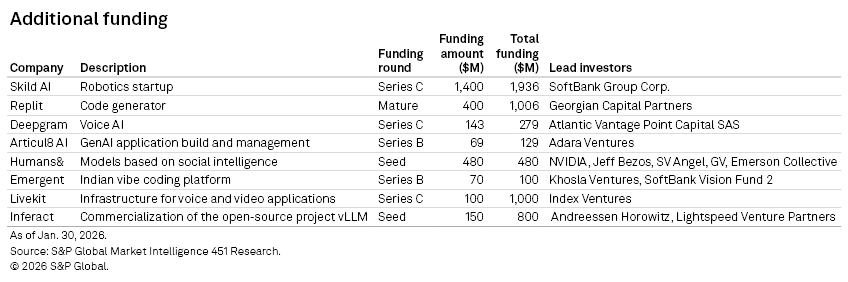
On Jan. 6, xAI announced that it has raised $20 billion in an upsized Series E funding round, exceeding its earlier $15 billion target. XAI is the company behind the Grok models and was recently mired in controversy following "undressing" images generated by its chatbot on X. The business said that the funding will accelerate further infrastructure build-out.
Higgsfield Inc., an AI video-generation startup, raised $80 million in a Series A extension that values the company at over $1.3 billion. Its platform allows users to leverage proprietary and third-party models to create short-form videos, optimized for mobile-first platforms like Instagram LLC or TikTok Inc. The extension reopens a prior $50 million Series A and brings the total Series A to about $130 million.
Chinese AI firm Zhipu (Knowledge Atlas Technology Joint Stock Company Ltd.) went public in Hong Kong after raising roughly $558 million in an IPO. Zhipu is known for developing the GLM series of large language models, including open‑source releases.
Accenture PLC agreed to acquire Faculty, a UK‑based AI‑native services and products company known for applied AI work and its Frontier decision intelligence platform. Accenture says Faculty's 400-plus staff will join Accenture and that Faculty CEO Marc Warner will become Accenture's CTO and join its Global Management Committee. Financial terms were not disclosed, although investor and press commentary around the deal characterized Faculty as reaching "unicorn" status.
London-based AI video pioneer Synthesia has raised $200 million in Series E funding, positioning the company at a $4 billion valuation. The round, led by Google LLC Ventures (GV) with participation from NVIDIA's NVentures, nearly doubles the startup's previous valuation from one year prior. The company states that the capital will be used to scale its next-generation AI video agents, explicitly referencing a strategic shift toward interactive upskilling and corporate training for its enterprise clients, which include over 90% of the Fortune 100.
Building off of its announcement of ChatGPT Health, OpenAI acquired Torch, a specialized health-tech startup, in a deal reportedly valued at approximately $100 million. Torch is known for developing a "unified medical memory" designed to consolidate fragmented patient data — such as lab results, doctor notes and wearable metrics — into a single AI-ready context engine.
Meta Platforms Inc. acquired Manus, a Singapore‑based developer of general‑purpose AI agents that can execute multi‑step tasks such as research, coding and analysis. The business, legally incorporated as Butterfly Effect Pte. Ltd, was reportedly acquired for over $2 billion. Manus claimed annualized average revenue of more than $100 million in December 2025, with a revenue run rate exceeding $125 million. The company had raised $75 million in a round of funding in 2025.
Zendesk Inc. acquired Unleash, an AI‑powered enterprise search platform focused on connecting knowledge across internal systems. Zendesk is a customer and employee service software vendor and says Unleash strengthens its push into AI‑first employee service by improving knowledge retrieval inside support workflows. Zendesk highlights Unleash's permission‑based RAG and connectors across dozens of content sources, plus native agents in Slack and Microsoft Teams with escalation to humans.
Politics and regulations
China says its Ministry of Commerce will assess and investigate Meta's acquisition of Manus for compliance with laws covering export controls, technology transfer and overseas investment. While Manus is a Singapore‑based company, it has Chinese research roots. Officials at China's Ministry of Commerce stress that cross‑border M&A, technology export and data transfer must follow statutory procedures, framing the matter as a compliance assessment. What is notable about this review is that the target company has redomiciled outside mainland China.
California companion chatbot safety law took effect at the start of January, with the intent to protect minors through stronger safety protocols. The theme of child safety also featured strongly in a letter by 42 state attorneys general to large technology and model companies, including Google, Meta and Microsoft, which included an urge to prohibit unlawful outputs for child-related accounts.
The World Economic Forum's Global Risks Report 2026 indicates that adverse outcomes of AI show one of the strongest upward trajectories in perceived risk over longer horizons, reflecting growing concern about societal and security implications. While immediate concerns often focus on economic shifts, the report emphasizes a deepening anxiety regarding the long-term societal and security implications of rapid AI integration, including a growing consensus that the risks of misinformation, autonomous conflict and systemic inequality are becoming more entrenched. Global leaders are being urged to pivot from reactive measures to proactive, multi-stakeholder governance.
Content Type
Products & Offerings
Segment
Language