Research — February 27, 2026
European Women's soccer shows growth, but potential still to be realized

The performance of women's professional soccer has come under review with the release of the Women's Super League Football Ltd. (WSL) first financial results, as well as the reported revenues of leading clubs globally. While revenues are showing signs of growth, there remains a sense that the sport still has significant headroom for development as it looks to secure control over its future as a standalone product.

➤ Women's soccer is developing in terms of revenue and attendances, but there is still room for more growth.
➤ Teams are attracting their own unique commercial partners.
➤ Digital media is proving to be very impactful for women's soccer.

WSL: Initial losses but hopes for future growth increase
The WSL posted a turnover of £17.4 million for the year ending July 2025, of which £8.7 million was generated from broadcasting deals and £8.5 million from sponsorship and licensing, with the UK generating 91% of this turnover.
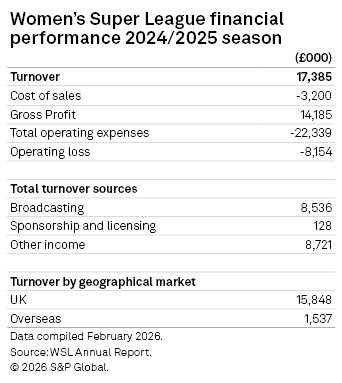
The league felt that these first‑year losses were expected and part of its ongoing strategy, particularly its commitment not to reduce financial distributions to clubs in the second tier of the WSL (WSL 2). The league believes this financial commitment is essential for growth and providing support to lower‑division teams is a key element of that plan.
The WSL's confidence in its financial future should be reflected in upcoming results, as it is set to benefit from a new domestic media rights deal signed in 2024 with Comcast-owned Sky and the BBC. The £65 million agreement represents a 63% uplift on the previous deal and runs from the 2024/25 season to the 2029/30 season.
The league has also increased revenue from its commercial partners, with lead sponsor Barclays Bank doubling its investment to £45 million in the WSL and women's soccer. Other commercial partners include Nike Inc., British Gas Trading Limited , Mercedes-Benz Group AG, Subway, and EA Sports FC.
The value of the WSL's commercial partnerships relative to its media rights value is an interesting feature of the women's game. It may suggest that TV viewership is still below the men's game, which in turn results in lower media rights fees. However, the scale and growth potential of brand exposure in women's football offer significant upside for sponsors and the league.
The WSL has also taken control of its own future by moving away from management by the Football Association (FA) and placing the league under Women's Professional Leagues Limited (WPLL). This strategic decision is intended to drive and safeguard the league's growth. In Germany, the Frauen‑Bundesliga has made a similar move, assuming ownership of its league and economic future.
European clubs dominate leading women's soccer clubs
Reported recent financial performance of leading women's clubs suggests that Europe's traditional giants remain the most financially successful, with at least half of the top 10 coming from the WSL. Three clubs have been particularly dominant: Arsenal, Chelsea, and Barcelona Femení.
The financial performance of all three clubs has been driven by success on the pitch, which brings higher sponsorship values and increased media exposure. During the 2024/25 season, Arsenal won the Champions League, beating Barcelona in the final. Barcelona completed a domestic treble, further solidifying its dominance in Spanish football. Chelsea matched this feat in the WSL, winning all three trophies on offer and setting a new points record when they won the league title.
Crowd attendances
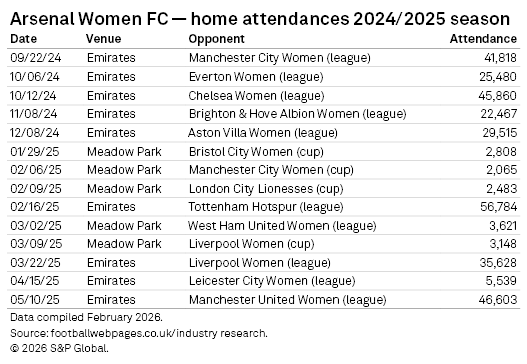
Arsenal Women made the strategic decision to play some key games at Arsenal's men's stadium, the Emirates, during the 2024/25 season. They offered ticketing schemes to attract larger crowds, and the biggest attendance came against local rivals Tottenham Hotspur in February 2025 as 56,784 fans watched the match in a stadium with a capacity of 60,704. The average attendance across the eight games played at the Emirates was 38,019.
The club's cup games were played at the main stadium, while other fixtures were scheduled at Meadow Park (the U21 stadium). Although some of these crowd levels are impressive, a full season view suggests there is still some way to go before attendances for the leading women's teams consistently match those of the men's game.
Exclusive commercial partners
WSL CEO Nikki Doucet has spoken about what she believes is a unique audience that watches women's soccer, and that distinct viewership brings rewards that global brands want to interact with and monetize.
Chelsea Women have brand associations with the mobile company Three and Skoda, among others. Arsenal Women recently extended their partnership with Mastercard, which started in 2019 and is now extended into a longer-term deal. The team also has an exclusive relationship with the beauty brand Il Makiage that was signed in 2022.
On the wider European stage, the sponsors of UEFA's women's club competition include Adidas AG, Amazon.com Inc., Lays, Vodafone Group PLC, Euronics, Heineken NV and PlayStation. Amazon and Euronics are exclusive to the women's game and do not sponsor UEFA's men's competitions.
Media rights deals
Outside of the recent WSL media rights deal, some of the global streaming giants have begun to secure rights to some of the elite women's soccer tournaments.
Disney+ has secured exclusive rights to Women's Champions League for five years from the 2025/26 season until the 2029/30 season. The deal covers all of Europe, something that has not been possible in the men's game and so will give Disney a unique continent-wide broadcast opportunity.
Netflix has also agreed to a two-tournament deal for exclusive rights to show the Women's World Cup in the US. The 2027 event will take place in Brazil and the 2031 tournament in the US.
Both these deals suggest that the streamers are continuing to embrace sports right for the scale of the audiences they offer and their ability to maintain and add new subscribers.
The success of women's sports in digital media
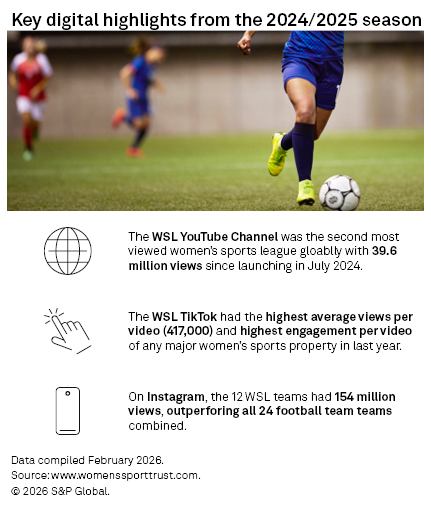
Women's soccer is having notable success in digital and social media with fans engaging with the leagues, clubs and players in significant numbers.
The WSL reported a 35% drop in broadcast audiences during the 2024/25 season possibly attributed to amended broadcast slots because of the more valuable broadcast deal. However, the league's social media accounts reported substantial successes.
On the international stage, during Euro 2025, viewing to the event via the BBC Sports digital accounts grew by 86% compared Euro 2022 for the quarter final stages.
Future potential
Women's soccer in the UK and Europe is growing and has secured new media deals, particularly for the WSL. Encouragingly, women's soccer attracts unique commercial partners and strong digital media engagement. However, TV viewing has been affected by new scheduling slots, and live match attendances are not yet regularly reaching capacity. If leagues can build on this momentum, the future has significant potential.
Economics of Networks is a regular feature from S&P Global Market Intelligence Kagan.
This article was published by S&P Global Market Intelligence and not by S&P Global Ratings, which is a separately managed division of S&P Global.
Content Type
Segment
Language