Research — February 27, 2026
CES 2025 – Where is battery metals exploration happening?

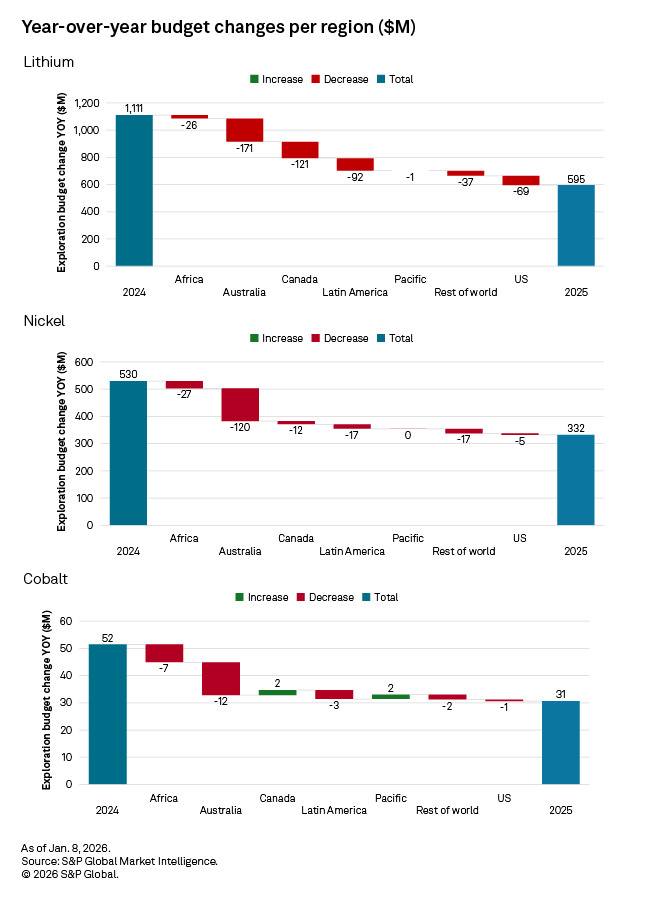
Global exploration budgets for lithium, nickel and cobalt fell sharply in 2025, declining 43% year over year to $958 million — the first significant contraction since spending surpassed $1 billion in 2022. While this downturn reflects broad market oversupply, weak prices and tighter financing conditions, its impact has not been uniform. Against this backdrop, regional dynamics take on greater importance, revealing where exploration activity has proven most resilient and where investment has retreated fastest. This regional lens helps explain how policy frameworks, project maturity and corporate strategy are reshaping the geography of battery metal exploration in a weaker market cycle.

➤ Canada emerged as the top exploration hub, leading activity across lithium, nickel and cobalt despite junior-sector cutbacks, underpinned by advanced assets and expanding federal and provincial incentives.
➤ Policy and market structure are increasingly shaping regional outcomes, with national strategies, permitting regimes and state participation influencing where majors and juniors deploy exploration capital.
➤ Exploration locations are expanding, with mature jurisdictions retaining dominance while selective investment continues to flow into emerging regions such as Africa, the Pacific and parts of Europe.

Canada: The most active hub across battery metals
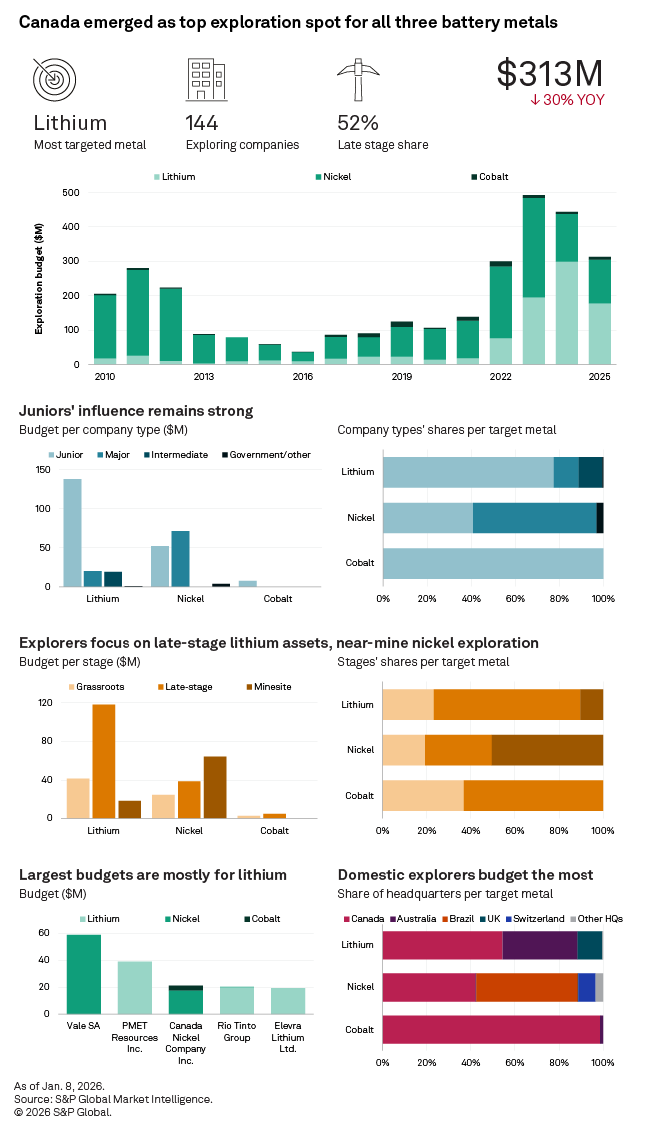
Despite significant cutbacks from the junior sector, Canada emerged as the top jurisdiction for exploration across all three battery metals in 2025, supported by a strong pipeline of advanced projects and a growing suite of federal and provincial policy incentives. Lithium exploration remained dominated by juniors focusing on late-stage, hard-rock assets. While most Canadian companies invest in domestic lithium projects, some firms also sought opportunities beyond their borders, investing in assets in the US and Latin America, particularly Chile, Argentina and Brazil. Nickel exploration was driven by majors — especially Vale SA — at advanced-stage projects and minesite assets. Cobalt exploration rose due to larger allocations to the Crawford project in Ontario. The asset holds the largest contained nickel reserves and resources in the western hemisphere, and it was fast-tracked at both the provincial level — via Ontario's One Project, One Process program (1P1P) — and the federal level — via the country's Major Projects Office (MPO).
Additional national policies continue to bolster early-stage and generative exploration throughout the country. Notable among these are the expanded Critical Mineral Exploration Tax Credit and the enhanced financing streams offered by the Ontario Junior Exploration Program (OJEP). These measures provide ongoing support to companies engaged in the initial stages of exploration, ensuring that Canada remains at the forefront of battery metal development.
Australia: Still a heavyweight but under pressure
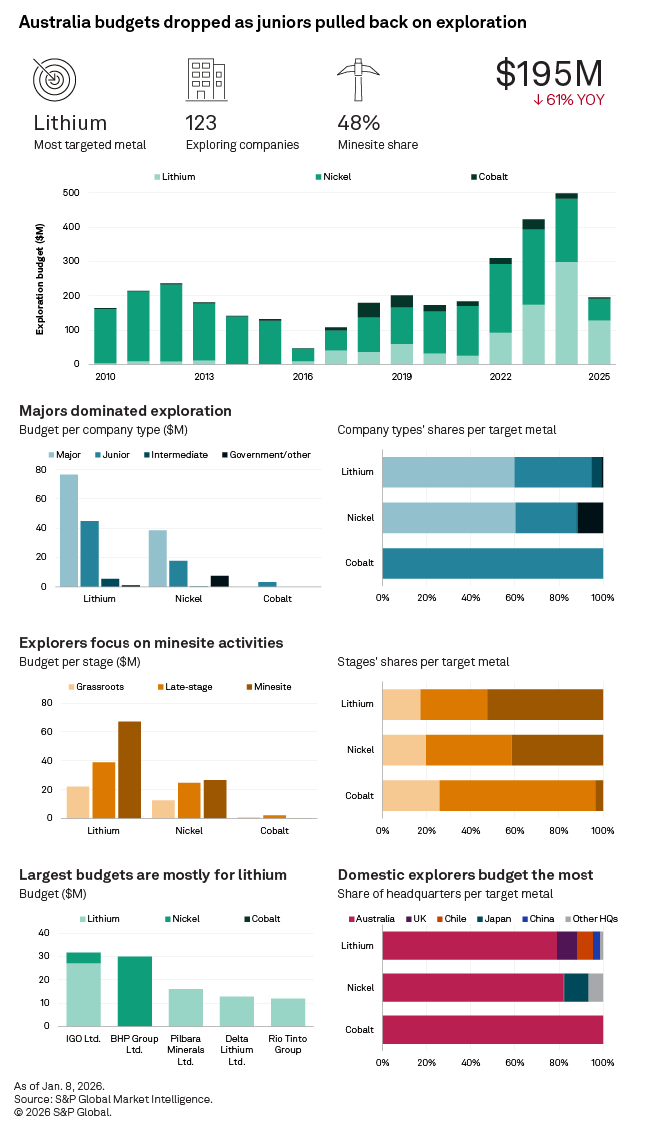
Australia remains one of the most important jurisdictions for lithium and nickel, yet 2025 brought substantial budget reductions. Juniors enacted widespread cost-cutting across lithium programs, while acquisitions — such as Sociedad Química y Minera de Chile SA (SQM)'s and Hancock Prospecting Pty Ltd.'s purchase of Azure Minerals Ltd., and Rio Tinto Group's purchase of Arcadium Lithium PLC — removed some of the largest independent explorers from the budget landscape. Increased allocations from majors Rio Tinto and IGO Ltd. helped soften the blow to budgets. Nickel exploration also contracted as companies redirected efforts elsewhere, with Chalice Mining Ltd. shifting focus to its gold-copper projects, IGO prioritizing its copper and lithium assets, and majors such as BHP Group Ltd. shuttering their nickel operations.
Australia's policy landscape for lithium, nickel and cobalt exploration is anchored by the Critical Minerals Strategy 2023–2030, which identifies all three as critical minerals and emphasizes the need to grow upstream supply, including exploration. In 2026, Australia released the updated Australian Critical Minerals Prospectus to promote its expanding project pipeline and attract global investment. These domestic initiatives are complemented by the recent US-Australia critical minerals framework, which introduces fast-tracked approvals and a substantial joint financing pipeline for critical minerals projects while tightening foreign investment screening procedures.
Latin America: Mixed momentum
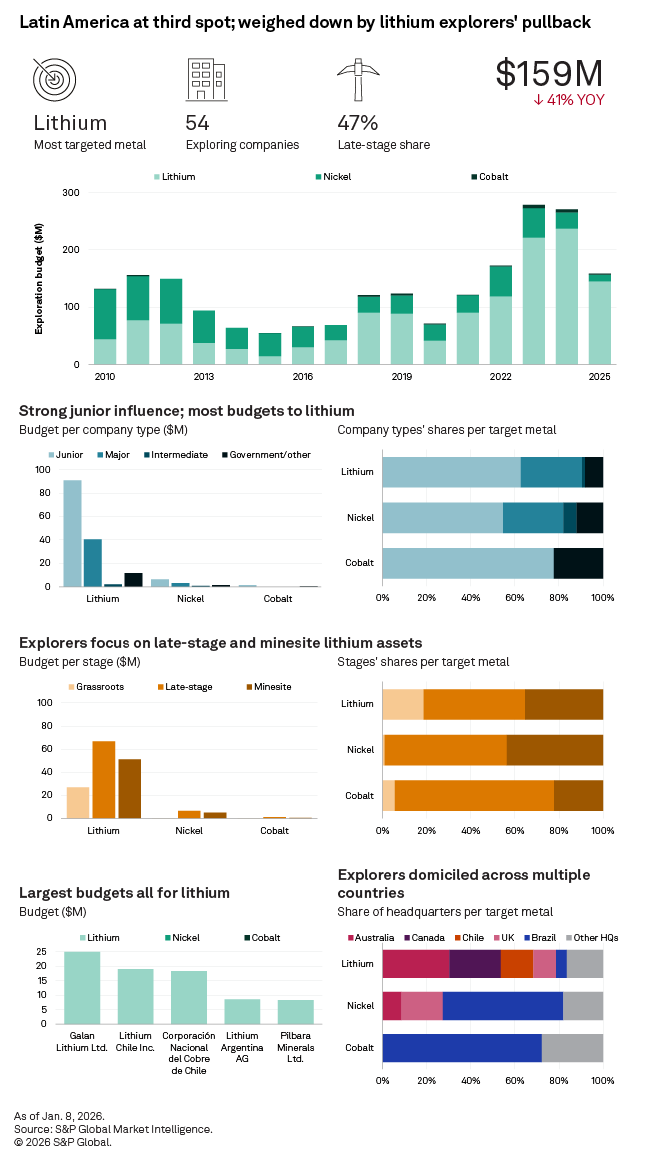
Latin America, renowned for its "Lithium Triangle," remains a lithium powerhouse but lagged in second place behind Canada in the regional ranking, reflecting uneven progress across its constituent countries. Argentina and Brazil recorded declines as projects moved toward development, with limited new allocations to generative programs. Allocations to Mexico dropped to just $0.5 million from more than $5 million in 2023 and 2024, following policy changes that nationalized lithium resources, restricted new mining concessions and prioritized the newly established state-owned enterprise Litio Para Mexico (Litio MX). The entity is also navigating budgetary constraints, however.
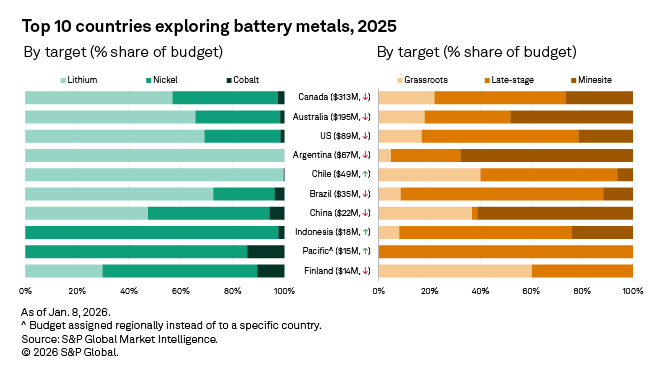
Chile stood out, with lithium budgets nearly doubling to a record-high $49 million. This growth was fueled by both grassroots and late-stage investments, led by major companies. Corporación Nacional del Cobre de Chile (Codelco) substantially raised its late-stage budgets, collaborating with Rio Tinto on the Maricunga project, which contains one of Chile's largest lithium resources. Eramet SA notably increased its presence in Chile by acquiring concessions over lithium salars (salt flats) and partnering with Lithium Chile Inc. to pursue early-stage exploration at the Molle Verde brine target.
Chile's National Lithium Strategy has played a pivotal role in encouraging major companies to expand their activities. The policy facilitated the creation of Nova Andino Litio, a joint venture between Codelco and SQM that will oversee lithium exploration, exploitation, production and commercialization in the Salar de Atacama until 2060. The introduction of Special Lithium Operation Contracts (CEOLs) further enabled companies such as Rio Tinto to enter the Chilean lithium sector, exemplified by its 2025 partnership with Empresa Nacional de Minería.
However, these policy developments have also raised entry requirements. With lithium exploration now requiring state participation, juniors face greater challenges in securing rights and often must partner with state-owned firms. Such partnerships tend to favor larger, well-funded companies. The focus on strategic salt flats and updated institutions also concentrates opportunities in areas dominated by major joint ventures, leaving juniors to compete in a more crowded, policy-driven environment, where access depends as much on meeting government priorities as on geological potential. This effect is reflected in 2025. The number of junior companies exploring for lithium in Chile fell to five in 2025 from six in 2024, with most experiencing budget declines except for Lithium Chile Inc., which partnered with Eramet SA. In contrast, the five major companies operating in Chile generally increased their allocations. Major players now account for 53% of Chile's lithium exploration budgets, with juniors responsible for the remainder.
US: Stabilizing but still well below peak levels
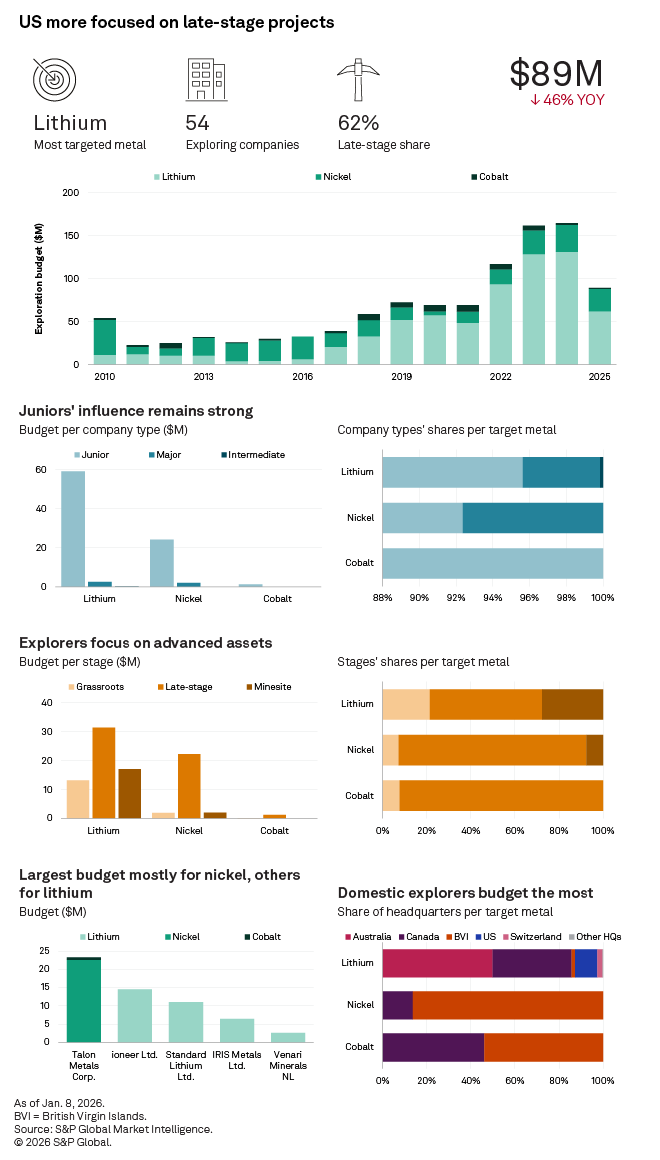
The US accounts for 9% of global exploration budgets for lithium, nickel and cobalt, ranking third among countries in overall exploration for these battery metals. More than 60% of the budgets come from Canada- and Australia-based companies, while only 7% is from US-domiciled companies. After leading in lithium exploration in 2022 on a per country basis, the US dropped to fourth, not keeping up with more aggressive increases in Canada, Australia and Argentina in the past three years. Activities are focused on late-stage and minesite assets, led mainly by junior firms. Nickel exploration remains limited to a handful of companies, dominated by Talon Metals Corp. on its late-stage Tamarack project in Minnesota, a joint venture with Rio Tinto, supported by considerable government grants for ore processing and exploration acceleration.
Some US-based companies stepped up their overseas programs, particularly in Africa. Ivanhoe Electric Inc. has its 60/40 nickel‑copper‑cobalt joint venture project with Sama Resources Inc. in Côte d'Ivoire, and KoBold Metals Co. accelerated its battery‑metal exploration push at the Mingomba copper-cobalt project in Zambia while simultaneously expanding into Namibia, where the company secured exploration licenses and began early-stage lithium and nickel fieldwork supported by its AI-driven geological targeting system. In terms of domestic efforts, initiatives supporting exploration include fast-tracking selected critical mineral mining projects under FAST-41 and several significant federal funding initiatives.
Africa, Pacific and Rest of world: Emerging frontiers
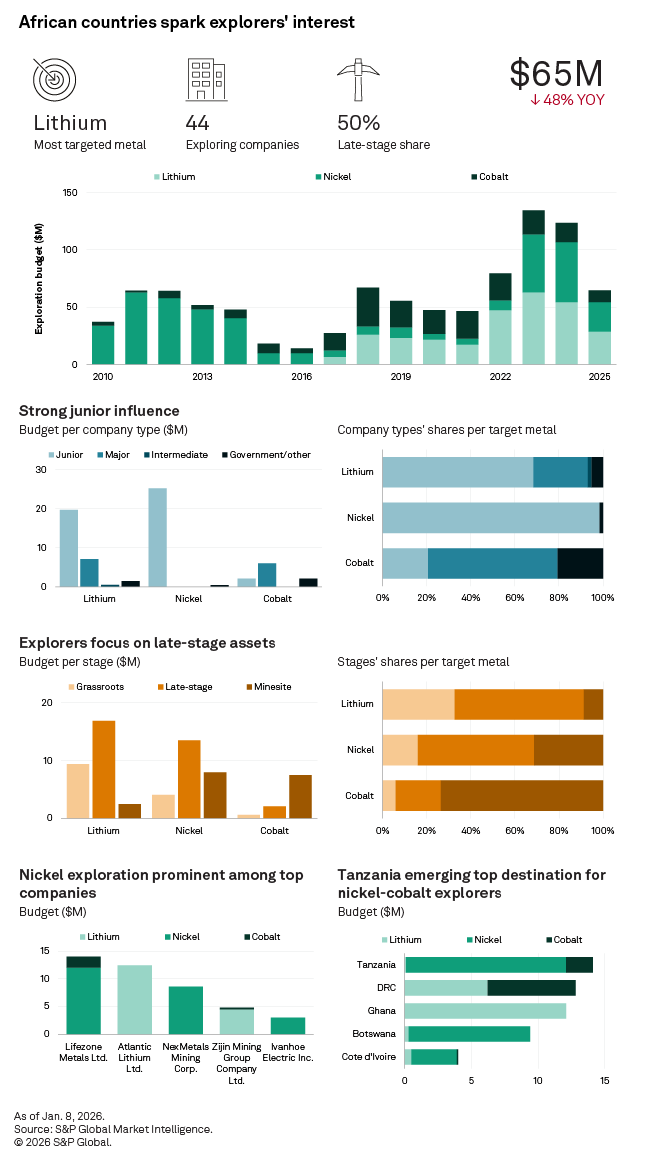
Africa remains the dominant region for cobalt exploration due to Democratic Republic of the Congo's resources. The continent is also attracting rising interest in nickel from companies leveraging advanced geophysics and AI to accelerate generative exploration in Zambia, Côte d'Ivoire and Namibia.
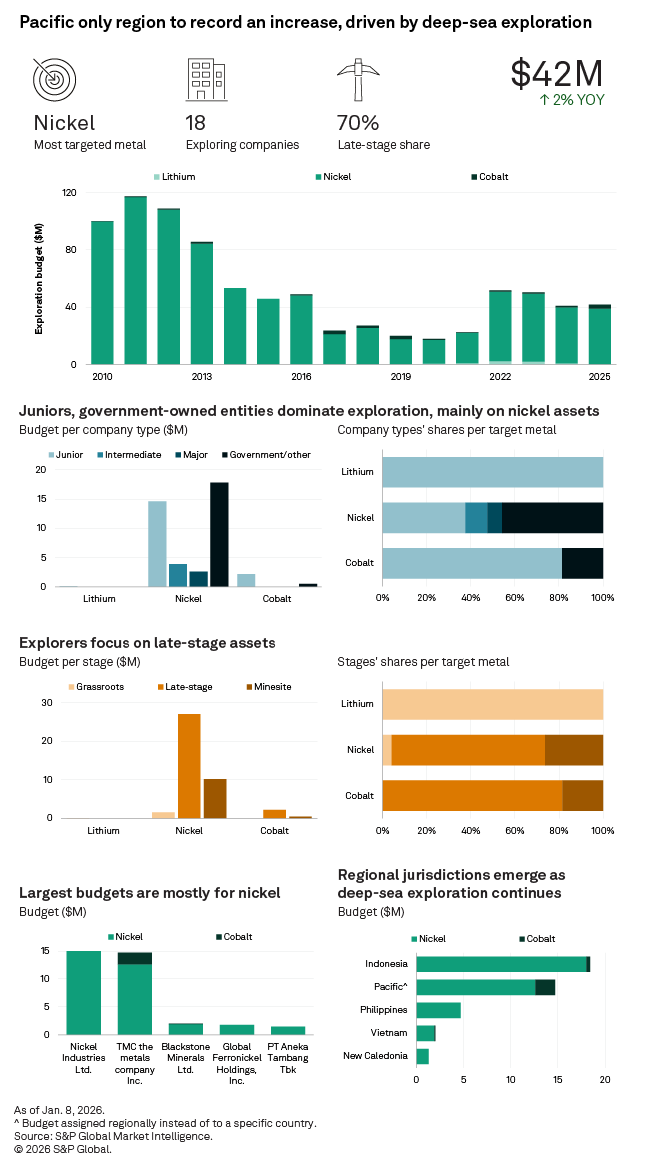
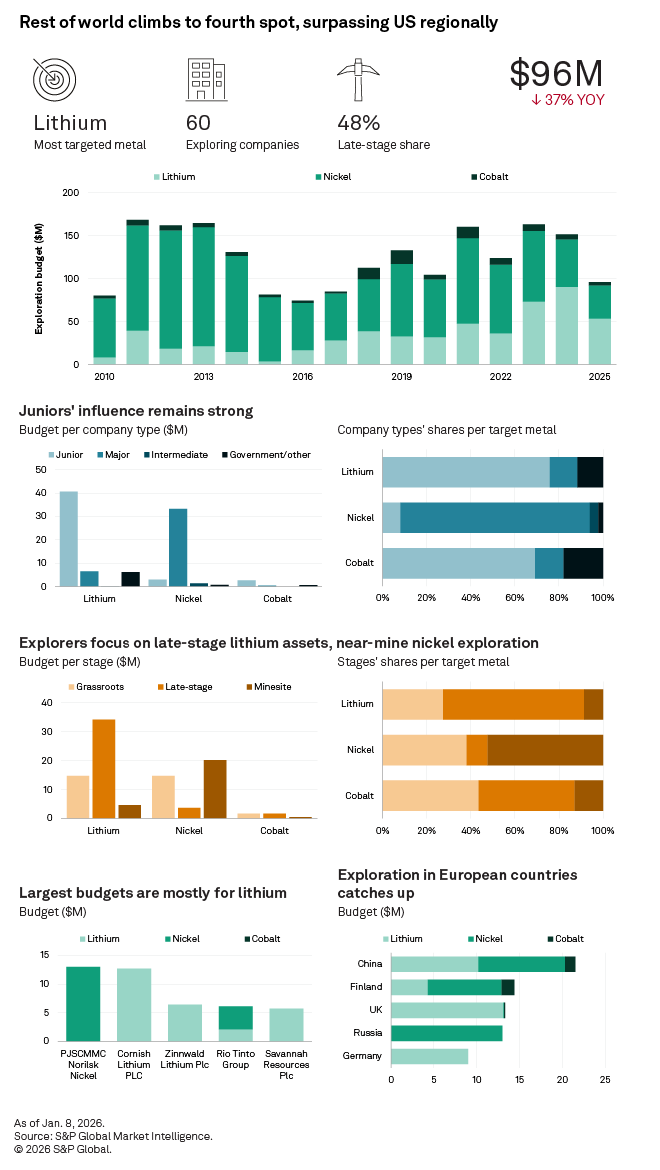
Outside the conventional jurisdictions, the Pacific region stands out in 2025 due to offshore exploration around Nauru and Tonga. At the forefront of this endeavor is Canada-based TMC The Metals Co. Inc., the only company in the dataset exploring polymetallic deep-sea nodules containing nickel, cobalt and manganese. TMC increased its nickel-related budget fourfold to $13 million as it continues to explore minerals in the Clarion-Clipperton Zone of the Pacific Ocean.
Exploration momentum in Europe, particularly for lithium, has been inching upward in the past two years. Countries such as the UK (Trelavour), Germany (Zinnwald, Vulcan) and Portugal (Mina do Barroso) continue to receive allocations, reflecting Europe's ambitions to build localized battery‑metal supply chains. Permitting challenges and public acceptance remain significant hurdles, however.
Conclusion
The 2025 budgetary decrease highlighted regional differences in battery metal exploration. Canada's policy-supported ecosystem and concentration of advanced projects allowed it to stand out, while Australia and Latin America faced pressures from consolidation, shifting strategies and regulatory changes. The US remained active, but well below peak levels, and emerging regions continued to attract targeted, often technology-driven exploration. As markets work through oversupply and pricing pressures, regional competitiveness — defined by policy clarity, project maturity and strategic relevance — will play an increasingly decisive role in determining where exploration rebounds first.
This article was published by S&P Global Market Intelligence and not by S&P Global Ratings, which is a separately managed division of S&P Global.