Research — Jan. 23, 2026
Copper RRS 2025 – Top miners pursue resilience with partnerships, asset growth
S&P Global Energy reports on the world's top copper producers in 2024 and their reserves replacement strategies over the 2015–24 period, following the previous Copper Reserves Replacement Strategies (RRS) articles published in 2021. These studies examine the relationships between each company's production, reserves, costs, exploration budgets, acquisitions, divestitures and copper discoveries during the decade-long period. The strategies of the top 10 producers across various RRS metrics are examined, while strategies for the top five producers were presented individually.

➤ From 2015 to 2024, the leading 10 copper producers added 130.9 million metric tons of copper reserves to cover 134% of their production over the period. By end-2024, the group held 363.5 MMt of copper reserves.
➤ The group collectively produced 88.8 MMt copper during the period, with a compound annual growth rate (CAGR) of 1%. Exploration activities accounted for 85% of reserves growth, while asset acquisitions contributed 15%.
➤ Copper exploration budgets for the group totaled $6.97 billion, with some producers increasingly prioritizing brownfield exploration and development. Grassroots copper exploration budgets in 2010–24 comprised 38% of the total copper budgets over the same period.
➤ Collectively, the group invested $14.43 billion in acquiring new reserves at an average cost of 33 cents/lb and realized $9.16 billion from divesting 15 MMt at 28 cents/lb.
➤ New copper discoveries have been limited, with only five of the top 10 producers having major finds between 2010 and 2024, totaling 7 MMt copper in attributable reserves, resources and past production.
➤ Persistent supply constraints and robust demand are expected to keep the copper concentrate market tight, intensifying the challenge of replacing reserves and sustaining output for the industry's largest players.

Access the top copper producer metrics RRS databook.
In 2015–24, the copper industry shifted from post-supercycle austerity to a supply outlook defined by structural constraints. Key factors such as declining ore grades, limited new discoveries, heightened environmental, social and governance scrutiny, and surging demand driven by electrification and carbonization efforts fundamentally reshaped how major producers approached reserves replacement. A strategic evolution took place in this period characterized by a nuanced mix of brownfield exploration, selective M&As, joint ventures and disciplined exploration efforts.
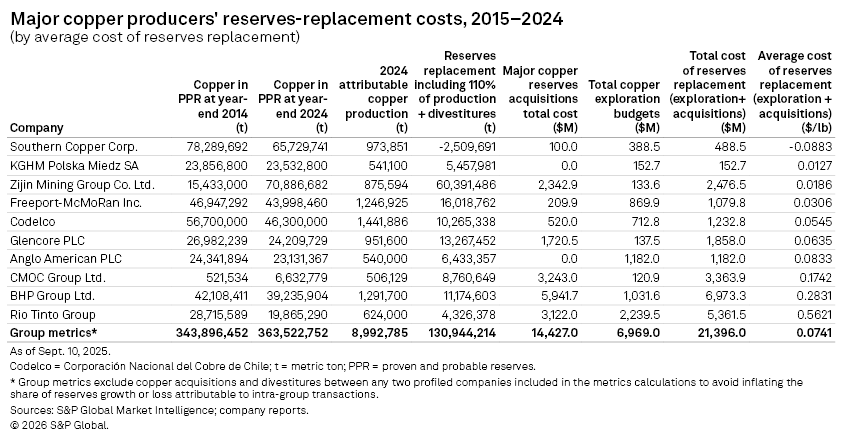
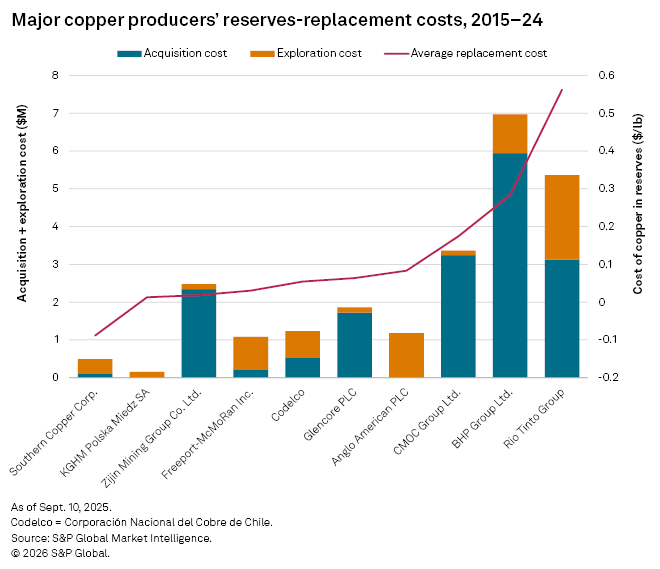
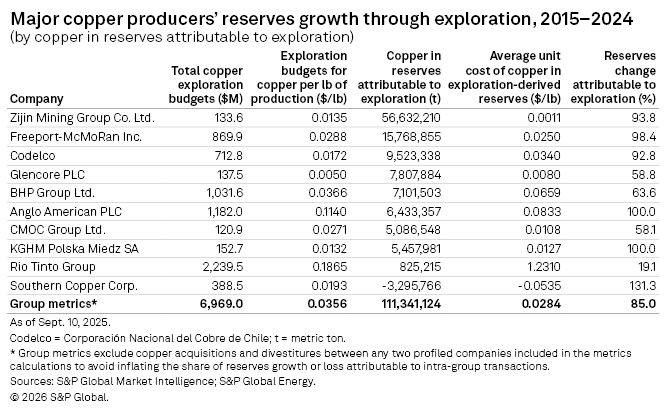
The reserves replacement strategies of the top 10 copper producers examined in the 2025 RRS study underscored common industry challenges and divergent approaches adopted by the leading companies. The group added 130.9 MMt of copper in reserves in 2015–24, replacing 134% of production, which grew 5%. Exploration activities accounted for the majority of reserves growth, contributing about 111.3 MMt, or 85%, through exploration, resource conversion and project development. Mine acquisitions supplemented reserves growth by 15%, adding 19.6 MMt copper in reserves to the group total. The average cost of reserves replacement was 7 cents/lb, with BHP Group Ltd. incurring the highest cost at 28 cents/lb and KGHM Polska Miedz SA paying the least at just 1 cent/lb.
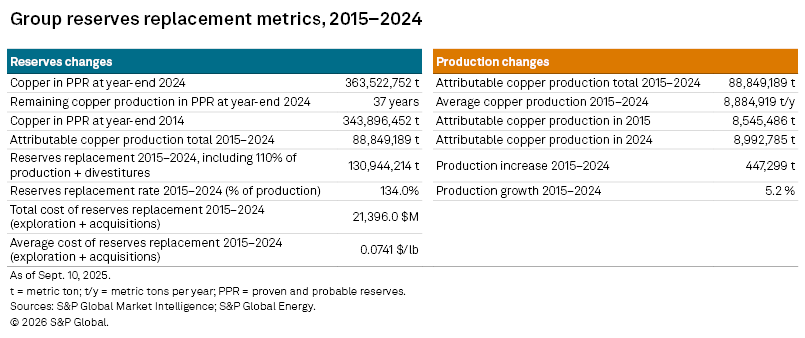
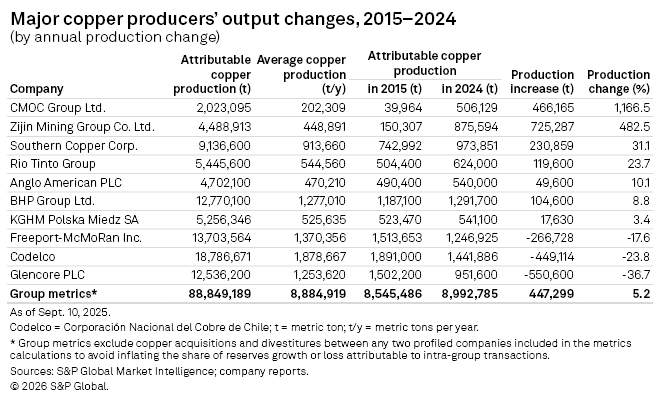
During the same period, the group produced 88.8 MMt of copper, increasing 5% over the decade. CMOC Group Ltd. recorded the highest production growth over the 10-year study period, with a CAGR of 29%.
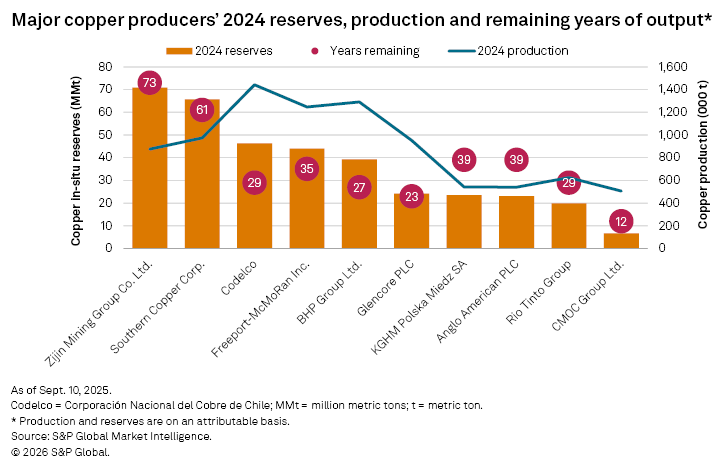
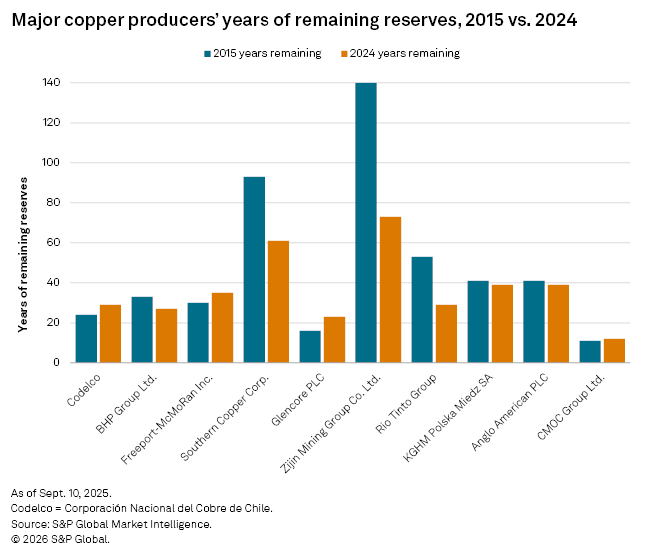
By the end of 2024, the top 10 copper producers held a combined 363.5 MMt of copper in reserves, supporting 37 years of production. Zijin Mining Group Co. Ltd., the sixth-largest copper producer in 2024, hosted the largest proven and probable copper reserves base at 70.9 MMt, underpinning 73 years of remaining production.
Chasing copper in a tightening market
While exploration was the main driver of long-term reserves growth in 2015–24, acquisitions enabled faster turnover of reserves to support short-term production for some players, though a notable shift toward assets with longer-term potential occurred during these years. In our study of the companies' transaction metrics as a group, copper acquisitions and divestitures between any two profiled companies were excluded to prevent inflating the share of reserves growth or loss from intragroup transactions. However, individual databooks include all acquisitions and divestitures to accurately reflect each company's respective reserves replacement strategies.
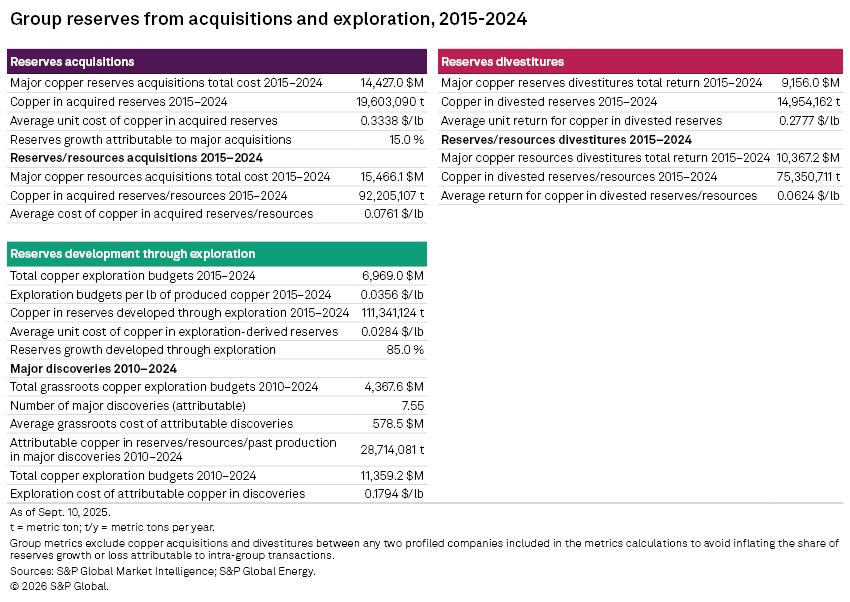
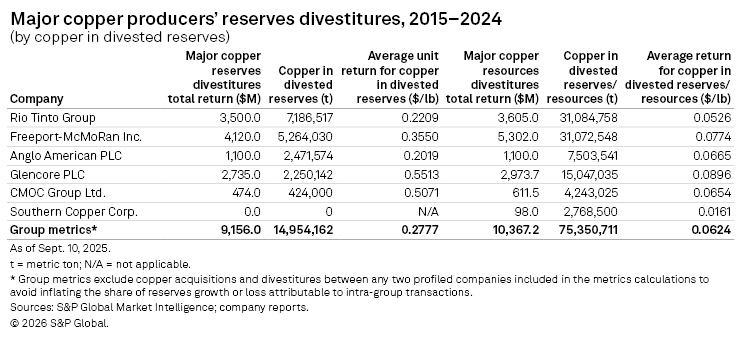
Over the period, the group spent a total of $14.43 billion in reserves acquisitions at an average of 33 cents/lb. BHP was the largest spender, investing $5.94 billion in the acquisition of OZ Minerals Pty. Ltd., which added 4.1 MMt of copper reserves at an average cost of 66 cents/lb of copper. In terms of tonnage, the group acquired a total of 19.6 MMt of copper in reserves. Glencore PLC secured the largest copper reserves, totaling 5.5 MMt, through the purchase of assets such as KCC (Kamoto) in the Democratic Republic of Congo (DRC) and the Minera Agua Rica Alumbrera (MARA) project in Argentina. Among the 10 companies, Southern Copper Corp. recorded the lowest average unit cost of copper in acquired reserves at 6 cents/lb, followed by Glencore at 14 cents/lb.
The group sold 15.0 MMt copper in reserves over the period, with a total return of $9.2 billion at an average price of 28 cents/lb. Rio Tinto Group's sale of its Grasberg in Indonesia accounted for 48% of the group's divested copper reserves, at an average price of 22 cents/lb.
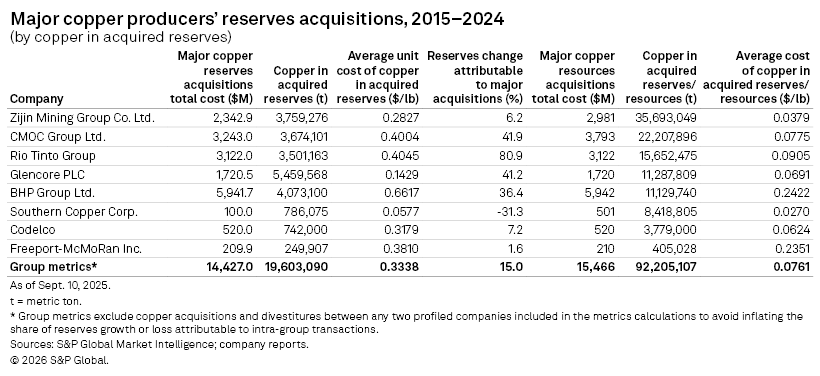
Throughout 2015–24, some producers exhibited a significant shift in M&A and partnerships toward a strategic focus on brownfield-oriented, long-life copper assets and consolidation. This strategy was also largely influenced by efforts to diversify jurisdictional exposure and address geopolitical and regulatory risk factors. Examples include Glencore's acquisitions, Rio Tinto and BHP's JV Resolution project in Arizona, Southern Copper's acquisition of El Pilar in Mexico and Michiquillay in Peru, and Rio Tinto's purchase of its remaining stake in Turquoise Hill Resources Ltd. in 2022, among others. On the other hand, divestitures made during the period mostly signaled prioritization of core, tier 1 copper assets.
Organic growth through exploration and brownfield activities added 111.3 MMt of copper reserves, with exploration budgets totaling $6.97 billion at an average cost of 4 cents/lb. Rio Tinto led in copper exploration investment, raising $2.24 billion, while CMOC came last with a $120.9 million budget.
Notably, Southern Copper's reserves downgrades and reclassification led to a deficit in its reserves replacement against a generally upward trend in production. In terms of volume, Zijin Mining developed the most copper reserves through exploration, adding about 56.6 MMt of copper at an average of 0.11 cents/lb, the lowest exploration cost per unit among the profiled companies. Conversely, Rio Tinto spent the most, at $1/lb for 825,215 metric tons of copper.
Copper discoveries remained scarce, with no significant finds since the last copper RRS study in 2021. Only five of the 10 producers had major copper discoveries attributed to them between 2010 and 2024, totaling 28.7 MMt of attributable copper in reserves, resources and past production. The dearth of new discoveries coincides with the pivot toward brownfield exploration, with grassroots exploration budgets accounting for only 25% of the global base metal exploration budgets in 2024–25, as detailed in our latest copper discoveries study.
Production trends, project pipeline and outlook
From 2015 to 2024, four companies — Corporación Nacional del Cobre de Chile (Codelco), Freeport-McMoRan Inc., Glencore and CMOC — extended their annual copper production by an average of 4.5 years, while other producers experienced a decline in their remaining years of production.
CMOC's production growth over the period was anchored by ramp-ups at its Tenke Fungurume and Kisanfu mines in the DRC, with the company producing 506,129 metric tons of copper in 2024. Currently, expansions are underway at both projects. In contrast, KGHM Polska recorded the smallest production growth with a 0.3% CAGR, buoyed by its domestic copper operations in Poland.
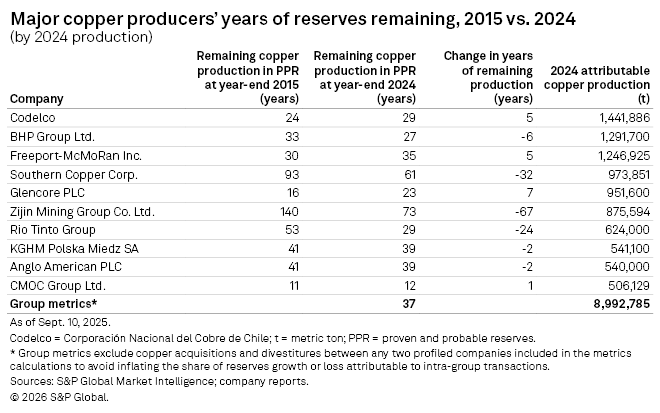
Glencore's copper production dropped the sharpest at 37%, followed by Codelco at a 24% decline, driven partly by structural losses at some of the companies' long-lived assets. The largest producer of the red metal in 2024, Codelco operates some of the world's most mature copper assets, including Chuquicamata, El Teniente and Andina Division in Chile. The company adopted a notable strategic shift, emphasizing partnerships over direct acquisitions. This approach prioritized JVs for exploration and district-scale optimization, with a focus on maximizing resource potential in Chile.
Concurrent with the pursuit of early-stage assets, development projects also remained crucial to the producers' replacement strategies, though operational setbacks at some key projects, as well as permitting challenges, hampered progress and raised uncertainties. However, several milestones were reported for some brownfield projects. In 2022, Anglo American PLC announced first copper production at Quellaveco in Peru, which it owns jointly with Mitsubishi Corp. Rio Tinto also commenced underground production at Oyu Tolgoi in Mongolia in 2023, with an anticipated annual peak output of 500,000 metric tons of copper. Similarly, BHP continued to receive near-term supply support from its Spence Growth Option project in Chile, which began concentrate production in 2020. In our most recent copper project pipeline analysis, we forecast mine production from currently operational assets to peak at 24.0 MMt by 2027 and fall to 18.8 MMt by 2036.
Impending tightness in the copper concentrate market, driven by structural demand growth and constrained mine supply expansion, is expected to pressure producer economics in the near term. At the same time, declining grades and long development timelines are reducing the likelihood of immediate reserves replenishment through organic growth at existing operations. As a result, companies are increasingly pursuing near- to medium-term supply certainty through selective and larger acquisitions, partnerships and portfolio expansions rather than stand-alone mine-level growth. According to our latest Copper in the Age of AI report, electrification is expected to accelerate the surge in global copper demand, which is projected to reach 42.0 MMt by 2040.
In line with this pursuit, the $53 billion merger between Anglo American and Teck Resources Ltd., announced in 2025, is expected to boost the former's production base. The combined entity, Anglo Teck, is positioned to become the fifth-largest copper producer, targeting 1.35 MMt of copper output by 2027. The merger is expected to bring district-level operational synergies in Chile through Collahuasi and Quebrada Blanca, in addition to supply optionality through expansion projects.
Furthermore, we expect that longer-term supply security will continue to influence dealmaking. BHP and Lundin Mining Corp.'s joint acquisition of Filo Corp. in January 2025 formed the Vicuña Corp. JV, which now operates the Filo del Sol and Josemaria projects in Argentina, close to its border with Chile. BHP and Lundin expect the project integration to capitalize on the Vicuña district's greenfield potential, with Lundin announcing an initial copper resource estimate of around 13.0 MMt of contained copper in measured and indicated resources. In January 2026, Rio Tinto and Glencore have restarted discussions on a possible megamerger following initial talks in 2024, which would unify the companies' multiple tier 1 copper assets under one roof and potentially create the world's largest miner by market capitalization.
Amid persistent supply headwinds, strategic investments, brownfield development and targeted acquisitions are expected to remain central to copper producers' efforts to safeguard future supply and strengthen market standing. With copper mining becoming more costly, well-positioned producers with bigger capital and projects nearing ramp-up are likely to stabilize or grow production and capture upside from escalating copper prices, as efficiency, permitting and capital discipline continue to drive growth in the sector.
Article amended at 9:47 a.m. London time on Jan. 16, 2026, to update the amount of copper reserves added by the top 10 major producers in the past decade.
This article was published by S&P Global Market Intelligence and not by S&P Global Ratings, which is a separately managed division of S&P Global.
Content Type
Theme
Location
Segment
Language