Research — January 30, 2026
Top 10 Insights to Accelerate Your AI Strategy in 2026

It is unlikely you went a day last year without reading a headline that included AI – whether it was a new technological advancement or model release, the rise of agents, questions around the future of work, or high-profile AI blunders and successes.
As you enter this year, I have compiled 10 insights to support your 2026 AI strategy based on hundreds of partner and client engagements throughout 2025.
- Option Paralysis is Real
AI technology continues to evolve at an unprecedented pace and has resulted in option paralysis for many organizations. While some leaders are leaning in, others are waiting for the perfect solution to emerge. As result, a “try multiple solutions” approach has been adopted as firms look to find the best solution for their needs. This has resulted in no clear winners in the AI provider race…yet. In most cases, traditional solutions are being used alongside new AI tooling. - Investors Continue to Bet on AI — Even If with Slight Skepticism
Funding continues to pour into AI firms, both public and private. According to Capital IQ Pro, GenAI start-up applications, including foundational model providers such as OpenAI, Anthropic, xAI and more niche providers, such as ModelML, Cohere, and Mistral AI, raised over $95B across 143 funding rounds.
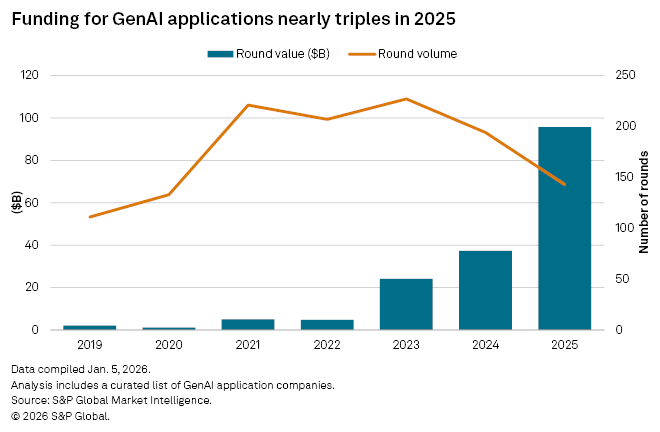
Valuations are high, seeing upwards of 100x multiple for some firms, but investors are still bullish — particularly as IPO speculation and the hopeful promise of big returns lingers. In parallel, technology firms supporting AI infrastructure continue to shift in the market. Oracle’s 2025 debt announcement to fund various data center projects, alongside NVIDIA‘s stock fluctuations despite overall growth, highlight the capital-intensive nature of the AI ecosystem and scrutiny surrounding long-term returns.
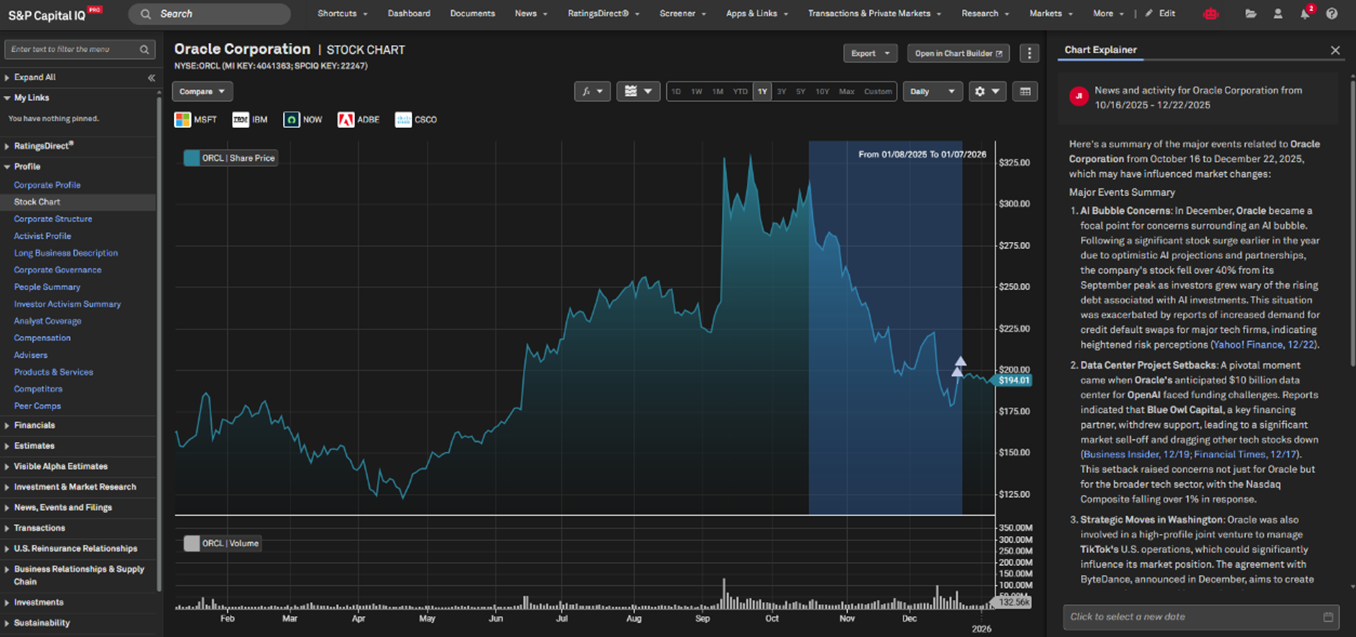
Source: S&P Capital IQ Pro – Chart Explainer | January 7, 2026.
- Use Cases Remain Administratively Focused
Use cases and true adoption remain primarily focused on reducing administrative burden from day-to-day tasks for knowledge workers. Customer service, as well as decision-support functions, remain the most penetrated personas for adoption. Defining use cases and ensuring the workforce has the skillset to capitalize on AI tooling remain challenges of adoption and impact across organization. While many knowledge workers are becoming more proficient in skills necessary to capitalize in AI, such as prompting, technology is advancing at a rate where upskilling requires continued focus.
- Buzz Words of the Year: Agentic & MCP
‘Agentic’ and ‘MCP’ (Model Context Protocol) were the buzzwords of 2025. That said, development has shifted to agents with work still to do for AI and agents to function in the ways humans do. Human-in-the-loop models and agents working alongside humans remain the reality today, and will be for the near future, as it relates to financial industry workflows. MCP server development moved into the spotlight as firms looked for more efficient ways to connect data to AI tooling. That said, MCP adoption is not without its challenges as organizations grapple with authentication, security and scalability challenges.
- Buying Takes Center Stage
Build vs. buy evaluation continues, with many moving towards buy to speed up implementation and for the ability to remain focused on core revenue-generating functions of their organization. Foundational model providers and large technology firms are exploring ways to enter new markets, while start-ups focused on solving vertical specific problems are beginning to gain traction and capture logos. Many firms are utilizing both large and niche AI providers in their buying decisions.
- The Partnership Ecosystem Strengthens
New partnerships are forming as firms aim to capitalize on the AI movement and support users in future ways. Foundational model providers are partnering and powering AI technologies while also building their own tools. Data providers are deepening relationships with foundational model providers and niche workflow solutions to broaden data reach and support client workflows. - Risk Tolerance Evolution
Compliance strategies have come to fruition. Firms with a ‘no AI’ stance have evolved as they developed policies to enable AI across their workforce, while more liberal AI policies have seen tightening. There is an increased focus on data integrity, IP protection, and monitoring of AI tooling. In parallel, there is a notion of “shadow AI” whereas employees are using AI tools on their own to support their work. Organizations are finding ways to mitigate risk associated with “shadow AI” use cases.
- Workforce Planning Strategies Evolve
The future of the workforce and AI job displacement was a top question in 2025. As with any technological advancement in history, such as the industrial revolution, some jobs that exist today will not exist in the future. Jobs will evolve, and the leading organizations are planning now. Additional efficiency gains, resulting in greater output, could also drive hiring increases. Organizations are focused on finding effective ways to measure AI impact across their firms.
- Open Wallets for AI Initiatives (Kind Of)
Executive teams are opening funding for AI initiatives, while also mandating cost savings due to AI. This is putting many firms in a bind as AI adoption is strong, but cost savings are coming to fruition at a slower pace. According to S&P Global earnings call transcripts, mentions of ‘GenAI’, and similar terms, remained relatively steady from Q4 2023 to Q4 2025, seeing a modest 4.5% increase in mentions over that timeframe. In parallel, ‘AI Cost Savings’ mentions, and similar phrases, increased 57%, with an average of 89% of those mentions having positive sentiment (meaning executives were positive about cost savings associated with GenAI), over the same two year timeframe.
AI impact reporting is being solidified with no industry standard yet set. Many firms are cutting without a fully baked strategy to meet budget requirements.
- Data Importance Remains
Even the earliest adopters and firms with the most advanced AI strategies are still evolving and placing importance on data quality and accuracy. Deeply understanding users’ workflows and what AI tooling can support is critical as strategies evolve. Data quality, accuracy, and differentiation — both proprietary and third-party — remains the critical foundation for AI tooling.