29 Sep, 2026
With US on the sidelines, other nations 'staying the course' on climate action

By Karin Rives
|
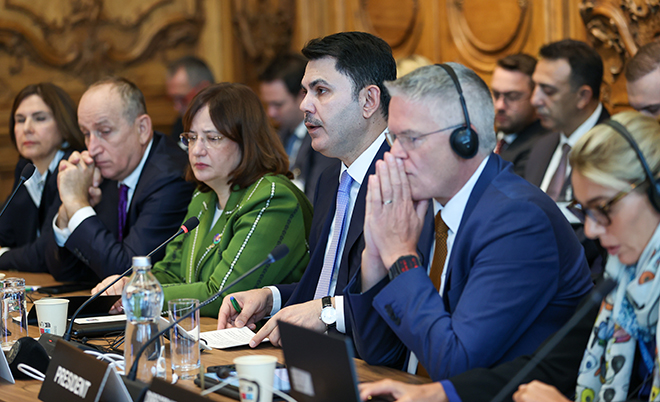
Turkey's minister of environment, urbanization and climate change, Murat Kurum, in blue tie, announces a new strategic partnership on Sept. 17 to help nations turn climate commitments into measurable and "concrete policies." Kurum is president of COP31, the United Nations climate summit that begins Nov. 9 in Turkey. |
Nadia Calviño looked out across a New York City conference room at people preoccupied with extreme weather, uninsurable communities, rising costs and geopolitical instability. As president of the European Investment Bank, she came bearing some good news, she told them.
"Europe is staying the course," Calviño said, adding that she had met with top Canadian officials, including the minister in charge of critical minerals, to discuss ways to strengthen mineral supply chains.
Their goal, Calviño told attendees on Sept. 21 at the opening ceremony of Climate Week 2026, was to "ensure that the green transition is also a force of prosperity and competitiveness for our economies and the entire world."
The growing collaboration between the European Union and Canada is a result of the tariff showdown and other tensions between the Trump administration and Canadian Prime Minister Mark Carney, but also indicative of a world that continues to tackle climate change without Washington.
Neither Europe nor the rest of the world is seeing sufficient emissions reductions to keep the planet from soon breaching warming of 1.5 degrees C and avoiding even more disruptive weather conditions and biodiversity loss. A report released earlier in September by the United Nations Environment Programme confirmed as much.
Yet investment firms, politicians, corporate leaders and nonprofit advocates from around the world said in interviews that their work continues in the absence of the US, the world's second-largest emitter of climate-warming emissions after China. Nations will not give up their collaboration to try to slow the warming trend and avoid the worst impacts of climate change, they said.
"No offense, but irrespective of one country pulling out, people are doing their job," said Sudhakar Sagi, whose start-up converts crop residue into low-carbon energy and other bioenergy projects in India. "And I think the response has increased manyfold in that way. Especially in Asia, people are very committed."
Uneven progress
India's growing economy has seen a rapid increase in greenhouse gas emissions in recent years, making the country the world's third-largest emitter. India is not aligned with the Paris Agreement's 2050 net-zero goal, but it sourced 50% of its grid-connected power from renewables in 2025 and has said it will reach 60% by 2035, despite daunting transmission and grid challenges.
The country of 1.4 billion had 296 gigawatts of renewable energy capacity installed as of August, up from 275 GW a year earlier, according to government data. India's emissions growth rate has been slowing as well, and Sagi said he believes his country will eventually meet its climate goals.
The European Union cut emissions by about 37% between 1990 and 2024. When controlling for weather variation that slowed progress, emissions fell 3.8% in 2025, according to the Centre for Research on Energy and Clean Air (CREA), a nonprofit based in Finland. The EU needs to cut emissions by about 3% annually to meet its 2030 goal of a 55% reduction from 1990 levels.
There is growing recognition worldwide that clean energy technologies are the most resilient and energy-secure solutions, said Jules Kortenhorst, co-founder of the Energy Transitions Commission, a London-based think tank whose members include executives from the energy and finance industries, along with nonprofits and other organizations.
"The sun cannot be blocked by a conflict in the Strait of Hormuz. The wind doesn't stop blowing from a war in Ukraine," Kortenhorst said. "The energy transition continues to move forward and there's significant hope emerging, particularly from the part related to electrification."
Many Europeans echoed that sentiment.

|
A person looks at the Mer de Glace glacier in the French Alps on Sept. 23. Successive heat waves during the summer of 2026 accelerated the glacier's shrinking, threatening ski resorts and local tourism. |
For the UK, the "clean energy mission is front and center of our economic policy, our energy security policy and, indeed, our national security policy, too," Ed Miliband, the country's foreign secretary, told Climate Week participants.
The UK parliament has passed "world-leading and 1.5-aligned budgets" to reach an 87% reduction in emissions by 2040, Miliband said. In the coming months, he said he expects to work with representatives from other nations to try to slow emissions globally.
"Countries all around the world now recognize this threat and they recognize they can only solve it by working together," Miliband said.
The European Union and China recently agreed to work jointly to try to cut emissions and speed up their respective transition to fossil-free energy. The bilateral efforts will focus on methane emissions management, carbon markets and other initiatives, according to a July 24 statement.
"Green is the defining color of China-EU cooperation," the parties said.
On Sept. 29, however, the European Commission proposed to delay by a year a provision that would have required importers of oil, natural gas and coal into the EU to show that new contracts meet the same methane monitoring, reporting and verification standards as EU producers, or face penalties. This was due to take effect Jan. 1, 2027. EU officials said Europe faces risks to its energy supply this coming winter.
China, the world's largest emitter of climate-warming pollution by far, has seen emissions flatten and decline over the past few years and its reliance on coal-fired generation has dropped in recent months, CREA reported Sept. 17.
Investors gauge new opportunities
Meanwhile, the European Investment Bank, functioning as the European Union's climate bank, together with the largest EU asset manager, Amundi SA, and other partners, in summer 2026 launched a new green bond initiative to raise €20 billion in private capital for large-scale sustainable infrastructure projects worldwide.
Such efforts come despite the US withdrawal from multilateral climate finance initiatives and amid rising demand for power globally. Investment firms have been adjusting their portfolio strategies accordingly.
"We have shifted our investment research toward companies better positioned to adapt to higher levels of climate impacts," said Timothy Dunn, founder and chief investment officer at Terra Alpha Investments LLC, who also attended Climate Week.
The US still has the strongest capital markets, which help to raise investments and scale clean projects, said Pete Kindt, global head of sector coverage for the Dutch bank ING Groep NV. But opportunities in the US today are limited to certain sectors and industries, he added.
"There is less progress made on advanced recycling, green steel or green aluminum, whereas Europe is trying to steer more of that," Kindt said. "There are still pockets of good investment opportunities in the US — renewables, [small modular reactors], virtual power plants — it's very much on the energy side."