29 Sep, 2026
Vote could spur moderate California energy policies amid transition: analysts
By Jason Fargo and Eamonn Brennan
Results of statewide elections in California this November are unlikely to significantly shift the state's long-term energy policy trajectory, analysts said, even as 2026's high costs and uncertain fuel supplies have tempered support for an accelerated energy transition and made energy affordability a more prominent political issue.
California's gasoline and refining market will continue to shrink regardless of this fall's gubernatorial election outcome, leaving the next governor to manage that decline rather than reverse it, Severin Borenstein, faculty director of the Energy Institute at the University of California, Berkeley's Haas School of Business, told Platts, part of S&P Global Energy.
Crude oil production has declined more than 75% in the state since 1982, according to the US Energy Information Administration, while California's crude refining capacity has declined by nearly 1 million barrels per day in the same span. Phillips 66 closed its Wilmington refinery in October 2025, and Valero Energy Corp. shut its Benicia plant in April 2026, removing roughly a fifth of California's local refining capacity and further increasing its reliance on waterborne fuel imports.
A Stanford Climate and Energy Policy Program study, released in February, attributed future declines to political consensus and long-term structural factors. These include the depletion of California's once-rich crude fields and a decrease in the economic viability of in-state production.
"California gasoline demand is declining, and we are going to lose refineries," Borenstein said. "How we are going to smooth out those bumps is the area of debate."
Supply gaps alter proposals
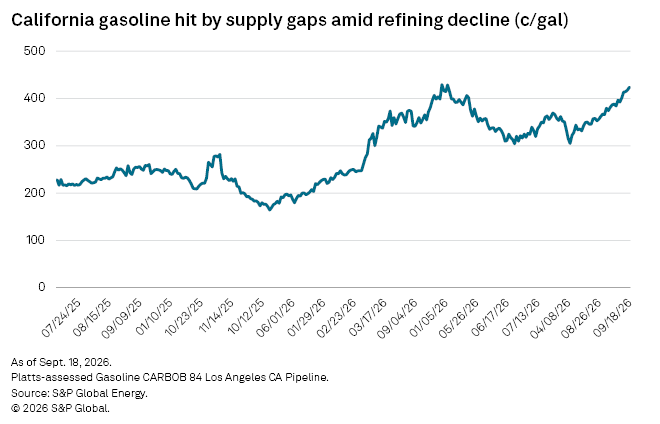
Supply disruptions and price spikes caused by the war in the Middle East have made a more moderate approach to fuels policy increasingly attractive in the nation's most expensive gasoline and diesel market.
For instance, Asian refined products exporters struggled in May to source crude from traditional Middle East flows, creating volatile gaps in California's import mix. Consequently, the California Air Resources Board softened its cap-and-invest proposal to reduce near-term compliance costs for refiners following intense industry pushback. The environmental group Communities for A Better Environment called the final version a "giveaway to Big Oil."

In August, the city of Carson, California, reached a $370 million settlement to end a long-running dispute with Marathon Petroleum Corp. subsidiary Tesoro Refining & Marketing Co. LLC over an oil-industry business license tax. The tax would have allowed Carson to charge refineries up to $1/b for crude processed in the city, calling into question the future viability of the state's largest remaining refining complex.
In a rare showing of congeniality between local political leaders and refineries, a Marathon spokesperson said the agreement provided both the company and the city with "stability and predictability," while city councilmember Jawane Hilton thanked Marathon for being a "good corporate partner."
Even with potentially eased tensions heading into the US midterm elections, there are no simple solutions available to California's next governor.
Having the state directly subsidize some refineries or purchase them to be run as state utilities, though fringe ideas unlikely to gain traction under either party, have been put on the table, Borenstein said. "Once you start subsidizing refineries, it's going to be very hard not to end up subsidizing all of them," he warned.
A more plausible option for addressing refinery closures may be moving refined products to the west by pipeline. Although permitting carries its own challenges, the situation has spurred competing proposals.
The Phillips 66-Kinder Morgan Inc. Western Gateway project would bring fuel from Texas; an HF Sinclair Corp. proposal is looking to leverage the company's Rockies footprint; and midstream operator Magellan Midstream Partners LP has pitched the Sun Belt Connector to fill gaps left by Kinder Morgan's SFPP pipeline reversal to California.
Democratic frontrunner Xavier Becerra would likely continue the current administration's focus on securing imports while maintaining electrification incentives, Borenstein said.
Governor Gavin Newsom (Democrat) signed legislation on Sept. 19 to speed the rollout of E15, a gasoline blend containing 15% ethanol, building on a 2025 law that legalized the fuel's sale in California. Further accelerating E15 sales and other pragmatic proposals, such as the Union of Concerned Scientists' push to formalize a new California-specific fuel standard, are among the potential policies that could thread the needle between affordability and climate action in a Becerra administration, Borenstein said.
He contended that Republican candidate Steve Hilton would be more inclined to ease regulation, back new pipeline capacity and de-emphasize the state's electric-vehicle push.
Neither Becerra's nor Hilton's campaign offices responded to requests for comment. Becerra formerly served in the US Congress, was California's attorney general from 2017 to 2021 and was secretary of the US Department of Health and Human Services during the Biden administration. Hilton, born in the UK, led a tech start-up in Silicon Valley and moderated a show on Fox News Channel for several years until 2023.
Shifting politics
California’s next governor will also have to contend with political realities that are pushing against the state's efforts to move beyond fossil fuels. The high cost of energy has dimmed voters' enthusiasm for green policies.
Polling by the Public Policy Institute of California (PPIC) showed support slipping for the state's law mandating an entirely renewables-based electric grid by 2045. In July 2026 and July 2025 surveys of California adults, PPIC found that 62% of respondents supported the law, compared with 66% in 2024 and 72% in 2022.
Mark Baldassare, PPIC's survey director, said the decline in support over recent years was significant.
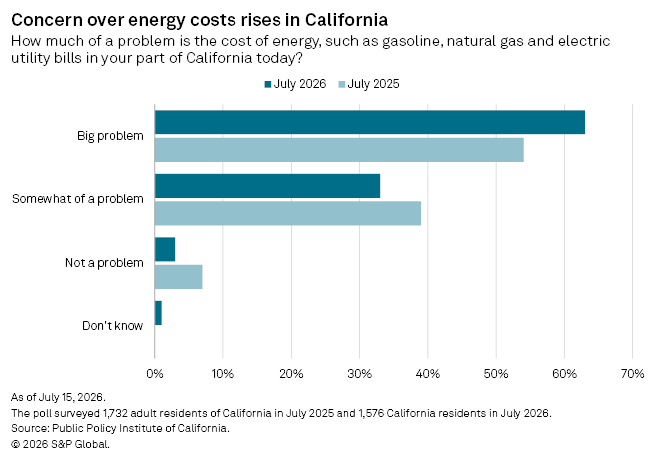
At the same time, the share of respondents telling PPIC that the cost of energy in their part of California was a "big problem" jumped from 54% in July 2025 to 63% in July 2026. The July survey also found that 60% of respondents would not be willing to pay more for renewable energy to help reduce climate change.
Dan Schnur, who teaches political communications at UC Berkeley and the University of Southern California, said in an interview that Becerra is showing signs of distancing himself from the state's current green agenda.
"He has somewhat intentionally, it appears, let it be known that the cost of energy might be more of a priority for him, even at the expense of environmental goals," Schnur said.
Becerra's campaign website alludes to energy affordability, rather than emissions reductions, as the centerpiece of the candidate's pitch.
"As California's governor, I understand one simple truth: climate action only succeeds if it is affordable, reliable, and fair," reads Becerra's website. "Bill affordability will be at the center of my energy policy, especially for low- and middle-income families."
But Schnur said that Becerra, who has maintained a commanding lead in several polls of the gubernatorial race, has little incentive to discuss the issue in great detail and risk alienating the environmental activist groups in the Democratic coalition.
"The only way he can lose this governor's race is with a major scandal or a major faux pas, so he's been pretty quiet," Schnur said.
David Fedor, a fellow at the Hoover Institution think tank, agreed that Becerra is aware of voters' discontent with high energy costs but purposely not taking a vocal stance on the issue.
"I think the assumption is he doesn't have to say much and doesn't want to say much until the election," Fedor said. "My general impression of him is that he's someone who is looking to manage the status quo."