08 Sep, 2026
US gas utilities focus on fixes after $36.8B of line damage in 2025

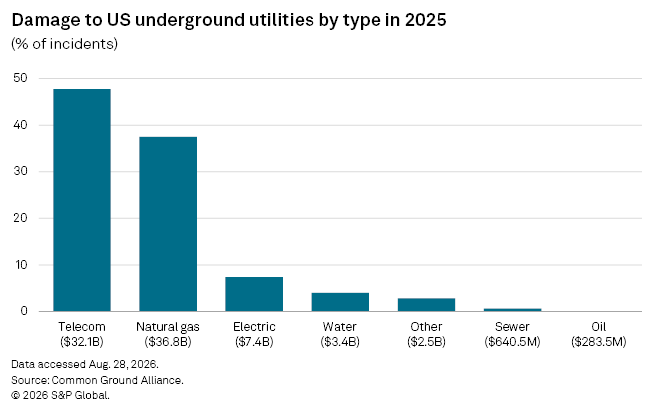
Construction work that damages underground natural gas lines has become an increasing concern for US gas utilities, which accrued $36.8 billion in repair costs in 2025.
One Gas Inc. President and CEO Curtis Dinan told Platts, part of S&P Global Energy, that the company fields about 1.35 million line location tickets per year, compared to a range of 1.1 million to 1.2 million in previous years. Dinan said the increase is partly driven by demand for fiber optic cable installation, especially in One Gas' Oklahoma service territory.
One Gas said it is working to insource more line-locating work and its watch-and-protect
In its most recent earnings call, One Gas said second-quarter line location activity increased 7% year-over-year and damage declined 6%. Dinan said those numbers indicated the benefits of bringing certain work in-house.
Atmos Energy Corp. reported operations and management expense at the lower end of its range on a recent earnings conference call. Atmos President and CEO Kevin Akers attributed the improvement to Atmos' ongoing activities and growth in line location work, compliance and maintenance in the Dallas-Fort Worth metroplex and other parts of its service territories.
Damage to underground utilities
Reported damage to all types of underground utilities has increased in recent years, according to the Common Ground Alliance (CGA), a nonprofit coalition of utility operators, construction companies, government agencies and other stakeholders that is dedicated to preventing damage to underground infrastructure from third-party contractors.
In its August economic impact report, CGA said underground utility damage resulted in $83.2 billion in repair costs in 2025. Natural gas and telecom utilities incurred the heaviest losses, accounting for a combined $68.9 billion in expenses.
A July report from the Future of Heat Initiative, a nonpartisan organization focused on energy regulation and utility oversight, found that natural gas pipeline replacement activities are often linked to improper operation, excavation damage and damage from external forces, which can lead to failures early in the operational life of a pipeline.
Sarah Magruder Lyle, president and CEO of CGA, said underground damage to pipelines often happens during work on other utilities in the same area.
"It is other infrastructure being put into the ground — or being revitalized, or being updated — that is often the challenge," Lyle said. "There's a huge push to get fiber into the ground right now, particularly because a lot of the Broadband Equity Access Deployment (BEAD) money is being released to states."
BEAD is a $42.45 billion federal program created in 2021 that is aimed at connecting people in underserved areas to high-speed internet.
Lyle said the US plans to invest about $1.95 trillion in underground infrastructure over the next five years, based on estimates of new pipeline construction from the Interstate Natural Gas Association of America, electric grid modernizations from the Edison Electric Institute, broadband expansion from BEAD funding and sewer and water revitalization from consulting firm FMI. The increased construction activity has the potential to cause more damage to underground systems if work is not performed correctly, Lyle said.
Root cause of the damage
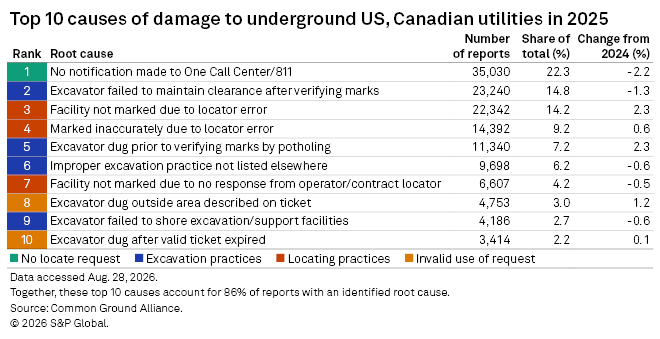
Lyle said the vast majority of underground damage can be tied to construction contractors failing to use 811, the national "call before you dig" service, to request that utilities mark the location of buried infrastructure before excavation work.
"That is something that CGA and our stakeholders work on: ensuring that we're educating people about the importance of calling 811," Lyle said.
CGA also works with utility commissions and policymakers to ensure that they understand how infrastructure damage affects their communities. Problems can cause a "ripple effect," Lyle said, such as a fiber line outage disrupting internet access for government, businesses and homes in a community. CGA is focused on shared responsibility and accountability.
"The fact of the matter is we know what we need to do to reduce this damage," Lyle said. "And third-party dig-ins are, for the most part, preventable if we work together and put the right policies in place to make sure that we're giving the people ... the information they need to work safely and that there is infrastructure there that holds stakeholders accountable and drives behavior change."