28 Sep, 2026
US energy storage industry chases 'terawatt-hour opportunity'

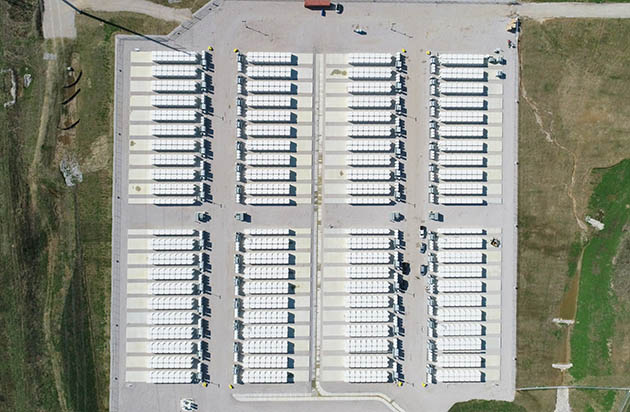
| AES Corp.'s Pike County energy storage system Source: AES Corp. |
Building on its rapid ascent so far this decade, the US energy storage industry has set course for the next phase of its expansion: reaching 1 terawatt-hour of cumulative installed grid-scale capacity by 2032.
That target, presented at the American Clean Power Association's RECHARGE summit in Aurora, Colorado, held Sept. 22-24, would mark a roughly 500% jump from mid-2026 levels and require 25% annual growth, according to the group.
Such expansion would have far-reaching benefits for the US power system and broader economy, including more affordable and reliable electricity, thousands of new jobs and hundreds of millions in local tax revenues, industry members said in interviews and presentations over the three-day event.
"I'm confident we're going to reach this target, and it's possible that we far exceed it, as we have on objectives in the past," Noah Roberts, executive director of the US Energy Storage Coalition, told Platts, part of S&P Global Energy.
The industry easily surpassed a prior goal of adding 35 gigawatts of power storage capacity by 2025, a seemingly ambitious target set in 2017 when the US had less than 1 GW in operation. Now companies are aiming to reach 225 GW of large-scale capacity by 2032, rising over 300% from mid-2026.
Realizing that ambition could unlock more than $250 billion in cost savings for American households and businesses over the next decade by making the power grid more dynamic and efficient, per the industry group's analysis, including by soaking up low-cost excess energy in the middle of the day to help serve peak power demands.
"It was really an attempt to say, 'Alright, we've reached scale in Texas and California. What does it look like nationwide? And when do we start to see the benefits that we've seen in those regions captured by all Americans?' And that is the terawatt-hour threshold [where] we really start to see those hundreds of billions of dollars in savings," Roberts said.
The industry's precise growth pace may hinge on business with hyperscale cloud-computing giants, a major emerging clientele, as well as demand from utilities and independent power producers. But much uncertainty surrounds forecasts, industry members acknowledged.
Even if bullish projections fizzle out, however, "I still think there is that terrawatt-hour opportunity where we have this dual challenge of energy addition but also an aging grid that, regardless of load growth, needs the flexibility and efficiency that energy storage has to offer," Roberts said.
Reforms 'absolutely essential'
Boosting its efforts, the energy storage industry has maintained support from the federal government under the second Trump administration, including valuable tax credits to support deployments and factories. Additional financial support has come through billions of dollars in federal loans and loan guarantees.
"We are pushing storage as hard as we can," Tom Hucker, a senior adviser at the US Department of Energy's financing office, said in a panel discussion at RECHARGE.
That was not the case in the early days of Trump's second act.
|
The US Energy Storage Coalition's Noah Roberts, left, speaks with the DOE's Tom Hucker at the RECHARGE conference in Aurora, Colorado. |
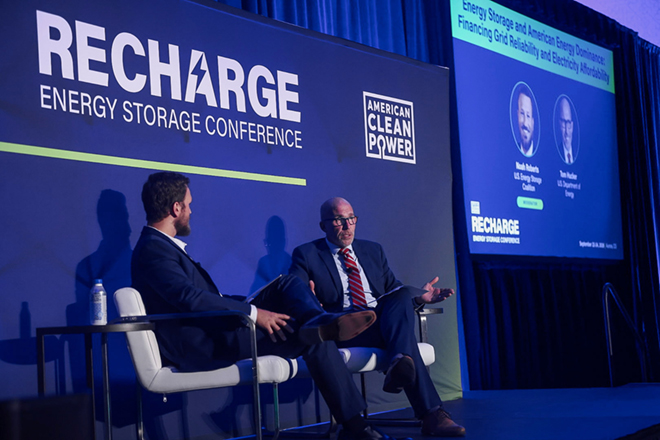
"At the beginning of the administration, they were a little ... less receptive to storage," Hucker said. "They thought of it as really just a way to get renewable energy on the grid, which we all might think is great, but it's not a priority for this administration. Now they have realized that it's key to affordability, and so we are doing a lot of storage deals."
To realize its terawatt-hour vision, the coalition is calling for further actions from policymakers, grid operators and industry itself.
That includes long-sought interconnection and permitting reforms to help companies build faster and further expand their footprints outside of California and Texas, which together account for approximately two-thirds of installed operating capacity.
"Clearing interconnection barriers and streamlining permitting is going to be absolutely essential," Roberts said. "And that's where Texas is a gold standard for the country."
While both the Electric Reliability Council of Texas and California Independent System Operator have implemented reforms that have opened their markets to large volumes of energy storage, many other grid operators "haven't updated their rules enough to enable storage to provide the full suite of services it can," Roberts added.
Reform efforts are underway across the US, including in the Southwest Power Pool, Midcontinent Independent System Operator and PJM Interconnection regions.
"PJM we could see [going] from 1 gigawatt to 20 gigawatts in the next few years, but it's going to rely on changing these niche market rules that are holding back the technology from participating," Roberts said.
Domestic supply chain surge
Another key requirement for the US energy storage industry to meet its terrawatt-hour ambition is a durable domestic supply chain, including at least 150 gigawatt-hours of annual battery cell and system manufacturing capacity, according to the Energy Storage Coalition.
The industry is already making significant progress on that front, with LG Energy Solution Ltd., Samsung SDI Co. Ltd., Tesla Inc., Fluence Energy Inc., Ford Motor Co. and other companies together lining up $100 billion in US supply chain investments to support battery storage.
South Korean lithium-ion battery manufacturing giant LG has been at the forefront, expanding its energy storage footprint in North America by converting electric vehicle production lines. It has lithium-iron-phosphate (LFP) cell production facilities in Spring Hill, Tennessee; Lansing and Holland, Michigan; and Jeffersonville, Ohio, in the US, and in Windsor, Ontario, in Canada.
The company plans to exceed 50 GWh of LFP cell capacity at the five facilities by the end of 2026 and is also expanding its system assembly capabilities at a site in Phoenix, Arizona.
"The numbers get very big, very quickly," Tristan Doherty, chief product officer at system integrator LG Energy Solution Vertech Inc., said in an interview. "To be the reliable partner that people want to go spend a $500 million or billion dollar project with, you have to be someone that they trust."
With its expanding US production capabilities and financial resources, LG is securing major deals with utilities and independent power producers responding to rising power demand. Some of these support hyperscalers, with whom LG is also working directly on separate behind-the-meter projects.
In May, DTE Energy Co., the corporate parent of Michigan utility DTE Electric Co., said it would spend $1.6 billion to buy battery systems from LG Energy Solution Vertech. Five of the eight projects covered by the procurement deal are part of a DTE energy storage portfolio backing a 1.4-GW Oracle Corp. data center in Saline Township, Michigan.
Vertech is also providing systems for Cypress Creek Energy's Steel River Energy Center in Wilson, Arkansas, the first two phases of which are under construction and combine 1.6 GW of direct current solar capacity with 1.9 GWh of battery storage. Google LLC has agreed to purchase the output, marking its biggest clean energy offtake deal to date.
"This is mission-critical infrastructure that's being built ... we're at the point end of the stick in a lot of ways of making sure that these things stay on," said Doherty, who is also chair of the Energy Storage Coalition.
Common goals
In addition, LG is supplying LFP cells to Tesla through a multibillion-dollar supply agreement, which the diversifying electric vehicle maker is using to help fuel its expanding energy storage business.
In August, Tesla completed a new 50-GWh factory near Houston to assemble the latest generation of its large-scale Megapack systems, complementing an existing 40-GWh Megapack factory in Lathrop, California.
Moreover, Tesla is ramping up US factories to make its own battery cells and cathode materials and to refine lithium, as part of a planned more than $25 billion capital investment surge this year.
Doherty is happy to have Tesla as both a customer and competitor.
"I think we all have a common goal of deploying more energy storage and growing the grid," the executive said. "And so we can compete, and the competition keeps us driving toward better products and toward better services ... it's not as though we're all competing for our slice of the pie. The pie is actually growing. There's enough for everyone."
Continuing to improve battery storage products for performance and safety, and engaging with communities where projects are arising, are other critical components of the industry's vision for reaching 1 terawatt-hour of installed capacity by 2032.
The Energy Storage Coalition is advocating for the adoption of the latest fire codes and standards, and for best practices to be applied nationwide as the industry expands into new markets.
"This is a critical priority for this sector," Roberts said. "And so it's really incumbent on the industry to work with towns and counties and state governments to come up with permanent processes that require those best practices."