16 Sep, 2026
Institutions move back to selling stocks, yet aggressively bought in IT sector

By Brian Scheid
After a rare month of buying in July, institutional investors returned to selling in August, even as they ramped up their purchases of IT stocks.
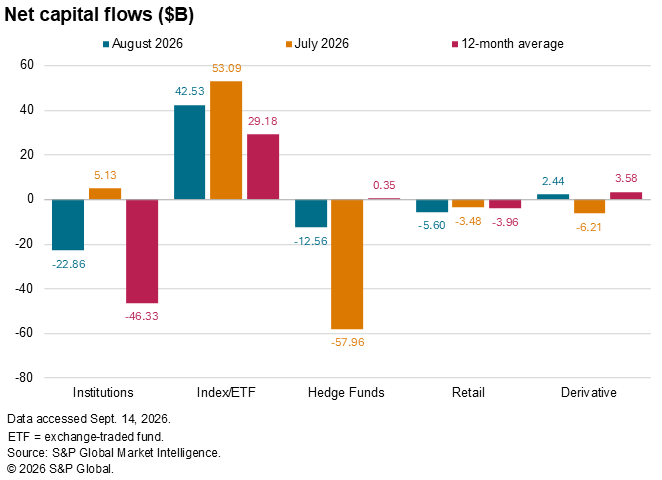
Institutions sold a net $22.86 billion in US equities in August, after buying a net $5.14 billion in stocks in July, the first month of net buying for the group since December 2023, according to S&P Global Market Intelligence data.
Institutional net selling in August was about half the group's 12-month average of $46.34 billion.
Institutions were net buyers in July, mainly due to a large move into IT stocks, and would have been net sellers without those purchases. This buying continued in August, even as institutions were net sellers overall. Institutions increased their overall IT holdings by nearly 0.8% during the month, compared with a 0.5% increase in July.
Institutional investors were net sellers across all sectors except IT and real estate. Purchases in these sectors may have been driven by the AI economy and the rapid growth of data centers.

For more information on capital flows data from Issuer Solutions, please contact your S&P Global relationship manager.

"These two sectors appear to be of particular interest to the institutional group currently," Julian van Rensburg, a senior research analyst with Market Intelligence, said in an interview. "Additionally, one may assume the real estate purchases are coming solely from data centers, which would be consistent with the overall IT buying from institutions, although we are seeing fairly broad-based buying across the real estate subsectors."
Institutions were most aggressive in selling consumer discretionary stocks in August, reducing their holdings in the sector by nearly 1%. This is potentially due to concerns over persistently high inflation and a likely push to trim some lagging stocks to free up capital for IT and real estate purchases, van Rensburg said.
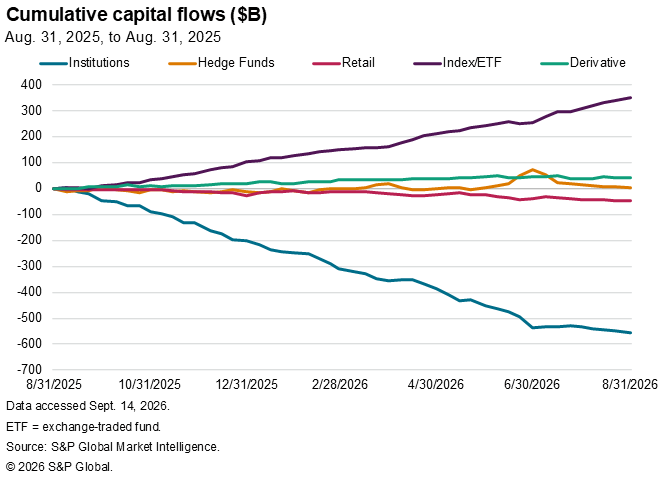
Index and exchange-traded funds bought a net $42.54 billion in stocks in August, down from $53.09 billion in July.
July's relatively high level of net buying was largely tied to the mechanical return of loaned securities amid a hedge fund short-covering trade, according to van Rensburg.
"August's inflows look more consistent with renewed passive demand tracking the market's advance to new highs," van Rensburg said. "So, while passive demand appeared to slow in August, it is still well above the 12-month average inflow and suggests indexing remains a preferred investment strategy in the current market."