15 Sep, 2026
Higher margins, wider reach drive growth of shadow banks in India
By Yuvraj Singh and Cheska Lozano
Shadow banks in India will likely grow their business in the humming South Asian economy, helped by their deeper reach among customers not always served by regular banks.
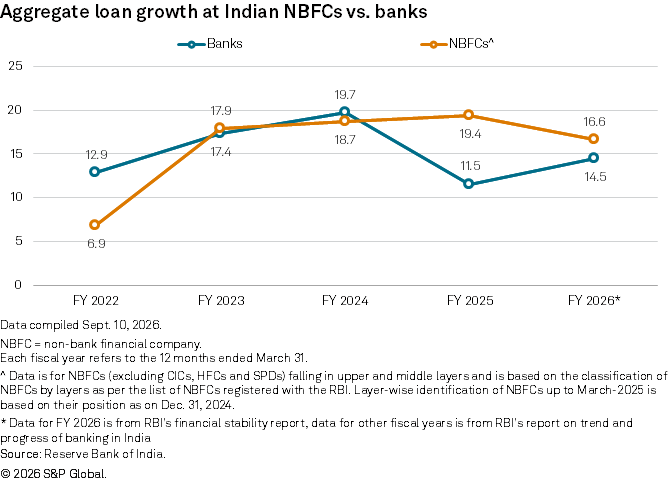
Credit extended by nonbank financial companies (NBFCs) was more than 55 trillion Indian rupees as of March 31, up from 27 trillion rupees five years earlier, according to the Reserve Bank of India (RBI). While their loan portfolio is about one-fourth the size of commercial banks' lending assets, which totaled 218 trillion rupees, NBFCs typically operate with higher margins and lower costs.
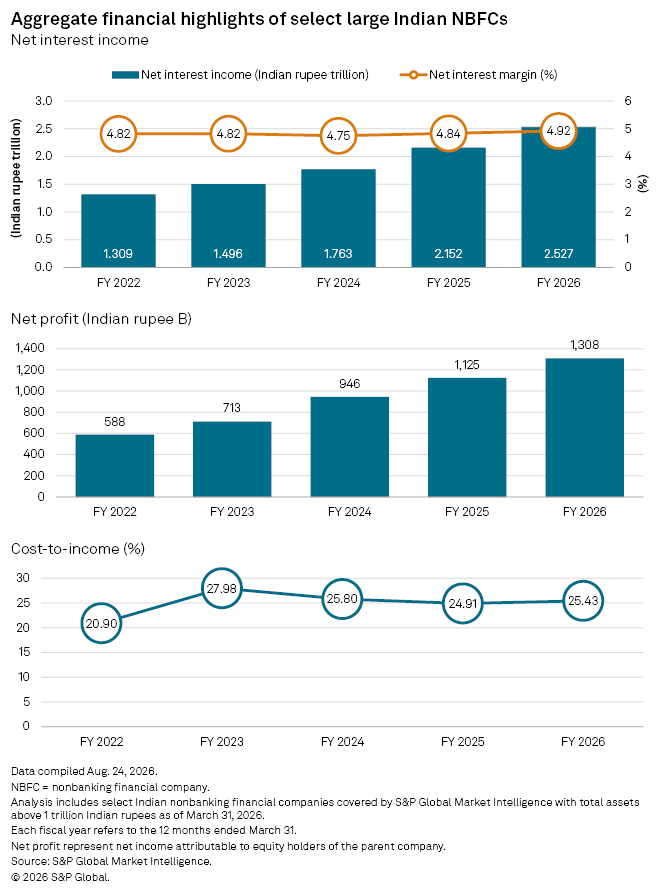
The aggregate net interest margin of the top 20 NBFCs, according to S&P Global Market Intelligence, was 4.92% in the fiscal year ended March 31. By comparison, the NIM was 2.91% at State Bank of India, the largest commercial lender, and 3.34% at HDFC Bank Ltd., India's largest private-sector lender, according to Market Intelligence data.
Large NBFCs "have evolved significantly from being niche lenders to becoming critical credit intermediaries," Pratik Shah, partner at EY India, told Market Intelligence. "Many of them now manage balance sheets comparable to midsized banks and play a critical role in financing infrastructure, affordable housing, micro, small and medium enterprises, vehicle finance and other sectors that are central to India's growth agenda."
India has a wide range of shadow banks that cater to retail borrowers, agriculture and small businesses. Unlike commercial banks, these lenders have a broader reach into rural and niche segments and offer specialized products such as gold loans, vehicle finance and micro, small & medium enterprises lending. A separate category of shadow banks specializes in mortgages.
Bajaj Capital Ltd., the largest retail-focused NBFC, has about 5 trillion rupees in net customer loans, while LIC Housing Finance Ltd., the largest housing finance company, has more than 3 trillion rupees in outstanding loans.
Why the RBI is increasing regulatory oversight over NBFCs
The scale and interconnectedness of NBFCs prompted the central bank to strengthen its regulatory framework for shadow banks. The RBI now categorizes NBFCs under a scale-based regulatory framework according to their size, activities and perceived risk. The top layer remains empty, as no NBFC has been identified as posing potential systemic risk.
Seventeen NBFCs were classified in the upper layer in an Aug. 8 list by the RBI and they are subject to enhanced requirements, including a minimum common equity Tier 1 ratio of 9%, a liquidity coverage ratio of 100%, higher provisioning requirements, limits on large exposures and loan staging based on days past due.
The new framework makes the classification process more transparent and predictable, according to Shah. "NBFCs approaching the threshold can now plan for the transition well in advance rather than waiting for the outcome of an annual scoring exercise."
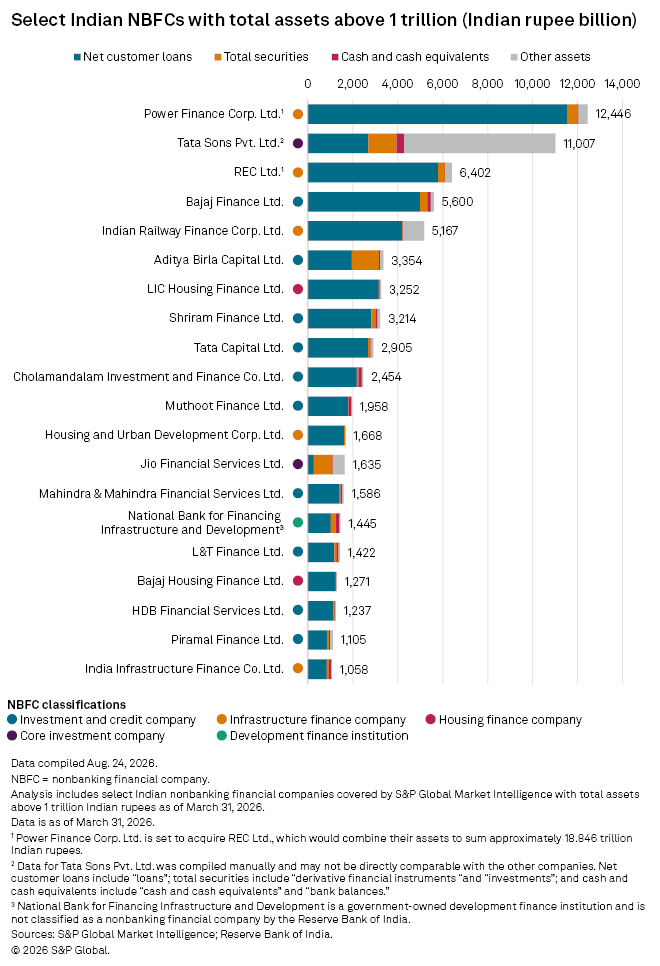
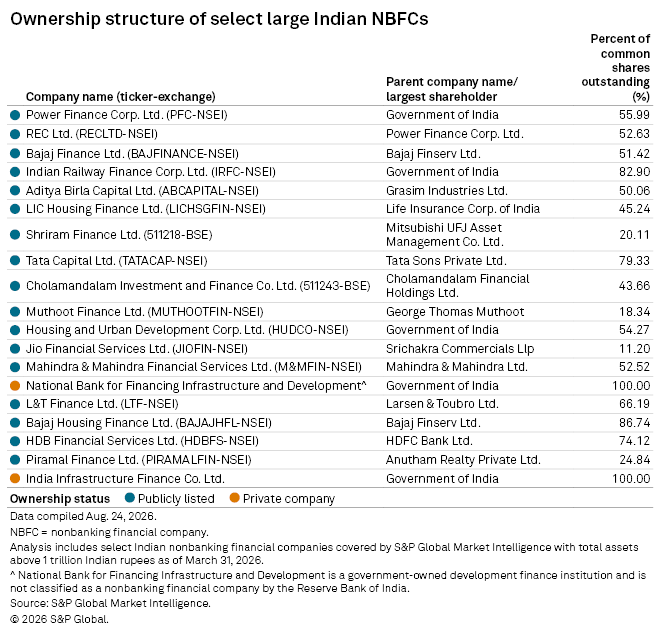
Most of the 20 NBFCs with more than 1 trillion rupees in assets each in the Market Intelligence sample are classified by the central bank in a higher regulatory bucket. Together, they held more than 70 trillion rupees in assets as of March 31, according to Market Intelligence data.
NBFCs are no longer on the sidelines of India's development story, said RBI Deputy Governor Shirish Chandra Murmu, at a summit on Sept. 3. "They extend credit to the last mile, reach the underserved and bring innovation to lending across the country."
India's GDP grew 7.8% year over year in the April-June quarter under a revised base year of calculation, according to a government press release on Aug. 31. The pace of growth exceeded the 7.0% predicted by the central bank.
Shadow banks have room to grow credit in the Indian economy
Shadow bank credit was equivalent to about 16.7% of India's nominal GDP as of September, up from 15.9% in September 2025, Murmu added.
Still, household access to formal credit remains relatively limited in India, with a large section of the population still reliant on moneylenders and other informal sources. Overall household debt stood at about 45.5% of GDP as of September 2025, according to an RBI report. China was at 59% and Malaysia at about 70%, according to the report.
This leaves a large underserved segment seeking credit to buy homes, vehicles and consumer goods, start businesses or pursue higher education. Commercial banks tend to focus on large corporates and retail borrowers with stronger credit profiles, and have a more limited presence in remote areas. Shadow banks are best equipped to tap these business segments.
"They specialize in markets where information is scarce and distribution is difficult, including used vehicles, small businesses, self-employed borrowers, gold loans and parts of consumer finance," Ajitabh Bharti, executive director and co-founder of CapitalXB, an NBFC, told Market Intelligence. "That creates pricing power." Banks, by contrast, carry large pools of relatively low-yielding corporate and mortgage assets.
Nonbank lenders usually have a higher cost of funds because most do not accept customer deposits. "NBFCs compensate for higher funding costs through higher asset yields, sharper customer selection and increasingly efficient distribution," Bharti said.
The NBFC's advantage stems partly from a leaner business model, with fewer branches and more specialized lending products. The cost-to-income ratio of major NBFCs has been about 25% in recent years, nearly half that of major commercial banks.
Strong capital to support growth
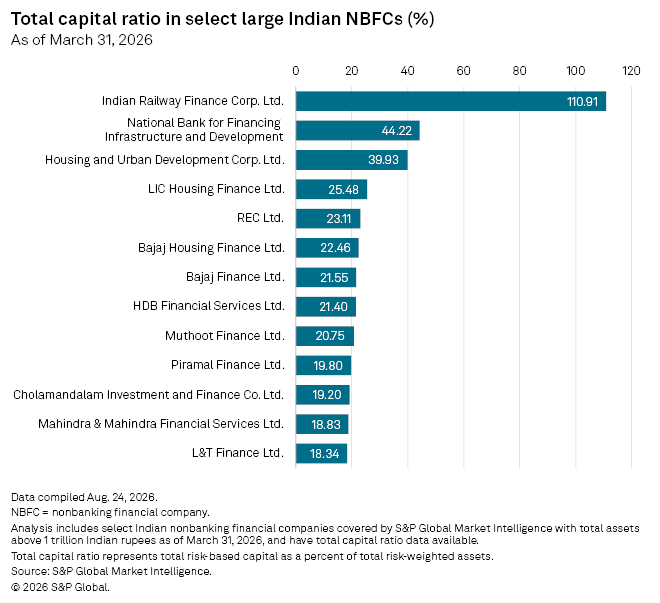
Most large NBFCs maintain capital well above the regulatory minimum of 15% of risk-weighted assets, providing a buffer against credit losses and supporting further growth. Among retail NBFCs, LIC Housing Finance reported a total capital ratio of 25.48%, while HDB Financial Services Ltd. had a ratio of 21.40%, according to Market Intelligence data.
The strong capital position also allows NBFCs to compete directly with banks in segments such as vehicle loans, housing and consumer finance, where they have already expanded significantly. Banks, meanwhile, are increasing their exposure to retail lending to capture higher-yielding segments and leverage their broader branch networks.
This competition could eventually narrow NBFC spreads. Banks have access to lower-cost funding and may be able to offer more competitive pricing, particularly to borrowers with stronger credit profiles. However, the market may be large enough to accommodate both types of lenders.
"If India continues to grow at 6-8%, the underlying credit pool itself expands substantially every year," Bharti of CapitalXB said. "Rising income, formalization and financial penetration can create enough incremental demand for both banks and NBFCs to grow."
As of Sept. 15, US$1 was equivalent to 95.93 Indian rupees.
|