24 Sep, 2026
Global PE exits in aerospace and defense take off on strong growth outlook
The volume of global private equity and venture capital exits in the aerospace and defense sector reached 30 in the first eight months of 2026, up 50% year over year and just one transaction shy of the 31 exits recorded during all of 2025, according to S&P Global Market Intelligence.
Total exit value reached $10.2 billion, surpassing the full-year 2025 total of $8.17 billion.
Exit activity in the space is being supported by the visibility into earnings growth among aerospace and defense assets, said Pratik Rajeevan, a partner at private equity firm GenNx360 Capital Partners.
Buyers are increasingly comfortable underwriting future performance because demand is supported by aircraft backlogs, aging fleets and recurring maintenance requirements, Rajeevan said, adding that buyers expect the sector to benefit from strong demand and sustained growth over the next five to 10 years.
|
|
Trade sales dominate as secondary buyouts gain momentum
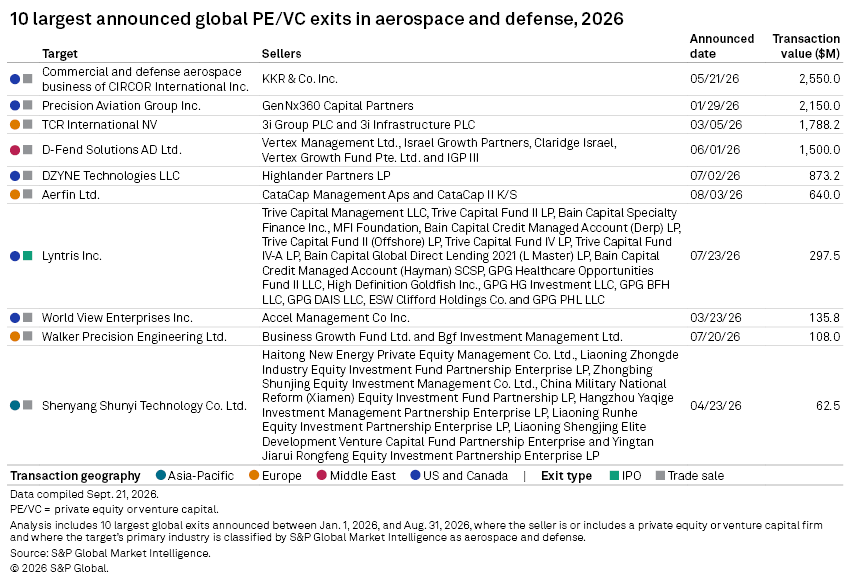
GenNx360 Capital Partners recently exited two aerospace and defense assets, Aero 3 Inc. and Precision Aviation Group Inc. (PAG), selling both to strategic buyers. GenNx360's exit of PAG was the second-largest announced exit of 2026 through the end of August, with a transaction value of approximately $2.1 billion.
Strategic buyers can sometimes bid more aggressively because publicly traded companies can use their stock as acquisition currency, particularly in the aerospace and defense sector, said Rajeevan.
Trade sales continued to account for the majority of private equity exits in the aerospace and defense sector, according to Market Intelligence data. There were 20 trade sales through the end of August, representing 69% of total exit volume.
While trade sales dominated exit activity, secondary buyouts gained ground. Their share of total exits rose to 27.6% in the first eight months of 2026, up from 14.3% during the same period in 2025.
High-quality assets drive demand for secondaries
The continued growth potential of aerospace and defense assets beyond their initial private equity holding periods is also driving demand for secondary transactions, which allow sponsors to retain control of an asset while allowing fund investors a chance to realize liquidity, said Jonathan Kirkland, managing director at Baird Global Investment Banking. "Higher-quality, scaled assets remain relatively scarce. While private equity groups remain focused on returning capital to their limited partners, sometimes the opportunity to continue riding a winner proves even more attractive."
In 2023, GenNx360 established a continuation vehicle with Neuberger Berman Group LLC and Blackstone Inc. to retain ownership of PAG.
"We could see a path to further double and triple it, which is why we [wanted to] continue to own the business," Rajeevan said, describing PAG as a "trophy asset" of the firm.
|
Top markets, top exits
Across markets, the US and Canada led exit activity with 12 transactions, followed by Europe with 10.
North America and Europe's large bases of established service providers and manufacturing suppliers make them attractive markets for aerospace and defense exit activity, Rajeevan said.
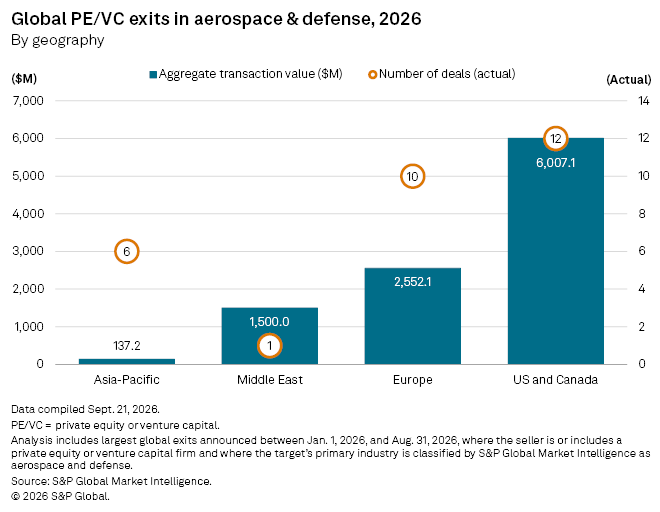
Supply-chain reshoring efforts in the US and Europe are supporting revenue growth and improving earnings visibility for many aerospace and defense companies, creating favorable conditions for investor exits, Kirkland said.
The largest exit in North America and globally was KKR & Co. Inc.'s sale of the commercial and defense aerospace business of CIRCOR International Inc. to Parker-Hannifin Corp. for $2.55 billion.
In Europe, the largest exit was 3i Group PLC's $1.5 billion sale of TCR International NV.
The increasing pressure to monetize investments should contribute to higher exit activity across the sector, Kirkland said, adding that many private equity firms have held portfolio companies longer than historical norms.
Many assets were held longer than usual due to the pandemic and subsequent supply-chain disruptions, according to a 2025 DC Advisory report.
The maturation of ancillary markets could also trigger more exits.
The gas-turbine market, for example, has become more mainstream, potentially bringing higher-quality assets to market that appeal to both private equity firms and strategic buyers, Rajeevan said.