24 Sep, 2026
General partner stakes outlook rises as private equity consolidation opens exits
Private equity industry consolidation is widening the exit window for general partner stakes funds and drawing new attention to a niche private markets strategy.
The announced value of minority equity investments in private equity and venture capital firms — including, but not limited to, investments backed by general partner (GP) stakes funds — totaled more than $2.5 billion since 2022, more than double the $950.6 million total of the prior five-year period, according to S&P Global Market Intelligence data.
For GP stakes investors, who invest not in private equity funds but in the firms that manage them, it is a sign of the embedded value that could be unlocked by a growing wave of M&A activity targeting private equity managers.
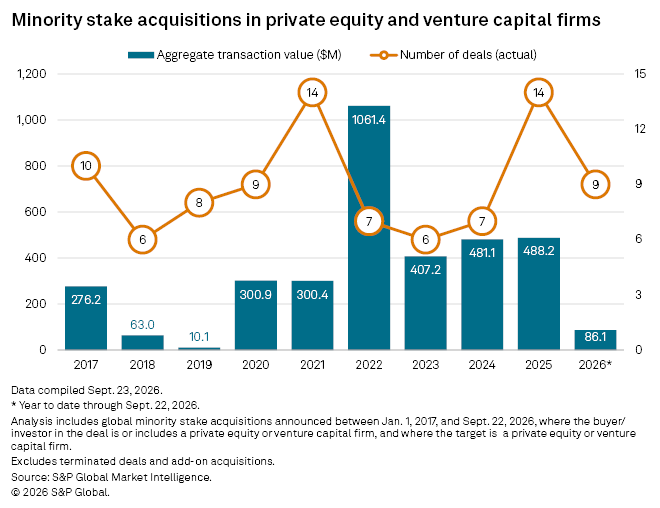
A consolidation trend is emerging among middle-market private equity firms under increasing pressure from years of relatively slow portfolio company exits and depressed fundraising.
Michael A.B. Orr, chief investment officer for alternatives at investment manager Xponance Inc., said there are increasing opportunities for investors who hold minority equity stakes in private equity firms through GP stakes funds to cash out as those firms merge or are acquired by larger competitors.
"In 2025, [GP stakes] exits were led primarily by control M&A. Due to consolidation in the industry, there has been liquidity," Orr said.
Exits on the upswing
That increase in realizations is helping resolve one of the key questions that has long dogged GP stakes investing, a question Blue Owl Capital Inc. co-CEO Doug Ostrover acknowledged in an interview during a recent company presentation.
The alternative asset manager ranks among the leading GP stakes investors globally, having raised $10.6 billion for the latest vintage of its flagship fund for the strategy, Blue Owl GP Stakes VI, as of July.
"The biggest negative in the asset class that people struggle with is: How do I get liquidity? I own a stake in a private company. What if they never monetize?" Ostrover said.
Previously, GP stakes investors often answered the monetization question by selling minority equity stakes in individual investors or manager portfolios to another investor on the secondaries market, said Brian Miner, a partner in the private equity practice of Paul Hastings.
GP stakes funds could also monetize their investments if the firms they invested in went public or if the minority stake was bought back by the manager.
Miner said the acquisition of the private equity firm is becoming more likely.
"It’s almost an exit that they fall into, but it has given significantly greater opportunities for stake investors to get liquidity for their positions," Miner said.
Orr added that GP stakes investors were once counseled to think of their invested positions as permanent capital, offering an ongoing, private credit-like return over a long hold period. That perception may be shifting as exits increase.
Sixty-five percent of single-investment liquidity events for GP stakes funds have occurred just since 2024, according to a report issued in March by Bonaccord Capital Advisors LLC. During the same period, GP stakes funds recorded 44% of all portfolio liquidity events.
Putting capital to work
Orr said GP stakes can be structured in different ways. Most involve the investor taking a 5% to 25% equity stake in the alternative asset manager, although some deals blend debt and equity.
Occasionally, investments are designed to sunset after a set time period or when a predetermined return is achieved, although that is most common with smaller private equity firms operating in the lower middle market.
"What is more common is it is a true partnership," Orr said.
In many GP stakes deals, the targeted alternative asset manager is getting not only a cash infusion that can be used to hire new personnel, expand into new strategies and accelerate progress toward strategic initiatives, Orr said.
They are also getting an experienced partner who has a stake in the firm's success and can provide advice and, importantly, connections to investors who might consider becoming a limited partner in a future fund.
Outlook
GP stakes are poised for growth as an asset class, Miner said. He described an "extensive" pipeline of GP stakes deals that are drawing the attention of institutional investors who may not have previously included GP stakes in their portfolios.
"It's an asset class that continues to evolve and expand, and I think there's still a lot of runway there," Miner said.
|