23 Sep, 2026
AI in banking unlikely to be the job killer many fear
By Vanya Damyanova, Thomas Mason, and Marissa Ramos

| Rapid AI adoption has stoked fears of large-scale layoffs across the banking sector. |
Banks' rapid adoption of generative and agentic AI is unlikely to trigger the mass layoffs many fear in the next few years.
Automation will lead to a reduction of certain tasks but will not necessarily eliminate entire jobs in the short- to medium-term, labor and banking sector experts said. Instead, new roles will emerge, leading to a deeper transformation rather than destruction of banking jobs, they said.
Net headcount at the banks that currently lead on AI spending and deployment is growing, said Alexandra Mousavizadeh, co-founder and co-CEO of AI benchmarking platform Evident, which tracks adoption across the world's largest banks.
"What we are seeing in the dynamics of the data is that AI is going to be the biggest job generator of our lifetime," Mousavizadeh said in an interview.
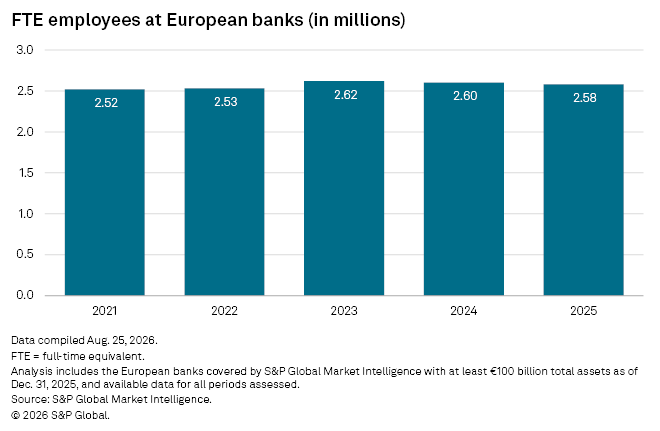
Headcount at European banks with total assets of €100 billion or above has remained relatively flat over the past five years, S&P Global Market Intelligence data shows. The number of staff was higher in 2025 than in 2021, when lenders boosted hiring to capture a post-pandemic boom in certain business lines, including investment banking.
AI will replace highly repetitive, administrative and information-processing tasks such as document verification, standard compliance checks, and many first-line customer inquiries, said Rita Fontinha, professor for strategic human resource management at the World of Work Institute, which specializes in researching major workplace trends.
Yet, it is important to distinguish between replacing tasks and replacing jobs, said Fontinha.
Most banking roles combine routine and non-routine activities, meaning only specific tasks will be automated. Bankers will, therefore, end up spending more time on activities that require human judgment, relationship management, problem-solving and complex decision-making, Fontinha said.
AI creates new banking opportunities
Estimates about the impact of AI-led automation should be looked at in the context of how the technology would augment existing roles, and how many new roles would emerge as a result of banks' increased AI use, experts said.
Because AI materially reduces the time to complete certain tasks, it can increase existing bankers' workload and the need for new hires, and not just of technical staff, Mousavizadeh said. For some call center jobs that are being cut, there are more front-office roles being created because AI generates products that banks were unable to offer before, she said.
For example, in treasury, AI has sped up monitoring so that banks can deal with currency mismatches in real time, something they could not do a couple of years ago, she said. This means people are now needed to run the monitoring, and additional staff needed to build the technologies that enable the new process, Mousavizadeh said.
In investment banking, analysts using AI can prepare pitch decks much faster and tap into third-party data pools they did not have access to before, Mousavizadeh said.
"If you're growing your market share because you're doing the product better, you're actually hiring more investment bankers," Mousavizadeh said.
Automation does not equal job destruction
Back- and middle-office jobs are generally seen as more susceptible to AI automation than front-office roles. Agentic AI is good at rules-based, document-heavy work, reconciliation, first-line know-your-customer (KYC) checks and credit file preparation. This type of work covers a lot of what a bank's back- and middle-office staff does, said Nicolas Pinto, vice president of marketing and partnerships at French fintech RollingFunds.
Bank estimates are already suggesting that half of sector jobs are at high risk of automation, yet the fact that jobs "could be automated" is not the same as jobs "will actually disappear," said Pinto, whose company specializes in buy-now-pay-later and digital onboarding services for small- and medium-sized companies.
"Some roles shrink for real, new ones show up...and a big chunk of the workforce just ends up doing their job differently rather than not doing it at all," Pinto said.
In a June 2024 report, Citigroup Inc. said 54% of banking jobs have high potential to be automated. In early 2026, Morgan Stanley released research projecting European banks would reduce their workforce by 10% in the next five years due to AI, but also noted that most of the reduction would come from natural attrition and retirement.
Although AI may lead to a reduction in some support function roles, banks are also likely to reallocate employees to areas where their skills are most needed, said Maria Rivas, senior vice president European financial institutions at Morningstar DBRS.
JPMorgan Chase & Co. CEO Jamie Dimon said the US group has "huge redeployment plans" for employees being displaced by AI.
"We offer them other jobs. They are usually well trained and highly talented and very good at things," Dimon said during JPMorgan's investor update in February. Dimon said AI-driven job reduction will likely be phased in over a longer period, allowing for reallocation and retraining of staff as some employees would also retire.
Goldman Sachs Group Inc. CEO David Solomon wrote "the AI job apocalypse is overblown," in a May 22 opinion piece for The New York Times. If Goldman Sachs' own projection proves correct, AI will not eliminate 25% of jobs — as some analysts have predicted — but it is "more likely that people find more productive ways to spend their time," Solomon wrote.
Addressing the AI skills mismatch
In the longer term, AI will likely lead to a more fundamental transformation of banking roles as new jobs emerge that focus on AI governance, oversight, model validation, risk management and human-AI collaboration, Fontinha said.
"History suggests that technological change rarely results in a simple reduction in employment. Instead, it changes the composition of work. Existing roles evolve, entirely new roles emerge, and demand grows for different combinations of skills," Fontinha said.
From that perspective, the greatest challenge is not likely to be the shortage of jobs, but the mismatch between existing workforce capabilities and future skill requirements, Fontinha said.
Banks have already acknowledged that challenge. Lloyds Banking Group PLC CEO Charlie Nunn said in early 2026 that banks must help workers "reskill themselves" as AI will radically change the way clients experience financial services.
HSBC Holdings PLC CEO Georges Elhedery said during an investor event in May the bank must keep staff engaged amid the ongoing technological shift, and that employees should join in and not resist the change.
In the future, the issue would not be about machines replacing humans, but "more about humans using AI outperforming humans who choose not to," fintech advisor and consultant Oriol Caudevilla said.
"Nobody becomes a better banker because they spend half of their day compiling spreadsheets or reviewing the same documents over and over," Caudevilla said. "If AI can take care of those things, employees can focus on what really matters: that is relationships, trust and decision-making."
|