31 Aug, 2026
Swedish elections could trim nuclear ambitions as left-wing challengers lead


| Election posters at a rally in a Stockholm suburb. Source: Jonathan Nackstrand/AFP via Getty Images. |
As Sweden gears up to a general election Sept. 13, energy policy could broaden from a focus on nuclear, with renewables players hoping for improved investment support.
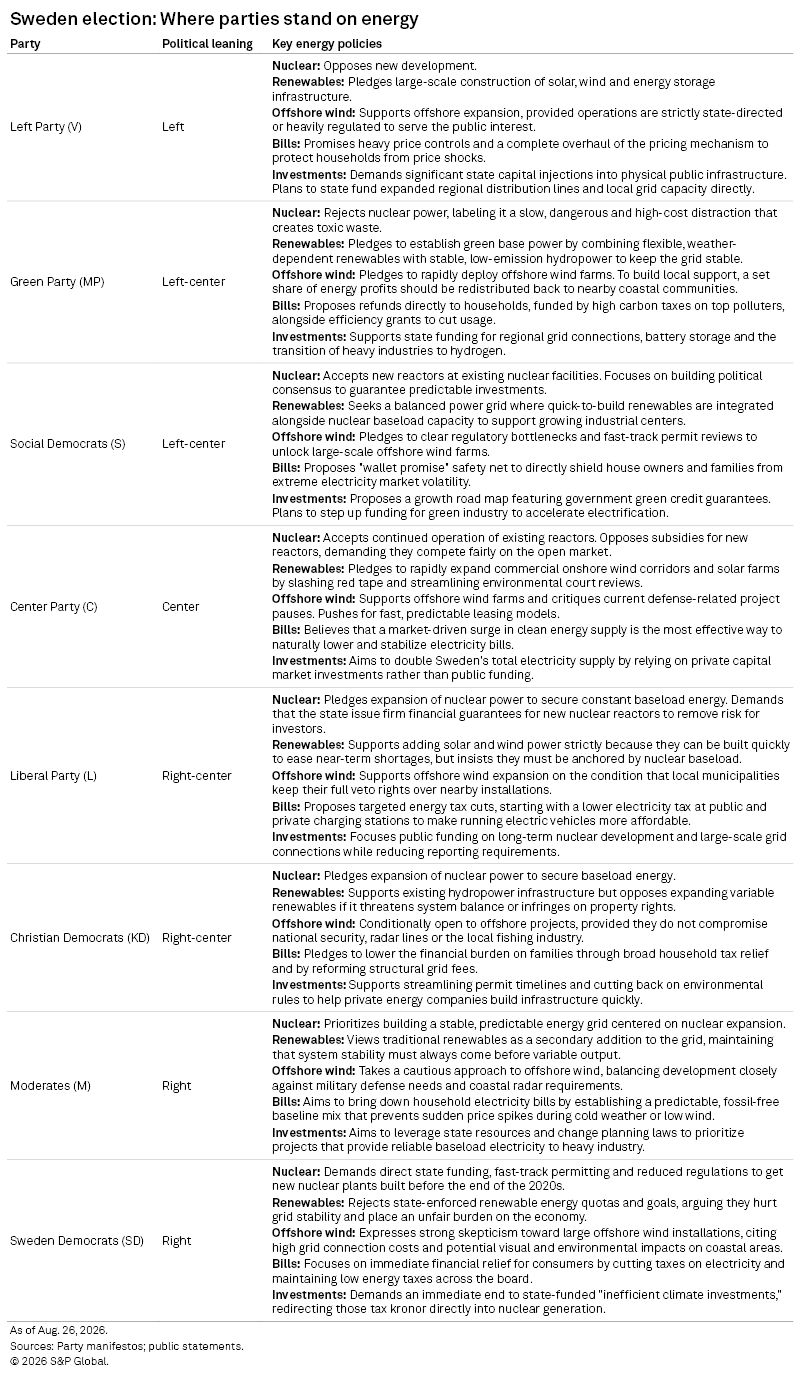
The Nordic nation has been led by a right-of-center coalition for the past four years, with support from far-right Sweden Democrats. Some observers expect a potential left-wing coalition government to trim down plans for new nuclear in Sweden after the vote. While polling is close, current estimates project that the coalition of Moderates, Christian Democrats and Liberals will be succeeded by a new coalition government led by the Social Democrats.
The current government has ushered in a "sea change" with its nuclear program and a new law for the risk sharing on financing new reactors, said Simon Haikola, senior associate professor at Linköping University. "Up until 2020 nobody was really considering building new nuclear power in Sweden," the academic noted, adding that new construction remains far off.
Sweden has not built new reactors since units at the Oskarshamn and Forsmark plants began operating in 1985, but legislation ratified in 2025 opened up state support for new projects via loans and contracts for difference. Funding is planned to cover investments totaling up to approximately 5 gigawatts of electrical capacity, corresponding to four large-scale reactors.
As of August 2025, companies wishing to build nuclear power reactors in Sweden can apply for financial support from the state. So far, five applications for support for new projects have been submitted, including by Finnish Fortum Oyj's project company NuCore.
In June, the government agreed to acquire a 60% stake in Videberg Kraft AB, state-owned utility Vattenfall AB's nuclear power development venture in Sweden.
The deal will support construction of new nuclear capacity near Vattenfall's Ringhals plant. Britain's Rolls-Royce SMR Ltd. has been chosen to supply three small modular reactor units to the project, each with an output of 470 megawatts. The first reactor is expected online in the mid-2030s.
If the election results in a new government with left-wing parties, Haikola expects a reduced nuclear program compared to the current plan and more political support for renewables. "What speaks in favor of at least the project in Ringhals going ahead is that the Social Democrats are not opposed," Haikola said.
While new nuclear enjoys support across much of the political spectrum ahead of the election, the Center Party opposes state backing to develop it, and the Left and Green parties reject new nuclear entirely.
"This debate is often simplified and misguided. In countries that have nuclear power, the scale of investment needed to accelerate the energy transition means that no technology should be ruled out," Alon Carmel, energy expert at PA Consulting, said.
Oskarshamn
The Social Democrats also pledge to return the Oskarshamn nuclear plant to Swedish ownership, citing national security.
The power plant is majority-owned by Uniper SE, which is currently subject to reprivatization following a 2022 rescue by the German government. Fortum owns 45% of the site and has a right of first refusal over Uniper's Nordic generation assets.
The Social Democrats did not respond to a request for comment on their plans for Oskarshamn from Platts, but the party's energy spokesperson Fredrik Olovsson said in late 2024 that the government could direct utility Vattenfall to buy the site. Alternatively, a group of major industrial power consumers could form a consortium with a power generator in order to buy the plant, he said at the time.
Germany's finance ministry, which is in charge of selling Uniper, told Platts in an email that the company would be sold as a whole and not asset-by-asset. Platts is part of S&P Global Energy.
Historically, it has been unusual for successive governments in Sweden to invest in large infrastructure projects, Haikola said. Meanwhile, views on how Vattenfall can be directed by the state have shifted recently, the academic added. "It's more OK nowadays to speak about making Vattenfall operate as a state company."
Renewables need incentives
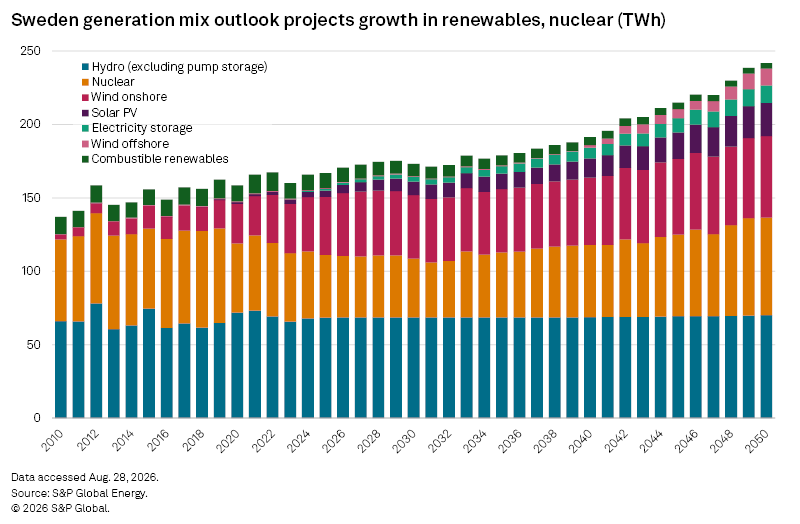
Sweden's offshore wind industry has been dormant in recent years, and several proposed projects have been blocked on defense grounds. Sweden currently operates an open-door permitting system without subsidies or revenue stabilization, which has prevented developers from committing to making investments.
While a report commissioned by the government in late 2024 recommended that new sites ought to be transitioned to seabed auctions from July 2026, the government has not yet launched such a system.
Sweden's onshore wind capacity has been growing slowly over the past four years. In 2025, only 29 MW worth of turbines were ordered by members of Sweden's renewables trade association Green Power Sweden, while the pace picked up in the first quarter of 2026 at 189 MW. In the absence of revenue stabilization mechanisms, onshore wind projects operate on the basis of power purchase agreements or the merchant market.
"Sweden is falling behind in the energy transition, not because it needs to decarbonize the existing system, but because it needs investment in new, reliable, low-carbon generation to power data centers, hydrogen, sustainable aviation fuel, green steel and other industries critical for Europe's future," Carmel said.
The conditions for investments in new clean power production need to be significantly improved, said Madeleine van der Veer, head of industry policy at Green Power Sweden. "The political risk of establishing renewable energy must be reduced through more predictable permitting processes, clearer rules of the game and long-term conditions for investors," she said in an email.
Green Power Sweden is calling for a national electrification target linked to Sweden's 2045 climate goal with interim targets for 2030 and 2035; faster and more predictable permitting processes; a reform of the municipal veto; and a clear mandate for authorities to contribute to electrification.
"Sweden has very good conditions for offshore wind and a range of potential projects. But to be investable Sweden would need to follow the examples of Denmark, Norway, France, the UK and other European countries and introduce auctions and a price support mechanism like the CfD," Carmel said.
Green transition, interconnectors
"The most important issue is to pick up the pace of electrification again," van der Veer said about the upcoming legislative period, noting that Sweden needs to accelerate the transition in industry and the transport sector.
Optimism around the green transition of heavy industry in Sweden has been dampened in recent years. In one prominent case, battery maker Northvolt AB closed its flagship factory in Skellefteå, northern Sweden, as it went bankrupt following ramp-up challenges and competitive pressures. Data center developer EdgeConneX Inc. has since bought the site, in a development Haikola described as a "worrying trend."
Industrial projects in northern Sweden are benefiting from lower electricity costs in price zone SE1, which is dominated by hydro and wind and has limited evacuation routes due to grid constraints.
Prices in the heavily populated south of the country are structurally far higher, and policymakers have sought to limit international power exports into Denmark and central Europe in a bid to curb prices.
In May, Swedish Minister for Energy, Business and Industry Ebba Busch announced that Sweden would halt new or upgraded electricity cable connections to continental Europe unless there was a shift in the focus of the European Commission's European Grids Package, which aims to improve access to power by reinforcing cross-country interconnection.
Some market watchers are skeptical. "Trade benefits an export-dependent country like Sweden, and this applies to electricity just like other goods. A key to our competitiveness is to minimize the total electricity system cost, which export cables contribute to," Martin Vallstrand, CEO of think tank Energiforsk, said Aug. 28.
A more impactful alternative to "cutting the cord" would be temporary direct subsidies to production or employment in industries that are hit hard by higher electricity prices, Vallstrand said.